Mtatsminda Pantheon
Hillside churchyard of St David's Church, halfway up Mtatsminda, where Georgia buries its great writers, artists and public figures.
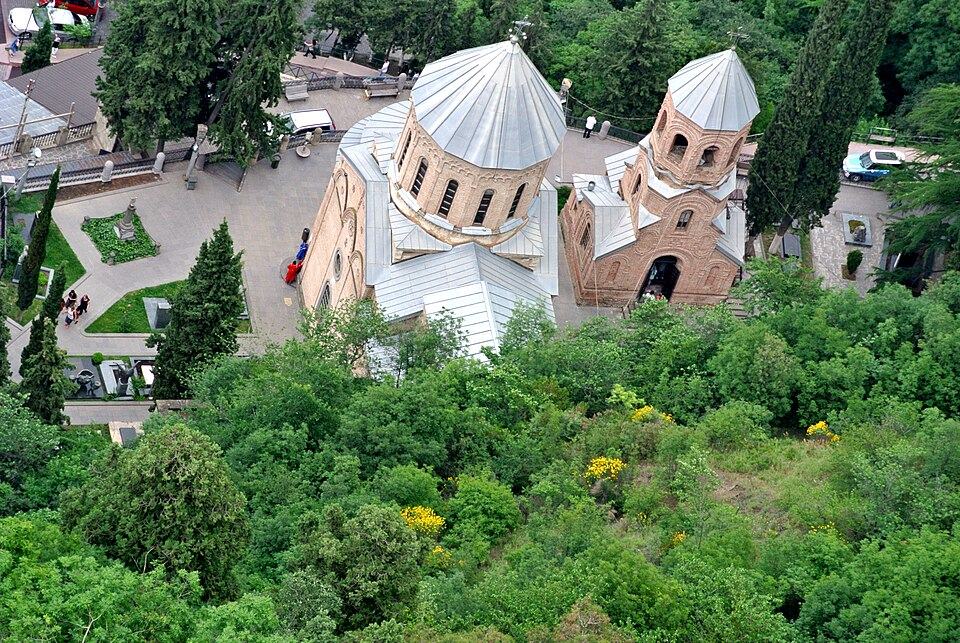 Mtatsminda PantheonPhoto: Zviad Avaliani, Attribution
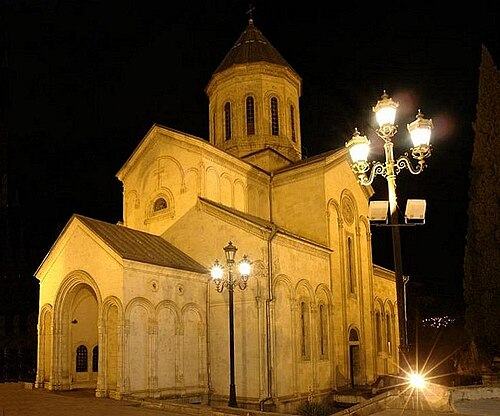
The Mtatsminda Pantheon is the terraced churchyard around St David's Church, on the slope of Mount Mtatsminda roughly halfway between Sololaki and the hilltop park. Since the 19th century it has been the resting place of the people Georgia most wants to honour, and walking its paths is a quick lesson in the country's literature and politics. Here lie the poets Nikoloz Baratashvili, Akaki Tsereteli, Vazha-Pshavela and Galaktion Tabidze, the writer and national leader Ilia Chavchavadze, the historian Ekvtime Takaishvili and the dissident Merab Kostava. Many graves carry carved portraits or sculptures, and the terrace looks straight over the rooftops of the centre.
The most visited grave belongs to Alexander Griboyedov, the Russian playwright and diplomat killed in Tehran in 1829, whose young widow, Nino Chavchavadze, had a monument with a grieving figure made for his tomb. Stalin's mother, Ketevan Geladze, lies nearby. The funicular stops close to the gate, and lanes climb up from the top of Sololaki in 15 to 20 minutes. St David's is an active church: on its feast day in late spring crowds walk up from the city, and some visitors press a small pebble to the church wall while making a wish.
History
Tradition holds that St David Garejeli, one of the Thirteen Assyrian Fathers, lived as a hermit on this slope in the 6th century before moving to the desert of Gareja, and the mountain took the name Mtatsminda, Holy Mountain, from him. The present church of St David dates from the 19th century. Griboyedov was buried beside it in 1829, and the churchyard was formally made a national pantheon in 1929. Later reburials brought Nikoloz Baratashvili here in 1938 and the first president of independent Georgia, Zviad Gamsakhurdia, in 2007.
What to see and do
- See the tomb of Alexander Griboyedov and Nino Chavchavadze
- Find the graves of Ilia Chavchavadze, Akaki Tsereteli and Vazha-Pshavela
- Step inside the 19th-century Church of St David
- Get off the funicular at the middle station on the way up
- Look out over Sololaki and the Old Town from the terrace
How to visit
Getting there
The pantheon is at the middle station of the Mtatsminda funicular, which starts on Chonkadze Street in Sololaki, about 15 minutes' walk from Freedom Square. On foot, climb the lanes and steps above Sololaki in 15 to 20 minutes.
When to go
Morning or late afternoon. Plan 45 minutes–1 hour here.
- This is a church and a cemetery: keep your voice low and cover shoulders and knees.
- Paths between the graves are steep and uneven, so wear shoes with grip.
- Pair the visit with the funicular ride to Mtatsminda Park; the pantheon is the halfway stop.
Mtatsminda Pantheon: FAQ
Who is buried in the Mtatsminda Pantheon?
Writers, artists and public figures including Ilia Chavchavadze, Akaki Tsereteli, Vazha-Pshavela, Galaktion Tabidze, Nikoloz Baratashvili and Merab Kostava. The Russian playwright Alexander Griboyedov and Stalin's mother, Ketevan Geladze, are also buried there.
How do you get to the Mtatsminda Pantheon?
Ride the funicular from Chonkadze Street and get off at the middle station, or walk up the steep lanes from Sololaki in about 15 to 20 minutes.
Nearby places
Straight-line distance from Mtatsminda Pantheon.