Mount Kazbek Climb
An eight-day guided expedition to the summit of Mount Kazbek, a dormant volcano on the Greater Caucasus ridge, by the classic route from Stepantsminda over the Gergeti glacier, with two acclimatisation days, glacier training and a spare day for weather.
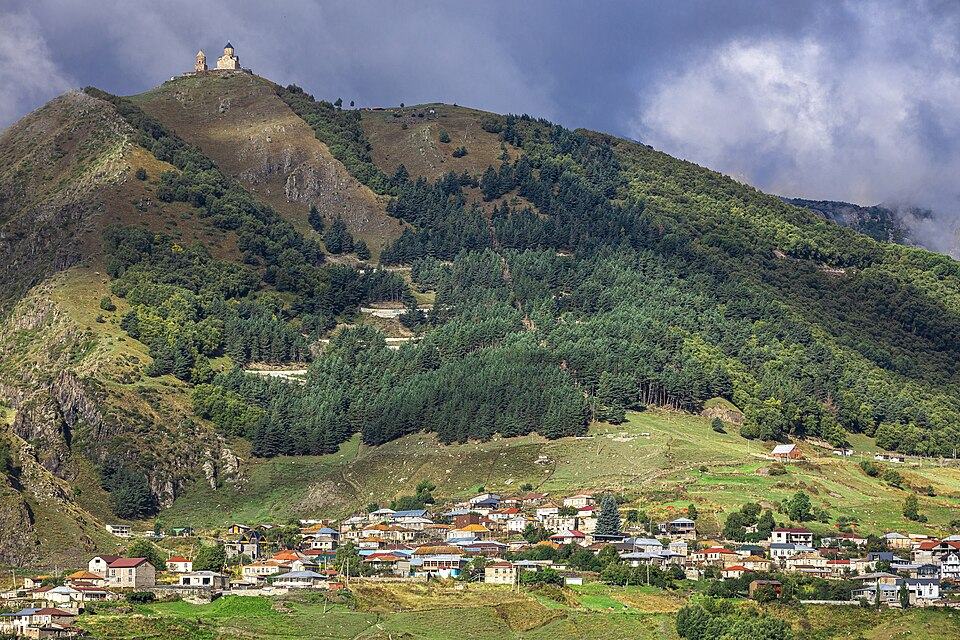 Stepantsminda (Kazbegi)Photo: Supanut Arunoprayote, CC BY 4.0
Mount Kazbek, or Mkinvartsveri in Georgian, rises to 5,054 m above the Tergi valley and is the third-highest summit in Georgia. The standard route from Stepantsminda is not a technical rock climb, but it is a serious glacier ascent: you cross a crevassed glacier on a rope, sleep at about 3,650 m in the former Soviet weather station known as the Meteo station or Bethlemi hut, and set off for the top in the middle of the night. The final slopes are steep snow and ice where you need crampons, an ice axe and a guide who has done it many times. Altitude, not technique, is what turns most people back, which is why this programme gives you two full acclimatisation days and a reserve day before you descend.
Our guides hold national mountain guide certification and work at a ratio of no more than two climbers per guide on summit day. You should already be a strong hill walker, able to carry a 12–15 kg pack for seven or eight hours, and ideally have worn crampons before; if not, the training day at the hut covers the basics. The climbing season runs from mid-June to mid-September, with July and August usually the most stable. Pack horses carry the heavy gear as far as the edge of the glacier, and the hut provides bunk beds and a basic kitchen where your team cooks.
Highlights
- Standing on the 5,054 m summit of Kazbek on the main Caucasus ridge
- Crossing the Gergeti glacier roped to a certified mountain guide
- Nights at the Meteo station, one of Georgia's highest buildings
- An acclimatisation climb towards the Bethlemi chapel at about 3,900 m
- Ice axe, crampon and rope skills practised on the glacier
- A spare summit day so weather does not decide the trip for you
Tour facts
A roped glacier ascent to over 5,000 m cannot be adapted for anyone with reduced mobility. Companions who do not climb can enjoy Stepantsminda, Gergeti Trinity Church by 4x4 and the Truso or Juta valleys on our Kazbegi Day Trip instead.
Places on this tour
8 places · tap any place to read its guide
- 1Tbilisi to Stepantsminda and a full gear check
- 2Acclimatisation hike above Gergeti to about 3,000 m
- 3Up to the Meteo station across the Gergeti glacier
- 4Glacier training and a climb towards the Bethlemi chapel
- 5Summit day: Mount Kazbek, 5,054 m
- 6Reserve day for weather or a second attempt
- 7Down the glacier to Stepantsminda
- 8
Day by day
01Tbilisi to Stepantsminda and a full gear checkOvernight: Stepantsminda
Your lead guide collects you from your Tbilisi hotel at 9 am for the 3-hour drive north on the Georgian Military Highway, topping the Jvari Pass (2,379 m) and then dropping to the Tergi. You arrive in Stepantsminda, at about 1,750 m, in time for lunch with the mountain filling the skyline above the village. In the afternoon the guide goes through every item you brought: boots against crampons, harness fit, layers, gloves and sleeping bag rating. Anything missing can be rented from the climbing shops in the village. Over dinner you talk through the route, the weather forecast and the plan for the reserve day. An early night helps, because tomorrow is your first step up in altitude.
02Acclimatisation hike above Gergeti to about 3,000 mOvernight: Stepantsminda
Today is about gaining height and coming back down to sleep, the classic way to let your body adjust. Walk from the village up the steep path to the 14th-century church of Gergeti Trinity (2,170 m), then carry on along the open ridge used by the Kazbek trail. The path climbs over grassy shoulders with the Gergeti glacier coming into view, and you aim for the Sabertse pass area at roughly 3,000 m. Here your guide checks your pace and how you feel at height. Have lunch with a wide view of Kazbek's summit cone and the Chaukhi peaks across the valley. Descend the same way to Stepantsminda for a second night at 1,750 m, eat well and drink plenty of water.
03Up to the Meteo station across the Gergeti glacierOvernight: Meteo station (Bethlemi hut)
Load the pack horses in the morning and take a 4x4 as far as Gergeti Church to save your legs. From there you follow yesterday's path past the Sabertse area to the point where the horses unload, close to the snout of the Gergeti glacier at about 3,000 m. Shoulder your pack and rope up with your guide for the glacier crossing. In summer the lower ice is often bare and the crevasses are visible, but higher up they can hide under old snow, so you move steadily in single file. The Meteo station appears on the moraine above at about 3,650 m: a stone building that started life as a Soviet meteorological post in the 1930s. Settle into the bunk room, melt snow for water and turn in early.
04Glacier training and a climb towards the Bethlemi chapelOvernight: Meteo station (Bethlemi hut)
Spend the morning on the glacier near the hut practising what you need for summit day. Your guide shows you how to walk in crampons on hard ice, how to use the ice axe as a third leg and how to stop a slide by self-arrest. You also practise moving together on a rope and what to do if someone breaks through into a crevasse. After lunch climb above the hut to the small chapel of Bethlemi, an old cave hermitage set into the rock face at around 3,900–4,000 m that pilgrims have visited for centuries. The view across the glacier to the summit gives you a clear idea of the route ahead. Return to the hut, rest and prepare your kit for a possible summit start the next night.
05Summit day: Mount Kazbek, 5,054 mOvernight: Meteo station (Bethlemi hut)
The alarm goes at about 1 am. After tea and a quick breakfast you leave the hut by headtorch, roped to your guide, and climb the glacier on firm, frozen snow. By dawn you reach the broad plateau at about 4,500 m below the summit cone, where the air is thin and the pace slows to a few steps at a time. The last section is a steep slope of snow and ice leading to the saddle and then the top, which sits right on the border with Russia. On a clear morning you look down on the whole central Caucasus, from Elbrus in the west to the peaks of Khevsureti in the east. The descent is just as demanding, and you are back at the hut 10 to 14 hours after leaving.
06Reserve day for weather or a second attemptOvernight: Meteo station (Bethlemi hut) or Stepantsminda
Kazbek makes its own weather, and strong wind or a fresh dump of snow can make the upper slopes unsafe even in August. This day exists so the summit attempt can wait for a proper window. If you have already reached the top, use it to rest, sort gear and walk down slowly to Stepantsminda, where a hot shower and a proper bed are waiting; we then shift the next day's descent forward. If the first attempt was turned back, your guide decides with you whether a second try at about 1 am makes sense, based on the forecast and how everyone is recovering. Either way, nobody is pushed upward against the guide's judgement on a mountain this high.
07Down the glacier to StepantsmindaOvernight: Stepantsminda
Pack up and leave the hut after breakfast. Cross the glacier on the rope one last time and meet the horses on the far side, who take the heavy bags. From there the walk down is long but easy on the legs compared with the way up, and the air thickens as you lose height. Look back from the grassy slopes above Gergeti Church for a final view of the summit you stood on. A 4x4 picks you up at the church and drives you down to your hotel. In the evening the team sits down together for a celebration dinner with khinkali, mtsvadi and a glass of Saperavi, and the guides hand out certificates to those who summited.
08Back to Tbilisi
Enjoy a slow breakfast with Kazbek out of the window, cloud permitting. On the drive south you have time for short stops that climbers usually skip on the way up: the orange travertine mineral springs below the Jvari Pass, the Friendship Monument above the Aragvi gorge and the 17th-century fortress church at Ananuri on the Zhinvali Reservoir. You reach Tbilisi in the early afternoon and the driver leaves you wherever you need to be, hotel or airport. If your flight is the next day, ask us to book a room in the old town; after a week at altitude, an evening in the sulphur baths of Abanotubani is the best recovery we know.
Prices
Price per person for a private tour, by the size of your group. Sample prices
| Group size | Per person | Whole group |
|---|---|---|
| Solo traveller | $2,855 | $2,855 |
| 2 travellers | $1,730 | $3,460 |
| 3-4 travellers | $1,385 | from $4,155 |
| 5-8 travellers | $1,140 | from $5,700 |
| 9-15 travellers | $950 | from $8,550 |
Room and children
- Single room supplement: $310
- Children under 6 free (sharing a bed); ages 6-11 pay 70% of the adult price.
- Prices change with hotel level and season; your quote is final.
Popular add-ons
- Tbilisi airport transfer (car, 1-3 people)$30
- Extra night in Tbilisi with breakfast$70
- Supra dinner with folk music$70
What's included
- Certified mountain guide, with an extra guide for groups of more than two
- Transfers from Tbilisi to Stepantsminda and back
- 4x4 rides between Stepantsminda and Gergeti Church
- Pack horses to and from the glacier edge for group and personal gear
- Three nights in a Stepantsminda hotel and four nights at the Meteo station
- Full board throughout, starting with lunch on arrival day and ending with the last breakfast
- Group climbing equipment: ropes, ice screws, snow stakes, first-aid kit and radio
- Hut stove, fuel and cooking gear
- Flights to and from Tbilisi
- Insurance with mountaineering and helicopter rescue to 5,100 m (Georgia also requires visitors to hold health cover from 1 January 2026)
- Personal climbing gear (rentals in Stepantsminda available)
- Hut fees if they apply to your season
- Drinks other than tea and water on the mountain
- Tips for guides, cooks and horsemen
Good to know
Who it's for
- Strong hill walkers ready for their first 5,000 m summit on a glacier route
- Climbers with some crampon and ice axe experience who want a guided Caucasus peak
- People who can carry a 12-15 kg pack for long days and value a plan with spare acclimatisation
- Travellers who enjoy simple hut life and a team atmosphere at altitude
If you want big Caucasus scenery without glaciers, ropes or nights above 3,500 m, our Kazbegi & Khevsureti Trek is the better choice.
What to bring
- Insulated mountaineering boots that take crampons; light trekking boots are not enough for summit day
- A sleeping bag rated to about -10 °C for nights at the Meteo station
- Category 4 glacier glasses and goggles against snow glare and wind
- A down jacket and spare mittens for the 1 am start at around 3,650 m
- A headtorch with fresh spare batteries
- Altitude medication you have discussed with your doctor, plus blister and first-aid basics
- Cash in lari for gear hire in Stepantsminda and drinks at the hut
- Summit success depends on weather and acclimatisation; the guide can turn the group back at any point.
- Kazbek's summit lies on the Russian border, so carry your passport on the mountain for registration.
- Travel insurance must cover mountaineering and helicopter rescue up to 5,100 m, which standard policies often exclude.
- The hut is basic: shared bunk rooms, no showers, and water melted from snow.
Walking days in numbers
| Day | Distance | Up | Down | Hours | Highest point |
|---|---|---|---|---|---|
| 2 | 14 km | +1,250 m | −1,250 m | 7-8 | 3,000 m |
| 3 | 10 km | +1,500 m | −50 m | 7-8 | 3,650 m |
| 4 | 4 km | +350 m | −350 m | 6-7 | 4,000 m |
| 5 | 12 km | +1,400 m | −1,400 m | 10-14 | 5,054 m |
| 7 | 10 km | +50 m | −1,500 m | 6-7 | 3,650 m |
Guest reviews
Questions about this tour
How hard is Kazbek compared with other 5,000 m peaks?
It is one of the more accessible 5,000 m peaks in the Caucasus, but it is not a trek. You cross a crevassed glacier, climb steep snow and ice on summit day and spend 10 to 14 hours on the move above 3,650 m. Most people who turn back do so because of altitude or weather rather than technical difficulty. Good fitness and a sensible acclimatisation plan matter more than climbing grade.
Do I need mountaineering experience?
Previous use of crampons and an ice axe is strongly recommended, for example on a winter skills course or an alpine glacier walk. Complete beginners with excellent fitness can sometimes join, but they should add a day of training and accept a lower chance of reaching the summit. Talk to us honestly about your background and we will advise.
What personal gear do I need?
Double or insulated mountaineering boots that take step-in or semi-automatic crampons; crampons; ice axe; harness with a locking carabiner and prusik cord; helmet; a 50–60 litre pack; sleeping bag rated to about -10 °C; down jacket; waterproof shell jacket and trousers; fleece mid-layer; thermal base layers; two pairs of gloves plus warm mittens; warm hat and buff; glacier sunglasses (category 4) and ski goggles; headtorch with spare batteries; trekking poles; high-factor sun cream and lip balm; two litres of water capacity, with an insulated bottle for summit day. Most of the hardware can be rented in Stepantsminda.
Who are the guides?
We work with Georgian mountain guides who hold national certification and have climbed Kazbek many times. They carry radios, a first-aid kit and the group's rescue equipment, and they make the final call on turning back. On summit day each guide takes no more than two climbers on the rope.
Is there any formal registration for the climb?
Kazbek lies on the border with Russia, and climbers are expected to register their route and passport details with the Georgian authorities before going up. Your guide handles this in Stepantsminda or on the way to the glacier, so carry your passport with you on the mountain.
What if I get altitude sickness?
Headache and poor sleep at the hut are common for the first night and usually ease with rest and water. Signs such as vomiting, confusion or breathlessness at rest mean you go down straight away, with a guide. The slow profile of this programme, with a night at 1,750 m after the first climb to 3,000 m, reduces the risk.