Orthodox Georgia Pilgrimage
A week following the story of Georgian Christianity from St Nino's arrival in Mtskheta to the cave hermitages of David Gareja and the royal monastery of Gelati, with time to join a Sunday liturgy and guidance on how to dress and behave in working churches.
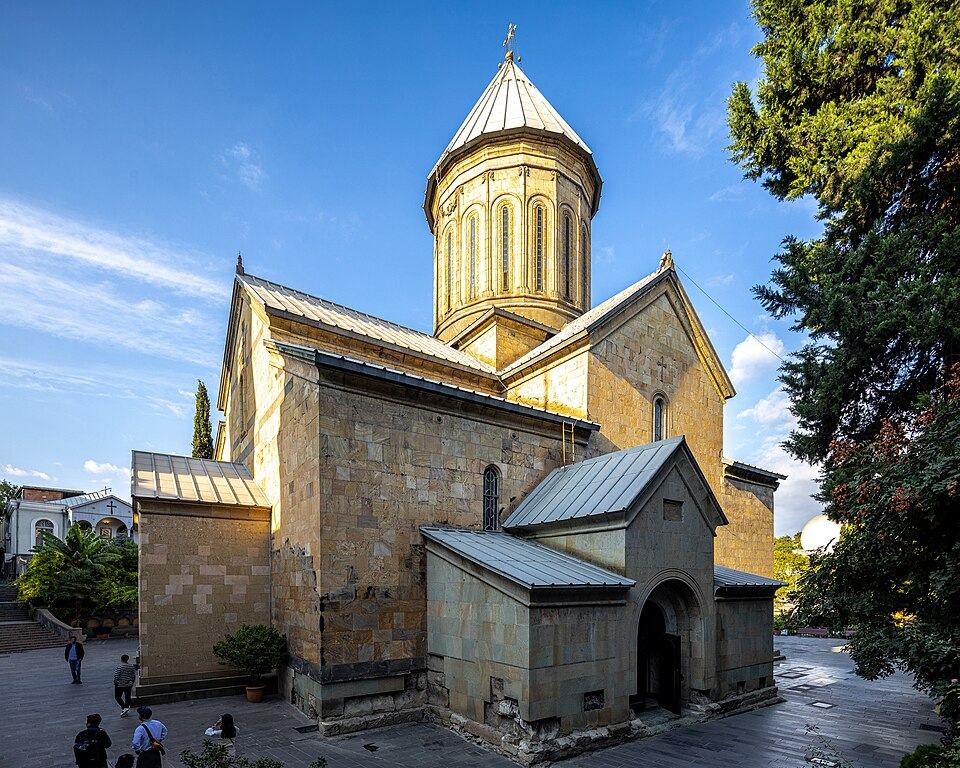 Sioni CathedralPhoto: Supanut Arunoprayote, CC BY 4.0
The Georgian court accepted the Christian faith in the 330s, and almost every place on this route is still a living monastery or parish rather than a museum. You start in Tbilisi with the grapevine cross of St Nino at Sioni Cathedral, then spend a day in Mtskheta, where the king and queen she converted lie buried at Samtavro and where the great cathedral of Svetitskhoveli rises over the believed resting place of Christ's robe. The journey continues to the desert lavra of St David at Gareja and to Bodbe, where Nino herself is buried, then crosses the country to Kutaisi for the royal foundation of Gelati and the martyrs' shrine at Motsameta.
The tour suits Orthodox pilgrims, Christians of other traditions and anyone curious about the faith that shaped Georgian identity. Your guide knows the lives of the saints and the etiquette of the churches, and can arrange for you to attend a liturgy, meet a priest or take part in a feast day if your dates coincide with one. Days are not physically hard, though David Gareja involves a hot hillside walk and the spring at Bodbe is reached by a long stairway. Modest dress is required at every stop, and we give you the details before you pack.
Highlights
- Nino's vine-branch cross, kept in Tbilisi's Sioni Cathedral
- Svetitskhoveli, Jvari and Samtavro in the old capital of Mtskheta
- The 6th-century cave monastery of St Shio at Shio-Mgvime
- St David's lavra at David Gareja and the hillside walk to Udabno monastery
- St Nino's grave and holy spring at Bodbe Convent
- Gelati, burial place of King David the Builder, and the martyrs of Motsameta
Tour facts
Sioni, Sameba, Svetitskhoveli, Samtavro, Bodbe's main church and Gelati are all close to parking on level or gently sloping ground. The Udabno hillside, the long stairway to the Bodbe spring and the steep path at Motsameta are difficult, and we can replace them with quieter time at the main churches.
Places on this tour
22 places · tap any place to read its guide
- 1Tbilisi: Sioni, Anchiskhati and evening prayer at Sameba
- 2Mtskheta, cradle of the faith, and the caves of St Shio
- 3The desert lavra of David Gareja
- 4Liturgy at Bodbe, then Alaverdi and Ikalto
- 5Across Georgia by way of Ateni Sioni
- 6Gelati, Motsameta and Bagrati
- 7Katskhi Pillar, Ubisa and the road home
Day by day
01Tbilisi: Sioni, Anchiskhati and evening prayer at SamebaOvernight: Tbilisi
After you are met at the airport and settled in your hotel, your guide begins with a short talk on what to expect inside a Georgian church. The first visit is Sioni Cathedral in the old town, the former patriarchal see, which keeps the cross that tradition says St Nino made from vine branches bound with her own hair. A few streets away stands Anchiskhati, a 6th-century basilica that no other church in the city predates. Late in the afternoon you drive up to Sameba, the Holy Trinity Cathedral consecrated in 2004, a building so vast it dwarfs the old town below. If a vespers service is under way, stand at the back and listen to the choir. Dinner is in the old town.
02Mtskheta, cradle of the faith, and the caves of St ShioOvernight: Tbilisi
Begin on the hill of Jvari, where tradition places the wooden cross Nino set up and where a small 6th-century church now stands above the meeting of two rivers. Down in Mtskheta, the convent of Samtavro marks the spot where Nino lived in a modest shelter by a blackberry bush. King Mirian III and Queen Nana are buried in its main church, and pilgrims queue at the grave of St Gabriel Urgebadze, a monk who died in 1995 and was canonised in 2012. Svetitskhoveli, the 11th-century cathedral of the Catholicos, stands over the place where tradition says Christ's robe lies. After lunch, drive a short way up a quiet valley to Shio-Mgvime, the 6th-century foundation of St Shio, one of the Syrian monks who settled in Georgia in that century. You can visit the cave where he prayed.
03The desert lavra of David GarejaOvernight: Sighnaghi
Leave early to beat the heat on the drive south-east into the semi-desert near the border with Azerbaijan. St David, a companion of Shio among the Thirteen Assyrian Fathers, came here in the 6th century and founded the lavra that still bears his name. Monks live here again today, and you can visit the rock-cut cells, the church and the saint's grave. Men and women may enter the lavra, but some inner parts are closed to visitors, and your guide shows you where. Fit pilgrims climb the hillside path to Udabno monastery, with its cave churches and 10th to 13th-century frescoes; the ridge lies along a disputed stretch of the border, so follow the guard's advice. Afterwards drive north to Sighnaghi for the night.
04Liturgy at Bodbe, then Alaverdi and IkaltoOvernight: Telavi
Bodbe Convent sits just outside Sighnaghi, and St Nino is buried in the small church inside its gates, where King Mirian is said to have built the first chapel over her grave. Your guide arranges for you to attend the morning liturgy with the nuns, standing as the congregation does. Below the convent, a long stairway leads down through the woods to the spring that tradition links to Nino's prayers. Pilgrims bathe there in a simple shift, and the bathhouse is separate for men and women. In the afternoon cross the Alazani Valley to Alaverdi, the 11th-century cathedral built over the grave of St Joseph, and Ikalto, founded by St Zenon and later home to a medieval academy. Night in Telavi.
05Across Georgia by way of Ateni SioniOvernight: Kutaisi
A long travel day takes you from Kakheti to Imereti. Whether you cross the Gombori Pass or take the longer road via Sagarejo depends on road status, which we confirm the night before. West of the capital, take the side valley south of Gori to Ateni Sioni, a 7th-century domed church on a cliff above the Tana river. Its 11th-century frescoes, among the finest in the country, show scenes from the life of the Virgin, and a small group of nuns now looks after the church. After a late lunch in the village, rejoin the main highway and climb over the Rikoti Pass into the green hills of western Georgia. You reach Kutaisi, Georgia's second capital in the Middle Ages, in time for an evening walk along the Rioni.
06Gelati, Motsameta and BagratiOvernight: Kutaisi
In 1106 King David IV, known as the Builder, founded Gelati as a monastery and an academy of learning, and he asked to be buried under its south gate so that everyone entering would walk over him. Inside the main church, the apse mosaic of the Virgin and Child with archangels dates from the 12th century, and the walls carry portraits of kings. Ten minutes away on a river bend is Motsameta, where two brothers, the princes David and Constantine, are venerated as martyrs killed by an Arab army in the 8th century. Their relics rest in a shrine by the altar, and pilgrims crawl beneath it three times while praying. In the afternoon visit Bagrati Cathedral, built in 1003 for the first king of united Georgia, then enjoy a free evening.
07Katskhi Pillar, Ubisa and the road home
On the way back to Tbilisi, stop at Katskhi Pillar, a limestone column about 40 m high topped by a tiny hermitage church. The climb is reserved for the monks, but from the base you can see the iron ladder and the small chapel at its foot. Further along the highway, Ubisa Monastery, dedicated to St George, sits in a wooded valley beside a tall defensive tower. Its 14th-century frescoes are signed by the painter Damiane, one of the few medieval Georgian artists known by name. A farewell lunch follows on the road, and you reach Tbilisi in the late afternoon. If you have an extra day, we suggest the feast-day calendar or a return visit to Mtskheta for a quiet hour of prayer.
Prices
Price per person for a private tour, by the size of your group. Sample prices
| Group size | Per person | Whole group |
|---|---|---|
| Solo traveller | $2,245 | $2,245 |
| 2 travellers | $1,360 | $2,720 |
| 3-4 travellers | $1,090 | from $3,270 |
| 5-8 travellers | $900 | from $4,500 |
| 9-15 travellers | $750 | from $6,750 |
Room and children
- Single room supplement: $210
- Children under 6 free (sharing a bed); ages 6-11 pay 70% of the adult price.
- Prices change with hotel level and season; your quote is final.
Popular add-ons
- Tbilisi airport transfer (car, 1-3 people)$30
- Extra night in Tbilisi with breakfast$100
- Supra dinner with folk music$70
What's included
- Airport transfers in Tbilisi
- Private guide with a background in Georgian church history
- Air-conditioned vehicle with driver for every day
- Six nights in hotels with breakfast
- Lunches and the welcome dinner as listed
- Arranged attendance at a liturgy and, on request, a meeting with a priest
- Wrap skirts and headscarves for the group to borrow
- Air tickets to Tbilisi
- Insurance with medical cover, a condition of entry to Georgia from 1 January 2026
- Candles, icons and donations at churches
- Dinners on days 2 to 7
- Guide and driver gratuities
Good to know
Who it's for
- Orthodox pilgrims who want to pray at the graves of St Nino, St Gabriel and the Syrian Fathers
- Parish groups and Christians of other traditions curious about one of the oldest Christian nations
- Travellers who want to attend a Georgian liturgy with a guide who explains what is happening
- Visitors interested in frescoes, monastic history and how faith shapes Georgian life today
If your interest in churches is mainly architectural and you would rather mix them with mountains and wine, our Classic Georgia tour gives a broader picture.
What to bring
- Ankle-length or below-knee skirts and a headscarf for women, as most monasteries expect them
- Long trousers and sleeved shirts for men; shorts are not allowed in churches
- A simple long shift or cotton gown if you wish to bathe at the Bodbe spring
- A sun hat, water bottle and walking shoes for the dry hillside at David Gareja
- Small change in lari for candles and church donations
- A light layer for cool church interiors and early morning liturgy
- Liturgies last two hours or more and the congregation stands; there are few seats.
- The Udabno ridge above David Gareja runs along a disputed section of border; follow the guard's instructions and do not cross.
- Day 5 is a long road day of about six hours; the Gombori Pass may be closed, so check road status before setting off.
- Some monastic areas are closed to women or to all visitors; your guide shows you where the limits are.
Guest reviews
Questions about this tour
What should we wear inside churches?
Women cover their hair with a scarf and wear a skirt to below the knee, with shoulders and upper arms covered. Trousers on women are tolerated at some city churches but not at most monasteries, so a skirt is safer. Men wear long trousers, no hats inside and no sleeveless tops. Many monasteries lend wraps at the gate, and we carry spares.
How should we behave during the liturgy?
Georgian services are long and the congregation stands, so arrive early and stand towards the side or back. Do not walk in front of the iconostasis or between the priest and the altar, keep phones silent and take no photographs while the service runs. Communion is for Orthodox Christians who have prepared. Lighting a candle and venerating the icons is welcome for any visitor.
Can I take photographs?
Outside, almost always. Inside, the rule varies: some churches post a sign banning photos, and at others the clergy prefer you ask first. Never photograph monks, nuns or praying people without permission, and never use flash on frescoes.
Is the tour suitable for non-Orthodox travellers?
Yes. Visitors of all faiths and none are welcome in Georgian churches as long as they dress modestly and behave respectfully. Our guide explains the meaning of what you see, and you choose how much of the devotional programme to join.
Can we time the trip for a feast day?
Yes, and it is a wonderful experience. Svetitskhovloba in mid-October fills Mtskheta with pilgrims, and the days of St Nino in January and June draw crowds to Bodbe and Samtavro. The Georgian Church follows the Julian calendar, so Easter and Christmas fall on different dates from Western churches. Tell us your dates and we will check the calendar.
Are there places women cannot enter?
A few. Some monastic areas are closed to women, and at Katskhi and parts of David Gareja visitors of both sexes stay in the public areas. Everywhere else on the route women are welcome, provided the dress code is followed.