Churchkhela Recipe
ჩურჩხელა
This churchkhela recipe brings Georgia's autumn sweet home: threaded walnuts dipped three times in a thick grape and flour pudding, then hung up to dry for about a week.
Recipe by the Maspindzeli team in Tbilisi · Updated 18 Oct 2026 · From Kakheti; made all over Georgia at harvest time
Full recipe with the timeline, timers and US measures: maspindzeli.ge/recipes/churchkhela/
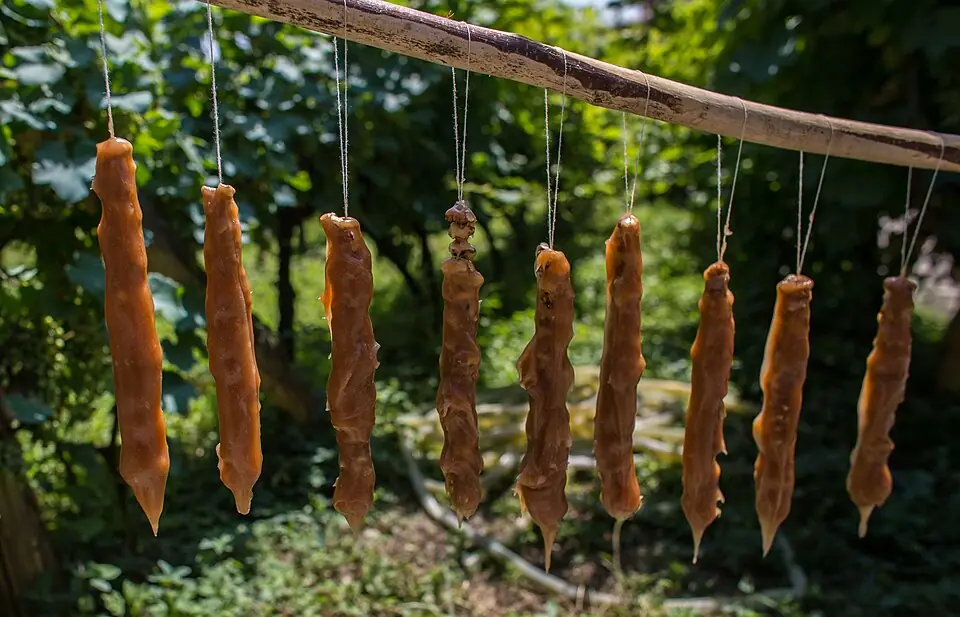
This churchkhela recipe shows how Georgian families make their best-known sweet: walnut halves threaded on a string, dipped several times in warm, thickened grape juice and hung up to dry into chewy, candle-shaped strands. Outside Georgia you may see it spelt churchela or hear it called Georgian Snickers.
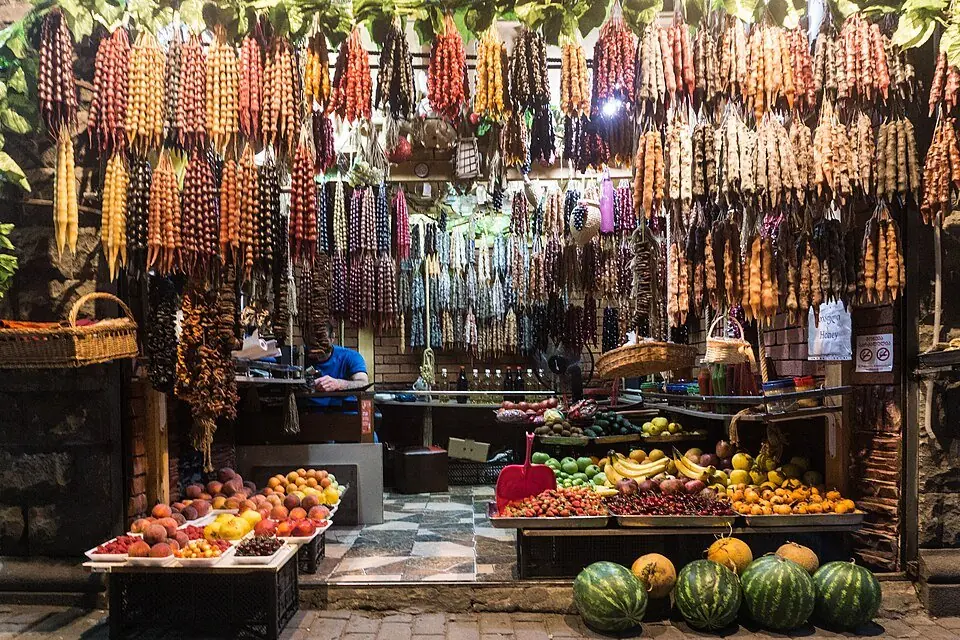
Churchkhela is made all over Georgia, but the Kakhetian version with walnuts and wheat flour is the classic, and its traditional method has been on Georgia's national list of intangible cultural heritage since 2015. Families make it in the autumn, around rtveli, the grape harvest in September and October. Fresh grape must is boiled down into badagi and thickened with flour into tatara, the pudding the nuts are dipped in. In western Georgia cooks often use hazelnuts and maize flour instead.
Because it keeps for months, churchkhela is eaten right through the winter: sliced on the New Year and Christmas table, during fasting periods and as a snack on long walks. At home, a good unsweetened bottled grape juice works well. The hands-on work fits into one afternoon; after that the strands simply hang and dry for about a week.
Timeline: what to do, and when
7 days from start to table · 2 h 15 min hands-on · 7 days waiting
Each bar is one step. Hands-on Waiting, while the oven, the pot or the dough does the work. Steps that sit inside a wait are done in parallel.
Dashed stretches are long waits, shortened on the chart so the busy steps stay readable.
Recipe
Churchkhela
Ingredients
Nuts
Tatara (thickened grape juice)
Amounts are scaled. Times stay about the same, but a bigger pot takes a little longer to come to the boil.
Contains: gluten (wheat), walnuts (tree nuts).
You will need
- Large, wide pan (at least 5 litres)
- Tall, narrow saucepan for dipping (optional, see step 7)
- Whisk, wooden spoon and sieve
- Strong cotton thread (thick button or crochet thread) and a long darning needle
- Baking tray
- A broom handle or pole laid across two chairs, with paper underneath
Method
- Start the juice5 min hands-on· start here
Pour 500 ml of the juice into a jug and put it in the fridge for later. Pour the rest into your widest pan and bring it to the boil over a high heat.
- Boil it down to badagi1 h 15 min waiting· starts at +5 min
Keep it at a steady boil, skimming off the foam now and then, until it has reduced to about 1 litre: roughly 1 to 1½ hours, longer in a narrow pan. Turn the heat down for the last part so it does not catch. It should taste noticeably sweeter and richer; stir in the sugar now if it is still sharp.
- Toast the walnuts10 min hands-on· starts at +10 min, during step 2
Spread the walnut halves on a baking tray and warm them in the oven at 160 °C / 320 °F for about 8 minutes, without letting them colour. This dries them so the strands keep better. Leave them to cool.
- Thread the strands40 min hands-on· starts at +25 min, during step 2
Cut 6 lengths of thread about 80 cm long, fold each in half and knot the end around a small piece of walnut or half a matchstick as a stopper. Push the needle through the centre of each half, all facing the same way, until each strand holds about 20 halves packed tightly together, roughly 25 cm. Tie the bare thread at the top into a loop for hanging.
- Mix the flour paste5 min hands-on· starts at +1 h 10 min, during step 2
Whisk the flour into the cold juice from the fridge until completely smooth. Push it through a sieve if any lumps remain.
- Cook the tatara20 min hands-on· starts at +1 h 20 min
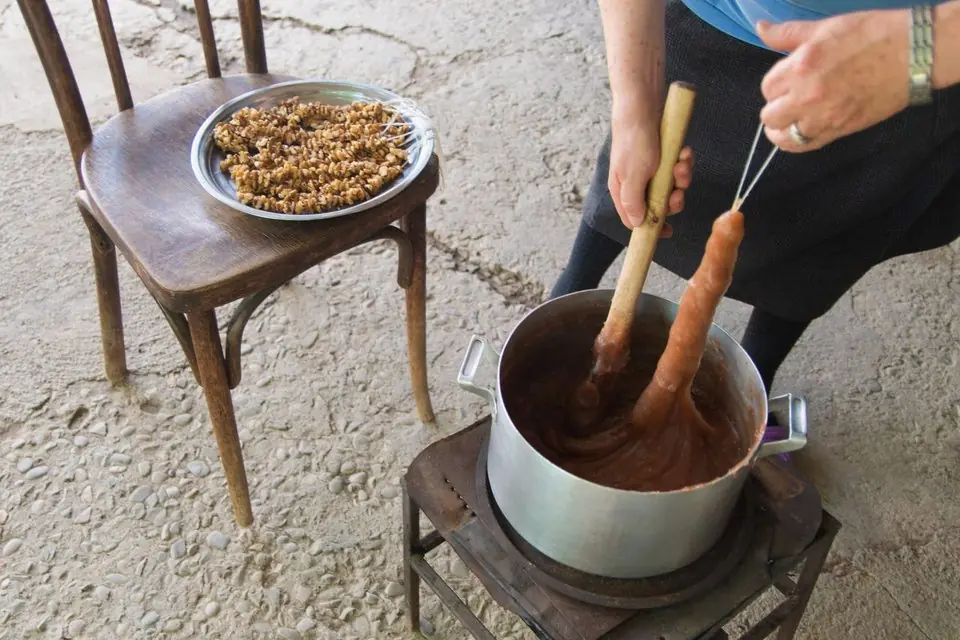
Turn the badagi down to medium and pour in the flour paste in a thin stream, whisking all the time. Switch to a wooden spoon and keep stirring on a low heat for 15 to 20 minutes as it bubbles and thickens. It is ready when it is glossy, as thick as a heavy custard and no longer tastes of raw flour.
- Set up the drying pole5 min hands-on· starts at +1 h 40 min
Take the tatara off the heat for about 5 minutes so it clings rather than runs. Meanwhile lay the pole across two chairs with paper underneath. If your pan is wide and shallow, pour the tatara into a tall, narrow saucepan so a strand can go in deep.
- First dip15 min hands-on· starts at +1 h 45 min
Hold a strand by its loop and lower it into the tatara until the top walnut is covered, spooning it over any bare patches. Lift it out slowly, let it drip for a few seconds and hang it from the pole. Repeat with every strand, keeping them apart so they do not touch.
- Let the coat set20 min waiting· starts at +2 h
Leave the strands for about 20 minutes, until the coating no longer runs and feels tacky. Keep the tatara on the lowest heat and stir it now and then; if it gets too stiff to dip, loosen it with a splash of water or juice.
- Second dip15 min hands-on· starts at +2 h 20 min
Dip each strand again in the same way and hang it back on the pole.
- Let it set again20 min waiting· starts at +2 h 35 min
Give the second coat another 20 minutes to firm up, stirring the tatara from time to time.
- Third dip15 min hands-on· starts at +2 h 55 min
Dip a third time for a thick, even coat. Any tatara left in the pan is a dessert of its own: pour it into small bowls, scatter over chopped walnuts and let it set in the fridge.
- Dry for a week7 days waiting· starts at +3 h 10 min
Hang the strands in a warm, dry, airy place, out of rain and away from direct heat, for 5 to 10 days. They are ready when the outside is no longer sticky and they feel firm but still bend. If you want to keep them into the winter, leave them up to 2 weeks so they dry right through.
- Slice and serve5 min hands-on· starts at +7 days
Cut off the stopper knot and pull the thread out, or simply cut the strand into 2 cm slices and pick out the bits of thread as you go.
About 750 kcal per strand (about 250 g), usually sliced and shared. This is an estimate from standard values for the ingredients, not a lab figure.
Cut the strand into rounds about 2 cm thick and pick out the thread, or pull the whole thread out from one end first. Eat it as it is, with tea, coffee or wine. Georgians also slip a strand into a bag for long walks and road trips.
Tips, swaps and variations
Tips from your host
- Use this season's walnuts. Old, bitter nuts spoil the taste of the whole batch.
- Test the tatara before dipping: a spoonful dropped on a cold plate should hold its shape and only spread a little.
- Pack the walnut halves tightly on the thread. Gaps between them turn into thin, weak spots in the finished strand.
- Dip each strand in one smooth movement and lift it out slowly. Fast, jerky dips leave lumps and bare patches.
- Hang the strands so they do not touch, and turn the pole now and then in the first day so they dry evenly.
Variations and swaps
- Western Georgia (Imereti, Guria, Samegrelo): threaded hazelnuts dipped in grape juice thickened with fine maize flour, giving a lighter coat. Made with maize flour in place of wheat, it is gluten-free.
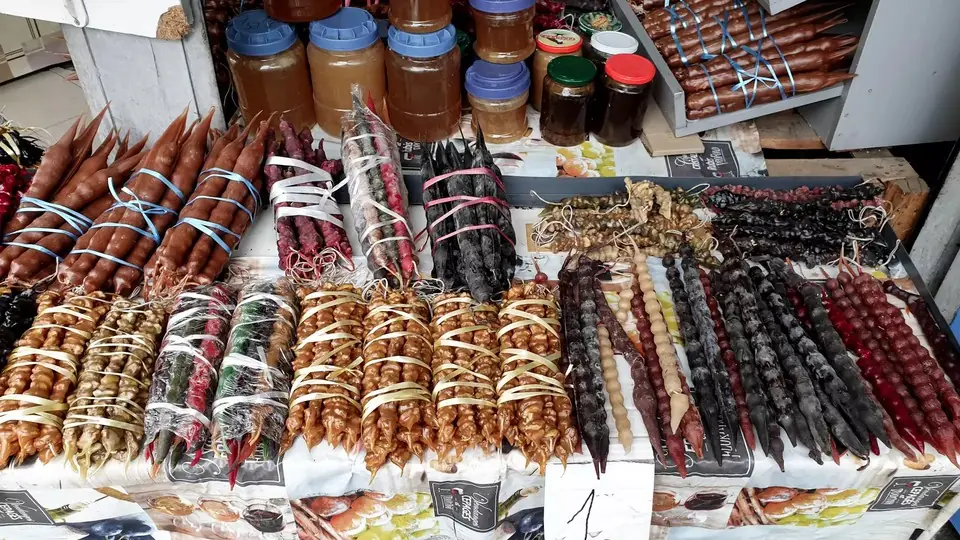
- Colour: dark grapes such as Saperavi or Isabella give a deep purple churchkhela; white grapes such as Rkatsiteli give a golden brown one.
- Racha and other regions also string dried fruit, apricot halves, almonds or pumpkin seeds, on their own or between the nuts.
- In Samtskhe-Javakheti mulberry juice is sometimes used instead of grape juice, thickened with wheat flour in the same way.
- For a more rustic coat, closer to the coarse grey flour used in Kakhetian villages, replace a third of the plain flour with wholemeal flour.
Serve it with
Make ahead and storage
Once dry, wrap each strand in a cotton cloth or paper and keep it in a cool, dry cupboard. Well-dried churchkhela keeps 2 to 3 months. Do not seal it in plastic while it is still soft, as trapped moisture can make it go mouldy. Over the weeks a fine white powder forms on the surface: that is grape sugar coming to the surface, not mould, and many Georgians think the strands taste better then.

Maspindzeli Travel, Tbilisi · private tours and cooking classes in Georgia · maspindzeli.ge · WhatsApp +995 598 74 74 54 · hello@maspindzeli.ge