Gozinaki Recipe
გოზინაყი
Gozinaki is the Georgian New Year sweet: toasted walnuts held together by honey boiled until it sets, rolled flat on a wet board and cut into diamonds. This gozinaki recipe shows how to tell when the honey is ready, the one step that decides how it turns out.
Recipe by the Maspindzeli team in Tbilisi · Updated 19 Oct 2026 · Made everywhere in Georgia for New Year
Full recipe with the timeline, timers and US measures: maspindzeli.ge/recipes/gozinaki/
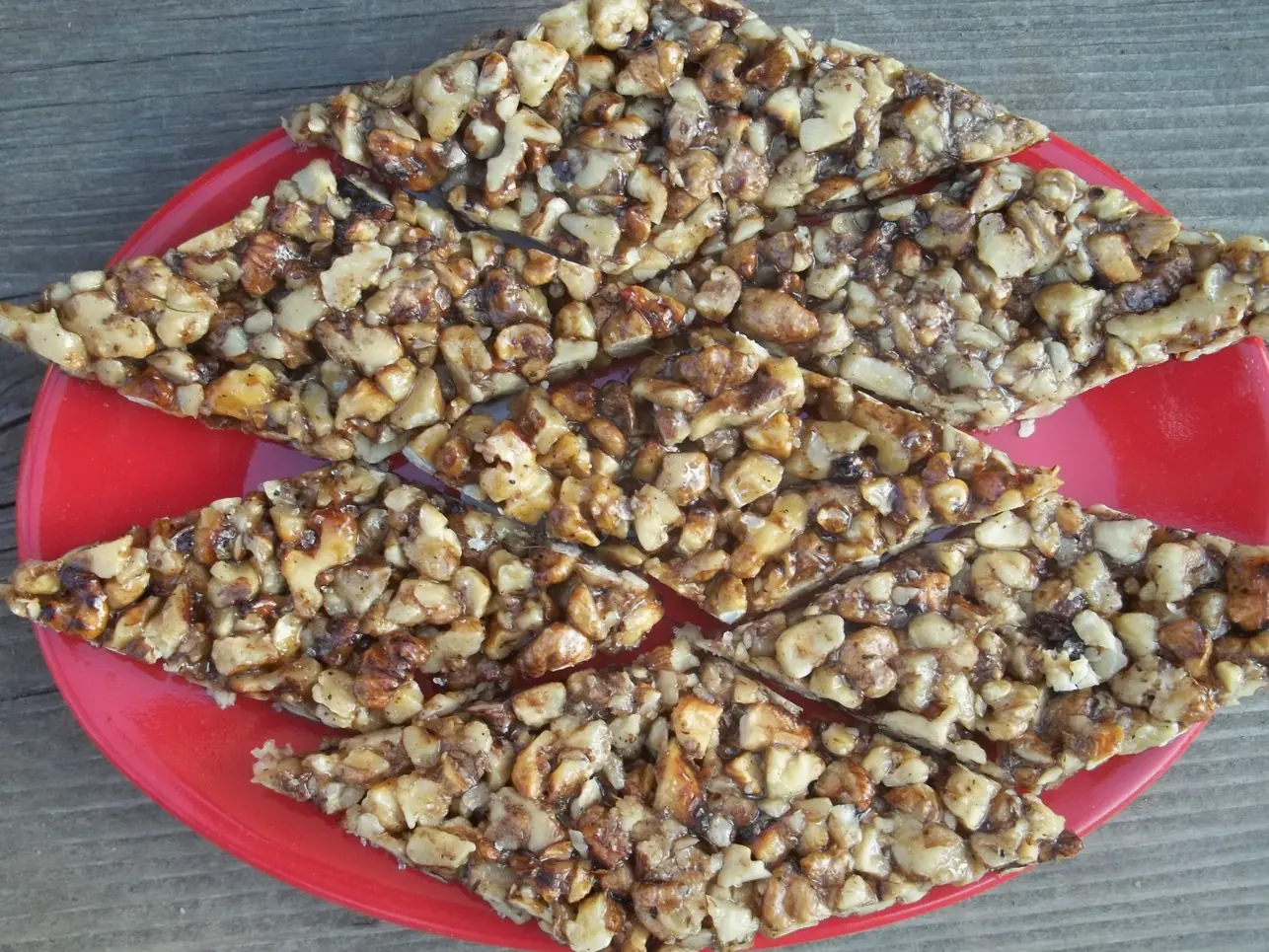
Gozinaki (გოზინაყი, sometimes spelt gozinaqi) is a Georgian brittle built on two ingredients, walnuts and honey. This gozinaki recipe follows the home method used across Georgia: lightly toasted, chopped walnuts go into honey that has boiled until a drop firms up in cold water, the hot mass is rolled out on a wet board, and it is cut into diamonds before it hardens. Good gozinaki is glossy and firm, a little chewy rather than glassy, and tastes more of nuts than of sugar.
For Georgians it is the taste of New Year. Families make it in the days before the holiday, often in big batches, and a plate of it waits on the table for midnight on 31 December, next to churchkhela and the rest of the feast. Eating a piece as the year turns is a wish for a sweet year ahead, and extra pieces go to neighbours and New Year visitors. The plate stays out through Orthodox Christmas on 7 January and lasts, if anything is left, until Old New Year, which falls on 13 to 14 January. In a survey by CRRC Georgia, about a quarter of adults named gozinaki as their favourite New Year dish, second only to satsivi.
How old it is, nobody can say. Georgia's tourism board tells of soldiers carrying it on campaigns and of early mountain versions made with dried apple or pear instead of nuts, but these are traditions, not recorded history. In Russia and Ukraine the name turned into kozinaki, which there usually means a bar of sunflower or sesame seeds. Allow about 2 hours 15 minutes in all; a little over one hour of that is hands-on, and the rest is the slab cooling and setting.
Timeline: what to do, and when
2 h 15 min from start to table · 1 h 5 min hands-on · 1 h 10 min waiting
Each bar is one step. Hands-on Waiting, while the oven, the pot or the dough does the work. Steps that sit inside a wait are done in parallel.
Recipe
Gozinaki
Ingredients
Gozinaki
For shaping
Amounts are scaled. Times stay about the same, but a bigger pot takes a little longer to come to the boil.
Contains: walnuts (tree nuts).
You will need
- Large dry frying pan
- Clean tea towel
- Large sharp knife and chopping board
- Heavy-based saucepan of at least 3 litres (the honey froths up a lot)
- Wooden spoon
- Glass of cold water for testing; a sugar thermometer helps but is optional
- Wooden board about 30 x 35 cm, or a tray lined with baking paper
- Rolling pin and a palette knife
Method
- Toast the walnuts10 min hands-on· start here
Put the walnuts in a large dry frying pan over a low to medium heat and stir them often for 8 to 10 minutes, until they smell toasted and the edges just start to colour. Keep them light: walnuts taken too dark make the gozinaki bitter.
- Rub off the skins and chop10 min hands-on· starts at +10 min
Tip the hot nuts onto a clean tea towel, fold it over and rub firmly so the loose, papery skins flake off, then lift the nuts out and leave the skins behind. Chop them with a sharp knife into even, pea-sized pieces of about 5 mm.
- Get the board ready5 min hands-on· starts at +20 min
Rinse the wooden board under the cold tap and shake it so it is wet but not puddled, or line a tray with baking paper. Stand the rolling pin, palette knife and a large knife in a jug of cold water, and fill a glass with cold water for testing. Once the honey is ready there is no time to hunt for anything.
- Boil the honey15 min hands-on· starts at +25 min
Pour the honey into the heavy saucepan over a low heat and stir with the wooden spoon. When it boils it swells into a pale froth: lift the pan off the heat until the froth sinks, put it back, and carry on like this, stirring all the time. After 10 to 15 minutes the bubbles turn small and even and the honey darkens by a shade.
- Test the honey5 min hands-on· starts at +40 min
Let a little honey drip from the spoon into the glass of cold water. If it dissolves or trails into threads, boil for another minute or two and try again. It is ready when the drop sinks, holds together and rolls between your fingers into a soft ball, about 115 to 120 °C / 240 to 250 °F on a thermometer. Do not let it go past a deep amber colour.
- Stir in the walnuts5 min hands-on· starts at +45 min
Turn the heat to its lowest setting, stir in the sugar if you are using it, then add all the walnuts at once. Keep stirring for 3 to 5 minutes until every piece is coated and the mixture looks glossy and golden. It is right when it gathers into one sticky mass with no loose honey left in the pan.
- Spread the slab5 min hands-on· starts at +50 min
Scrape the mixture onto the wet board straight away and flatten it with the back of the wet spoon. Roll it with the wet rolling pin into a slab about 1 cm thick and roughly 25 by 30 cm, dipping the pin in water whenever it starts to stick. Push the sides straight with the wet palette knife.
- Cool for a few minutes10 min waiting· starts at +55 min
Leave the slab for about 10 minutes, until it feels warm rather than hot and holds a clean cut. Do not wait until it is cold, or it will crack and splinter under the knife.
- Cut into diamonds5 min hands-on· starts at +1 h 5 min
Wet the large knife and press it down through the slab in parallel lines about 4 cm apart. Turn the board and cut a second set of lines on a slant across the first to make diamonds. Wet the knife again after every cut and leave the pieces where they are.
- Leave to set1 h waiting· starts at +1 h 10 min
Let the gozinaki cool and harden completely: about an hour in a cool room, longer in a warm kitchen. It is set when the top no longer feels tacky and a piece snaps cleanly away from its neighbours.
- Lift off and serve5 min hands-on· starts at +2 h 10 min
Run the knife through the cuts once more and lift the diamonds off the board with the palette knife. Arrange them on a plate, or pack them away for later as described under storage.
About 290 kcal per serving (1 of 15, about 55 g or two diamonds with the edge pieces shared out). This is an estimate from standard values for the ingredients, not a lab figure.
Eat it with your fingers, one diamond at a time, ideally with tea. At New Year a plate goes round the table after midnight, and whatever is left gets nibbled through the first days of January.
Tips, swaps and variations
Tips from your host
- Pick a light, mild honey such as acacia or wildflower. Strong dark honey like chestnut or buckwheat gives a darker, sharper gozinaki, and very runny new-season honey needs a few more minutes on the heat.
- Go by the water test rather than the clock. Hobs, pans and honeys all differ, and the test shows you when enough water has boiled off for the slab to set.
- Use a deep pan, at least four times the volume of the honey. Boiling honey froths up fast, and lifting the pan off the heat for a few seconds calms it, which is how Georgian cooks stop it spilling over.
- Chop the nuts by hand into even pieces. The fine crumbs a food processor makes soak up the honey, and the slab then falls apart when you cut it.
- Keep the board, rolling pin, spoon and knife wet the whole time. Hot honey cannot grip a wet surface, so the slab lifts off cleanly later.
- Hot honey burns like caramel: keep a bowl of cold water by the stove and keep children back while you spread and cut. To clean the pan, fill it with hot water and let the hardened honey dissolve.
Variations and swaps
- With or without sugar: Georgian cooks do not agree. Some stir in a spoonful of caster or icing sugar near the end for a firmer, drier set; others use nothing but honey and nuts. Both are traditional, so leave the sugar out if you prefer.
- Hazelnut gozinaki: use the same weight of hazelnuts. Toast them a little longer, rub off the skins and halve them instead of chopping them small.
- Seeds and other nuts: pumpkin seeds are an old mountain choice that, according to Georgia's tourism board, cooks in Racha still use, while almonds, sunflower seeds or peanuts are newer ideas. Toast seeds gently, as they catch faster than walnuts.
- Salt and vanilla: a pinch of salt and the seeds from half a vanilla pod, added with the nuts, round off the sweetness. It is a modern touch rather than the classic taste.
- Thicker or thinner: roll it about 1.5 cm thick for a softer, chewier bite, or press it down to 5 mm for crisper pieces. The cooking stays the same.
- Other shapes: some cooks roll the warm mixture into walnut-sized balls with wet hands or press it into a lined tin and cut squares. Pieces dipped in melted chocolate are a newer idea.
Serve it with
Make ahead and storage
Once the pieces are fully set, layer them in an airtight tin or box with baking paper between the layers and store it somewhere cool and dry, such as a pantry shelf. They stay good for up to 2 weeks and are crunchiest in the first week. Leave them out of the fridge: they sweat when they come back into a warm room, and that moisture turns the honey sticky.

Maspindzeli Travel, Tbilisi · private tours and cooking classes in Georgia · maspindzeli.ge · WhatsApp +995 598 74 74 54 · hello@maspindzeli.ge