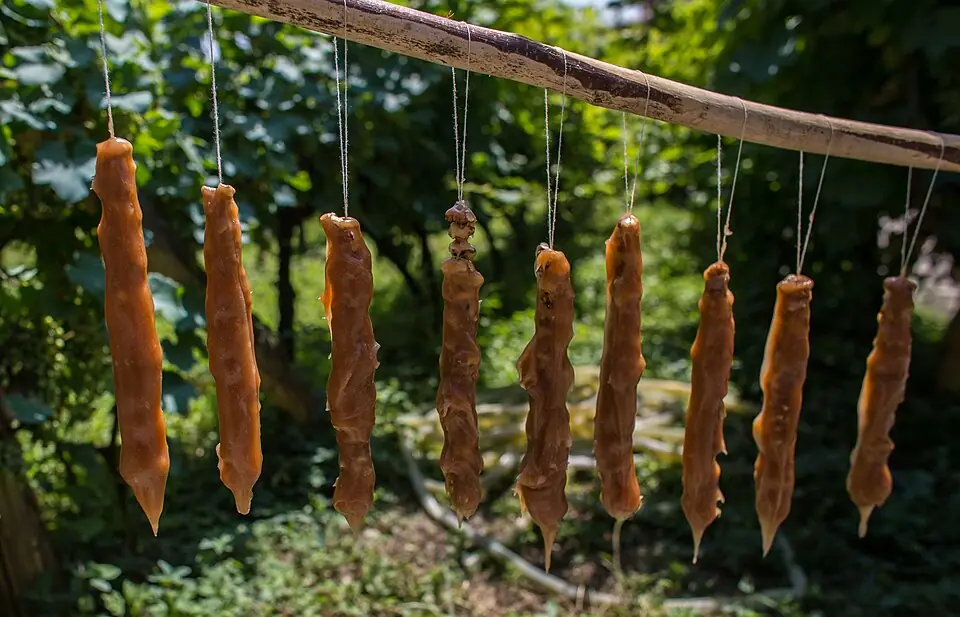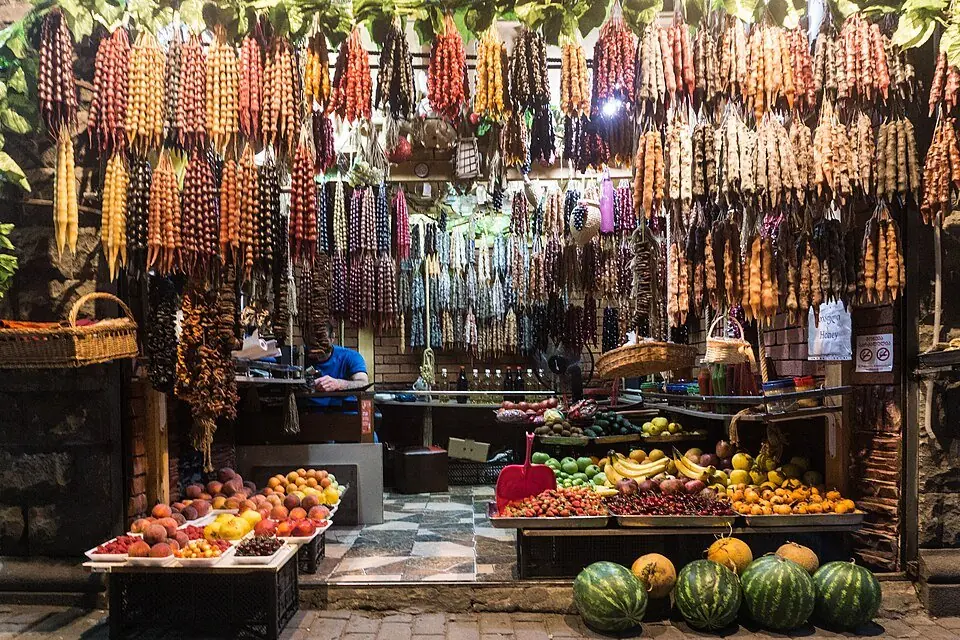
- Churchkhela is a Georgian sweet made by threading nuts on a string and dipping them several times in grape must thickened with flour, then hanging the strings to dry into a chewy stick usually 20-35 cm long.
- Kakheti makes the best-known version, walnut halves in wheat-thickened tatara; Imereti, Guria and Samegrelo prefer hazelnuts and corn flour, and Racha adds dried fruit and pumpkin seeds.
- The new batch follows rtveli, the grape harvest, so October and November are the best months for soft, fresh strings, though dried ones are sold all year.
- Expect to pay about 3-5 GEL (about $1-2) a stick at Tbilisi's Dezerter Bazaar in 2026 and a little more in Old Town souvenir shops; treat these as approximate prices.
- Churchkhela keeps for months wrapped in cotton or paper, contains no meat or dairy and packs well for the flight home, but countries such as Australia ask you to declare nuts.
Churchkhela is Georgia's best-loved traditional sweet: walnuts or hazelnuts on a string, coated layer by layer in grape juice cooked thick with flour, and dried until it looks like a knobbly golden or purple-brown candle. It tastes of concentrated grape with a crunch of nut in every bite, and the classic recipe uses no butter, eggs or milk. You will find it hanging in bunches at every Georgian market and at roadside stands all through wine country.
Autumn is the time to try it, because families cook the new batch from fresh must straight after rtveli, the grape harvest. Below you will find how churchkhela is made, how the Kakheti and Imereti styles differ, where to buy good strings in Tbilisi and on the road, approximate prices for 2026, how to keep it and fly it home, how to make your own, and which other Georgian sweets deserve a taste.
What is churchkhela?
Churchkhela (ჩურჩხელა, said roughly CHOORCH-kheh-lah) is a row of nuts on cotton thread, dipped in a hot paste of grape juice and flour, again and again, until the coat is several millimetres thick. Once dry, the outside turns matt and firm while the inside stays soft, like a dense fruit jelly around the nuts.
Georgia's registered specification sets a standard stick at 20 to 35 cm long and 1.5 to 4 cm across, with walnuts, hazelnuts, almonds, pumpkin seeds or dried fruit inside. Georgians eat it with tea, pack it for long drives and hikes, and serve it at New Year and Christmas. With no meat, dairy or eggs, it is also a fasting treat.
| Churchkhela at a glance | Short answer |
|---|---|
| Main ingredients | Nuts, grape juice and flour (wheat in the east, corn in the west) |
| Season | Freshest from late September to November; sold all year |
| Approximate price | From about 3 GEL (about $1.10) a stick at markets in 2026 |
| Keeps | Several months, wrapped and stored cool and dry |
| Diet notes | Vegan; contains nuts; the Kakheti style contains wheat |
How churchkhela is made: badagi, tatara and many dips
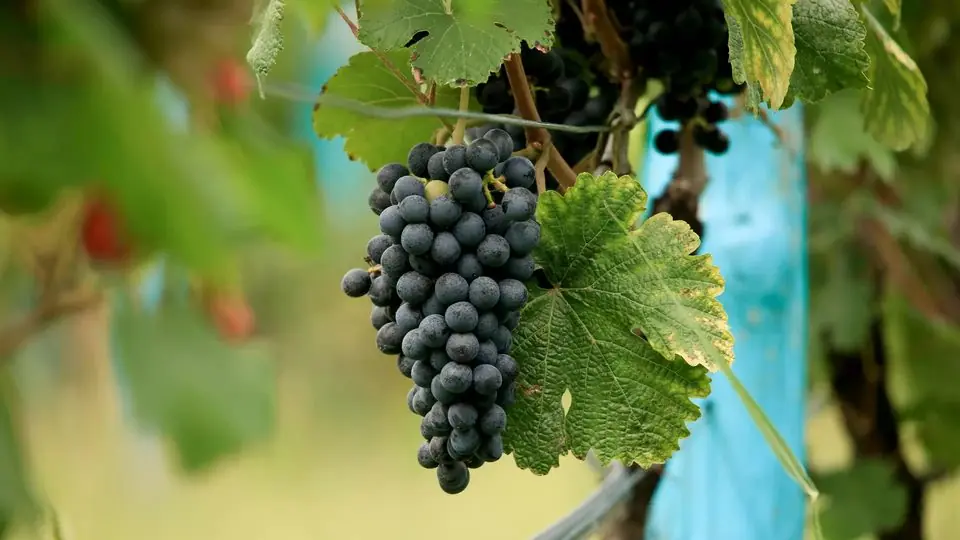
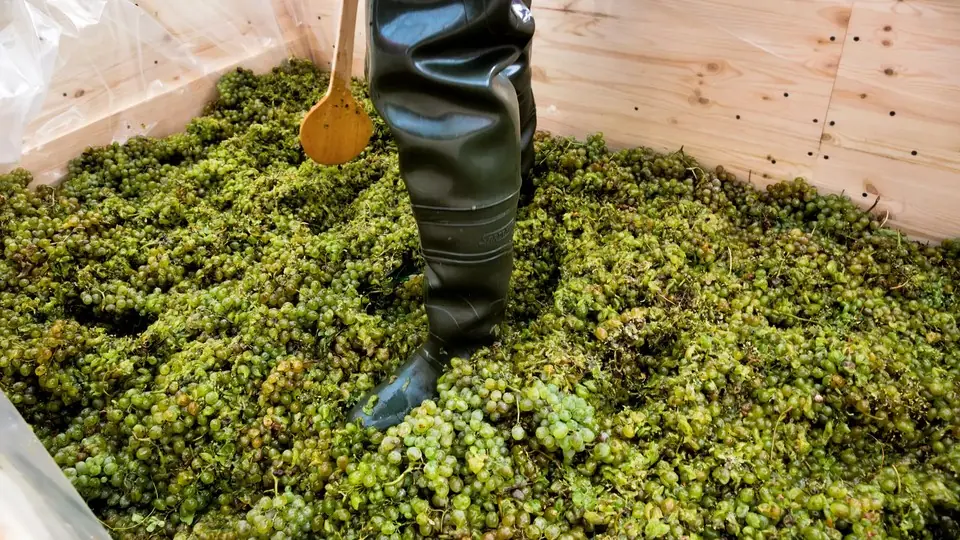
Churchkhela is a side product of winemaking: at the harvest, part of the fresh must goes into a cauldron instead of the qvevri.
- Cook the must into badagi
The juice simmers for hours while someone skims the foam, darkening into badagi, a sweet grape syrup. Some families still stir in a little fine chalk or white clay to soften the acidity. - Thicken it into tatara
Flour whisked into some of the juice goes back into the pot: wheat flour in Kakheti and Kartli, where the paste is called tatara, and corn flour in the west. It cooks until it is as thick as heavy custard. - Thread the nuts
Walnut halves, hazelnuts or almonds go onto thick cotton thread with a long needle, leaving a loop at the top. In family kitchens this is the children's job. - Dip, drip and repeat
Each string is dipped, hung until the layer turns tacky, then dipped again, usually two or three times, until the nuts vanish under a smooth coat. - Dry in the open air
The strings hang on poles in a dry, airy spot for several days to two weeks or more, until the surface stops sticking. Wrapped in white cotton and kept in the dark, they keep improving for weeks.
Kakheti, Imereti and other regional styles of churchkhela
Nearly every wine region makes its own version, and locals will happily argue about whose is best.
| Region | Core | Thickener | What to expect |
|---|---|---|---|
| Kakheti | Walnut halves | Wheat flour (tatara) | Thick, firm coat; the traditional method has national heritage status |
| Kartli | Walnuts | Wheat flour (tatara) | Close to the Kakheti style |
| Imereti, Guria, Samegrelo | Mostly hazelnuts | Corn flour; the sweet is often called janjukha | Lighter coat; dipped, left about 10 days, then dipped again |
| Racha | Dried apricots and other fruit, pumpkin seeds | Thickened grape juice | Fruitier, less crunchy |
| Samtskhe-Javakheti | Nuts | Mulberry juice with wheat flour | A rarer, darker variation |
Names shift too. In western Georgia pelamushi can mean the corn-flour dipping paste, while in Tbilisi it usually means a chilled pudding of thickened juice.



Churchkhela history and the Georgian name
No one can date the first churchkhela, but it is old. Georgia's national tourism administration says chemical tests on clay vessels from archaeological digs show they once stored it, and the food historian Darra Goldstein writes that Georgian soldiers carried it on campaign for its calories.
On 13 December 2011 churchkhela became geographical indication number 2 on the Georgian register, applied for by the Ministry of Agriculture, and its grapes must come from Georgian vineyards. In 2015 Georgia's National Agency for Cultural Heritage Preservation declared the traditional Kakhetian method a monument of intangible cultural heritage, together with Kakhetian bread.
The origin of the word is unclear. Some tour companies link it to Megrelian words for cold and hot, the hot dip and the cool drying, but we have found no linguistic source for that. Neighbours make close relatives: Armenian sharots, Turkish cevizli sucuk and Cypriot soutzoukos.
When is churchkhela season? Rtveli and the fresh batch
Churchkhela is sold all year, but the new batch follows the grape harvest. Rtveli begins in Kakheti in September (on 10 September in 2026) and moves west, finishing in Guria and Adjara as late as December. October and November are the peak, when Kakheti stands fill with sticks still soft enough to dent with a fingernail. By spring most stock is older and chewier, though still good.
To see it made from fresh must, come between mid-September and mid-October; the churchkhela sessions on our food and wine tours run from April to November. Our Rtveli Grape Harvest tour puts you with a Kakhetian family for the picking, the treading and the churchkhela pot. Like all our trips it is private: you set the dates and the group size, your guide speaks your language, and children of any age are welcome.
Where to buy churchkhela in Tbilisi, Kakheti and beyond
In Tbilisi
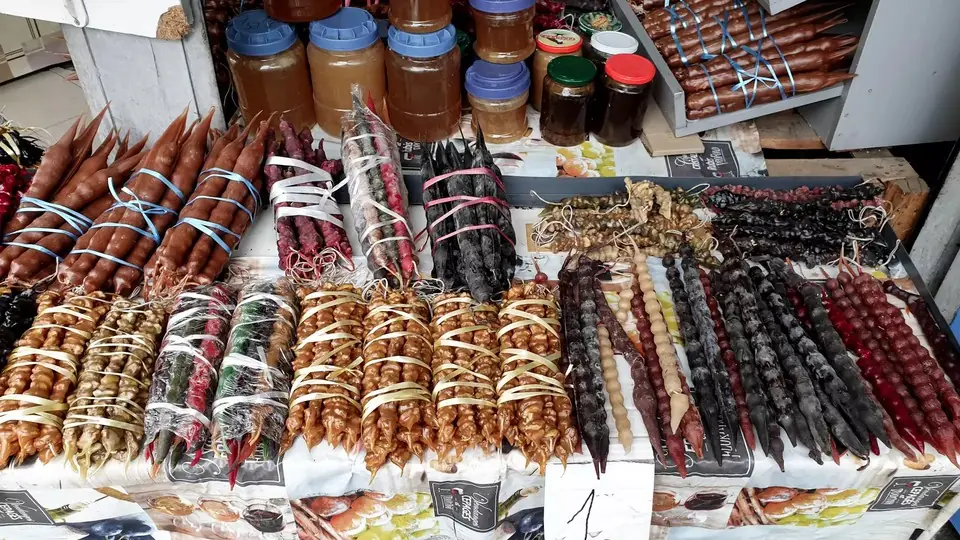
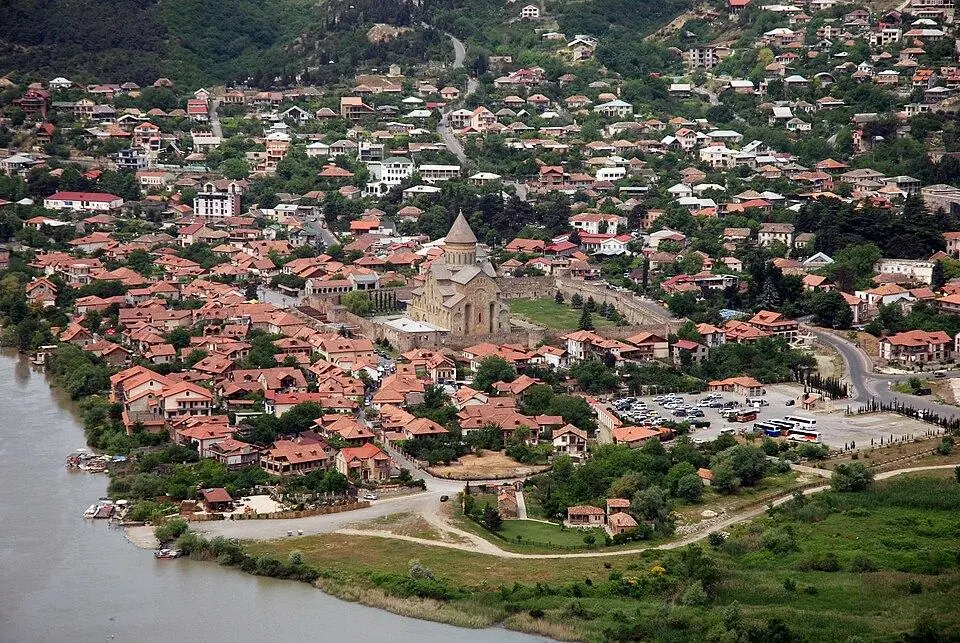
The Dezerter Bazaar near the central railway station is the best place in the capital: a row of stalls hung with curtains of sticks, sorted by colour and nut, lets you compare a dozen makers in ten minutes. Supermarket churchkhela is fine as a snack but rarely soft. Souvenir shops on Kote Afkhazi (Leselidze) Street charge more, and the stalls on the lane to Svetitskhoveli in Mtskheta, 30 minutes from the city, are handy on a day trip.
On the road in Kakheti and the west
In autumn the highway through Sagarejo towards Gurjaani and Sighnaghi is dotted with stands selling churchkhela and sacks of walnuts, and Telavi's bazaar has village makers. Family sellers are usually fresher and cheaper than town shops, and most let you taste. On a private day trip, ask your driver to stop where the strings look best; our Kakheti travel guide covers the wine towns along the way. In the west, find the hazelnut style at Kutaisi's Green Bazaar and Batumi's Central Market; on the Military Road, stalls near Ananuri sell it with honey.
| Where | Approximate price per stick, 2026 | Notes |
|---|---|---|
| Dezerter Bazaar, Tbilisi | 3-5 GEL (about $1-2) | Widest choice; buy several and ask for a better price |
| Roadside stands in Kakheti | Similar to the markets | Often the freshest in October and November |
| Old Town souvenir shops | 5-7 GEL (about $2-2.50) | Convenient, prettier packaging |
Prices are approximate for 2026 and move with each harvest. Longer sticks, almond cores and gift boxes cost more.





How to spot good churchkhela
- Squeeze gently: a good stick gives a little and springs back. Rock-hard or cracked ones are old.
- The surface should be matt and dry. A tacky coat is underdried, while a faint white bloom is only sugar.
- Natural colours run from pale gold to dark burgundy. Neon pink or green usually means dye and a stick made for tourists.
- Look for whole nut halves packed closely under a thick coat, not a thin glaze with gaps.
- Ask for shinauri, homemade. Family sticks taste more of grape and less of sugar.
- Ask to taste. Most market sellers will cut a slice if you are buying several.
How to store churchkhela and take it home
Churchkhela was made to keep. Wrap each stick in baking paper or cotton and store it cool, dark and dry. Soft autumn sticks are best within a few weeks; fully dried ones last several months, slowly firming up. The fridge works in a warm flat, and they freeze well.
For the flight, pack the sticks in their own bag, since the coating can stain clothes. As a solid food they can travel in hand luggage.
Customs rules at home
The EU bans travellers from bringing meat and milk products in from outside the EU, and churchkhela contains neither. Australia asks arriving passengers to declare certain foods, nuts among them, and a biosecurity officer decides what may enter. Rules change, so check your country's official customs or biosecurity site before flying.
Making churchkhela: cooking classes and our recipe
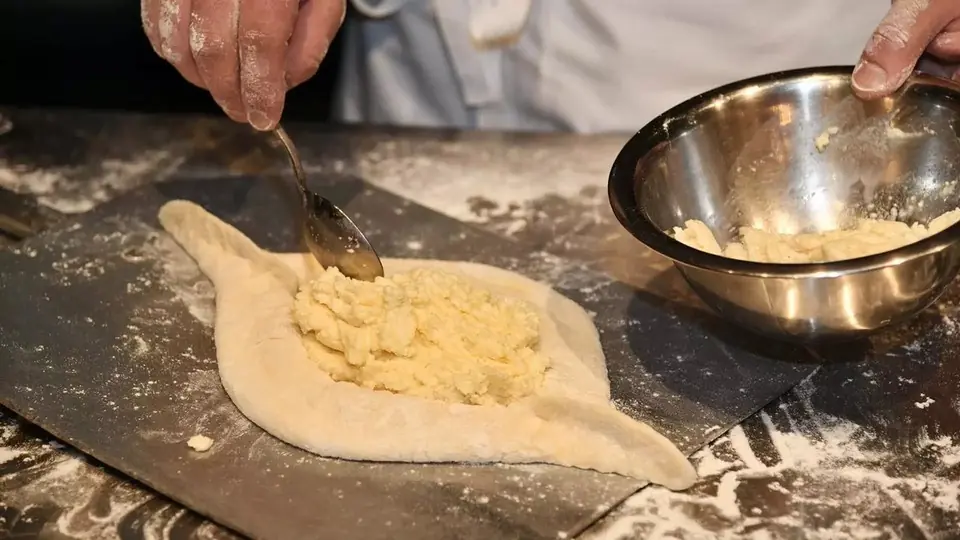
Churchkhela is best learned beside a Georgian family's pot. On our Georgian Cooking Tour you thread and dip walnuts at a guesthouse near Sighnaghi, and on Wine and Supra a Kvareli family teaches it one evening. The strings take days to dry, so you dip your own and take home a batch made earlier. Both are private trips on the days you pick, whatever the size of your party, led by a guide fluent in your language, and kids of every age tend to love the dipping.
Make churchkhela at home
To try it in your own kitchen, follow our churchkhela recipe: it times each stage, from threading the nuts and reducing the juice to cooking the tatara, dipping coat after coat and the days of drying.

Other Georgian desserts to try
Georgian restaurants do little with dessert, but grapes, nuts, honey and fruit give the country plenty of sweets. Our Georgian food guide covers the full menu; look for these next.
- Pelamushi: thickened grape juice set into a soft, chilled pudding, often topped with walnuts; a harvest-season dish.
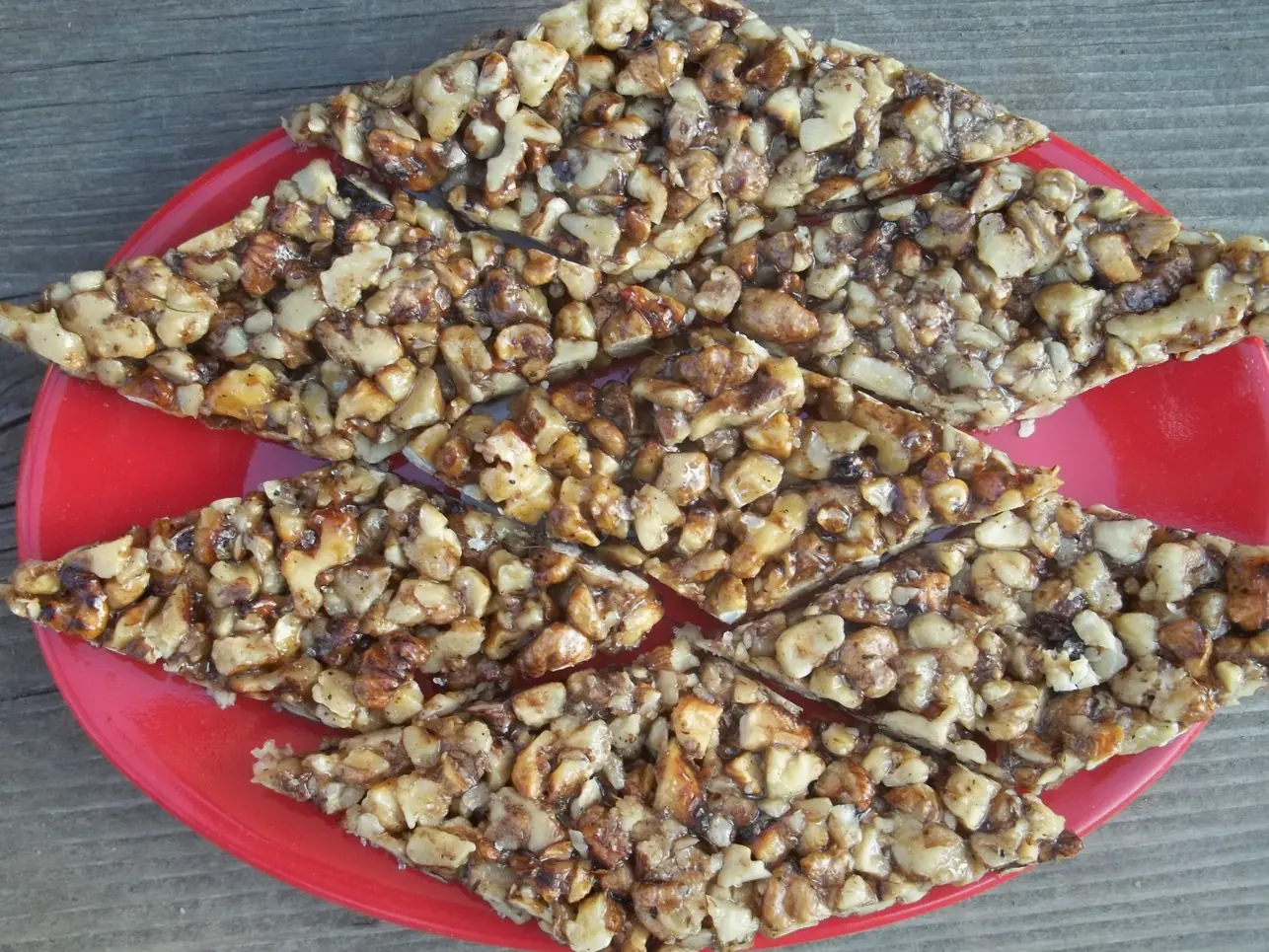
- Gozinaki: walnuts boiled in honey, spread thin and sliced into diamonds, a New Year treat.
- Tklapi: fruit purée dried into thin sheets. Sweet ones are a snack; sour plum ones season soup.
- Chiri: dried persimmons, sold through autumn and winter.
- Muraba: whole fruit, even young green walnuts, preserved in syrup and served with tea.
Churchkhela FAQ
What is churchkhela made of?
Nuts, grape juice and flour. Walnut halves or hazelnuts on a string are dipped several times in grape must cooked down and thickened with wheat or corn flour. Regional versions use almonds, dried fruit, pumpkin seeds or mulberry juice.
What does churchkhela taste like?
Like chewy, concentrated grape jelly around crunchy nuts: sweet with a light tartness, and less sugary than most confectionery.
How do you eat churchkhela?
Bite or slice it like a sausage and pull out the thread, which is not edible. At home it is often cut into rounds and served with tea or wine.
Is churchkhela vegan and gluten-free?
It is usually vegan. Kakheti churchkhela contains wheat flour, so it is not gluten-free; western corn-flour versions have no wheat, but ask about shared pots. Almost every kind contains nuts.
How long does churchkhela last?
Fully dried and wrapped in paper or cotton, it keeps several months in a cool, dry place, while sticks from the new harvest taste best in their first weeks. A white sugary bloom is harmless; mould or a sour smell is not.
Can you take churchkhela on a plane?
Yes, in hand or checked luggage. It has no meat or milk, the products the EU bans travellers from bringing in, but countries such as Australia require you to declare nuts, so check your destination's rules.
How much does churchkhela cost in Georgia?
Expect about 3-5 GEL (about $1-2) per stick in 2026 at Tbilisi's Dezerter Bazaar or a Kakheti roadside stand, and about 5-7 GEL (about $2-2.50) in Old Town souvenir shops. These are approximate and shift with each harvest.
Where can I learn how to make churchkhela in Georgia?
In Kakheti, best from mid-September to October, when families cook fresh must anyway. Our private food and wine tours include sessions with families near Sighnaghi and in Kvareli from April to November.