Ajapsandali Recipe
აჯაფსანდალი
A home-style ajapsandali recipe: salted aubergine fried golden, then stewed gently with onion, sweet peppers, ripe tomatoes and potato, and finished with raw garlic and big handfuls of basil and coriander. Vegan, fine for Lent, and often better the next day.
Recipe by the Maspindzeli team in Tbilisi · Updated 24 Oct 2026 · Cooked everywhere in summer; often called a Tbilisi dish
Full recipe with the timeline, timers and US measures: maspindzeli.ge/recipes/ajapsandali/
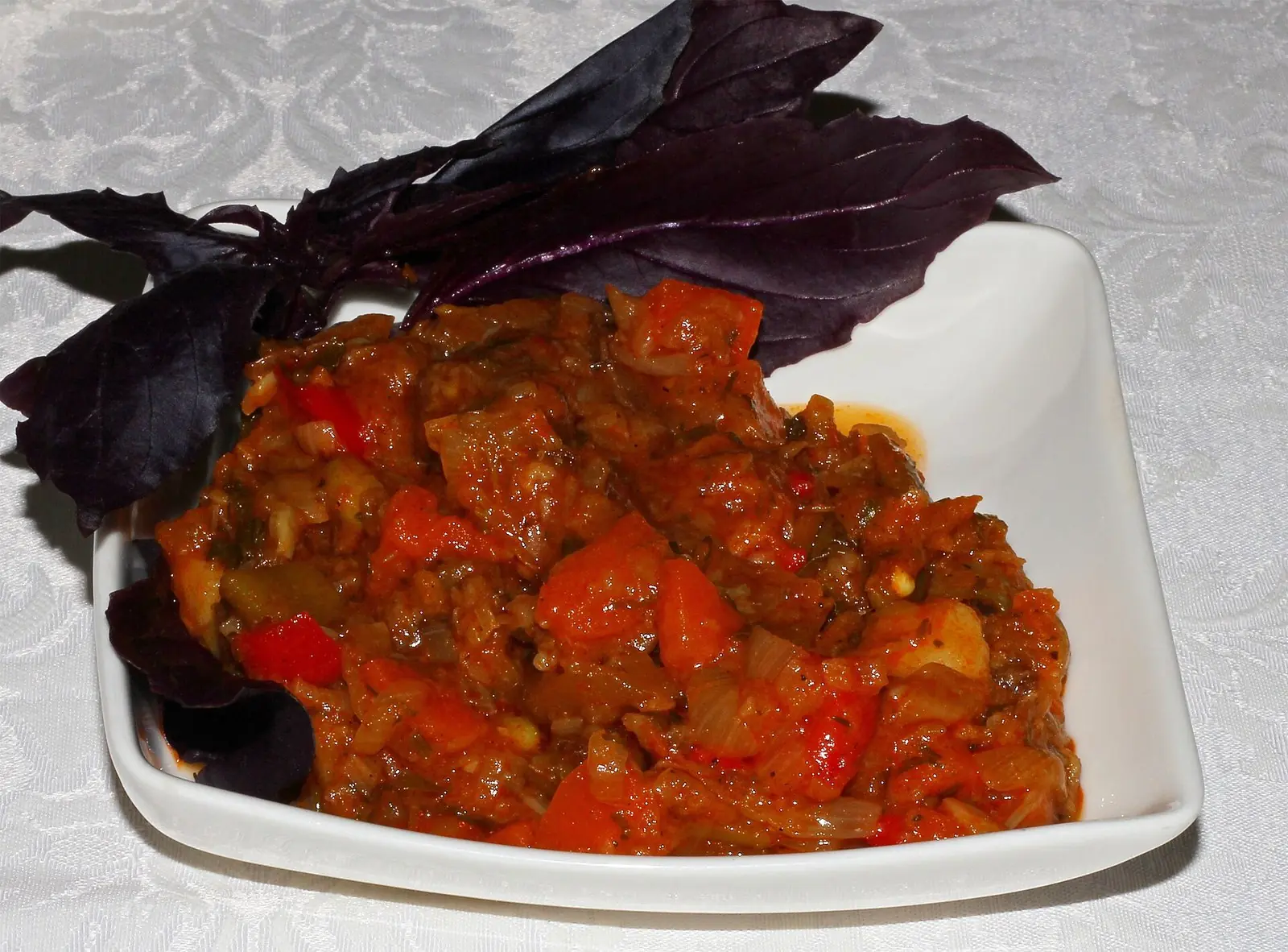
This ajapsandali recipe makes the Georgian summer stew of aubergine, sweet peppers, ripe tomatoes, onion and potato, seasoned at the very end with garlic, green chilli and a generous mix of basil, coriander, parsley and dill. The aubergine is salted and fried first, then everything simmers together just long enough to turn soft and glossy while the pieces keep their shape. You may also see the name spelt ajapsandal or adjapsandali.
It is a dish of the hot months, when market stalls are heaped with aubergines and peppers, and Georgian food writers class it as a city dish from Tbilisi. Armenia and Azerbaijan cook their own versions under similar names, and nobody can say for sure where it began or what the word means. Georgian families disagree happily about the method: some layer the raw vegetables in one pot, some fry each one first, some leave out the potato. This page follows the fried-first way, and the variations below cover the others.
Made with oil and no meat, dairy or eggs, ajapsandali is samarkhvo, fasting food, so it turns up on Georgian tables in Lent and on the other fast days of the Orthodox year. It is eaten warm, at room temperature or cold from the fridge, with bread to scoop it up.
Timeline: what to do, and when
1 h 56 min from start to table · 1 h 16 min hands-on · 45 min waiting
Each bar is one step. Hands-on Waiting, while the oven, the pot or the dough does the work. Steps that sit inside a wait are done in parallel.
Recipe
Ajapsandali
Ingredients
Vegetables
To finish
Amounts are scaled. Times stay about the same, but a bigger pot takes a little longer to come to the boil.
You will need
- Colander set over a bowl
- Large frying pan (about 28 cm)
- Large heavy pot or casserole with a lid (about 4 litres), cast iron if you have one
- Medium saucepan for the potatoes
- Box grater, for the tomatoes
- Mortar and pestle (optional, for the garlic)
Method
- Salt the aubergines10 min hands-on· start here
Peel the aubergines in lengthwise stripes, leaving some skin on so the pieces hold together, or peel them completely as many Georgian cooks do. Cut them into chunks of about 3 cm, toss them with the 2 tsp fine salt in the colander and set it over a bowl.
- Let them drain30 min waiting· starts at +10 min
Leave the aubergines for 30 minutes. Brown drops will bead on the cut sides and drip into the bowl: that water would otherwise make them steam in the pan and soak up oil.
- Par-boil the potatoes5 min hands-on· starts at +10 min, during step 2
Peel the potatoes, cut them into 2 cm cubes and put them in a saucepan of cold salted water. Bring to the boil and cook for about 6 minutes, until a knife slides in but the centre still resists a little, then drain.
- Chop everything else20 min hands-on· starts at +15 min, during step 2
Halve and thinly slice the onions. Seed the peppers and cut them into strips about 1 cm wide, and slice the chilli, keeping the seeds only if you want heat. Cut the tomatoes in half and rub the cut faces against the large holes of the box grater; throw away the flat skins that remain. Pound the garlic to a paste with a pinch of salt, chop all the herbs (soft coriander stalks too) and set a handful aside for serving. Drain the potatoes when they are ready.
- Squeeze the aubergines5 min hands-on· starts at +40 min
Take the aubergines a handful at a time and press them gently between your palms to force out the liquid without crushing them. Pat them dry on a clean tea towel.
- Fry the aubergines15 min hands-on· starts at +45 min
Warm 5 tbsp of the oil in the large frying pan on a medium-high flame until it shimmers. Fry the aubergines in 2 or 3 batches, turning them now and then, for 4 to 5 minutes a batch, until golden on several sides and soft inside. Lift each batch onto a plate, and add a splash more oil before the next one only if the pan looks dry.
- Soften the onions and peppers12 min hands-on· starts at +1 h
Set the heavy pot over a medium heat with the remaining 3 tbsp oil. Cook the onions for about 7 minutes, stirring, until soft and pale gold, then add the peppers and chilli and give them 5 minutes more, until the peppers are tender right through.
- Add the tomatoes6 min hands-on· starts at +1 h 12 min
Pour in the grated tomatoes with the tomato paste, if using, and the black pepper. Let it bubble for about 5 minutes, stirring now and then, until the sauce thickens a little and smells sweet.
- Stew it all together20 min waiting· starts at +1 h 18 min
Tip in the potatoes and the fried aubergines and fold them through the sauce with a wide spoon. Cover, turn the heat down low and stew for 15 to 20 minutes, until the potatoes are completely tender and the aubergines silky. Shake the pot from time to time instead of stirring, and add a few spoonfuls of water only if it starts to catch.
- Add the garlic and herbs3 min hands-on· starts at +1 h 38 min
Stir in the garlic paste and all the herbs except the handful you kept back. Taste before you add salt, because the aubergines already carry some, then let it simmer for 1 more minute and take the pot off the heat.
- Rest, then serve15 min waiting· starts at +1 h 41 min
Keep the lid on for at least 15 minutes so the garlic and herbs mellow into the vegetables. Scatter over the reserved herbs and serve warm or at room temperature, or cool it completely and chill it overnight.
About 500 kcal per serving (1 of 4). This is an estimate from standard values for the ingredients, not a lab figure.
Ajapsandali usually shares the table with several other dishes rather than arriving as a course of its own. Spoon some onto your plate next to whatever else is served and scoop it up with torn bread; on a hot evening Georgians happily eat it cool from the fridge.
Tips, swaps and variations
Tips from your host
- Do not skip the salting. A wet aubergine steams instead of browning and drinks far more oil; half an hour in salt and a gentle squeeze fix both problems.
- Cook each vegetable until it is truly soft before it joins the stew. Crisp peppers or underdone aubergine never catch up in the short simmer at the end.
- Once everything is in the pot, fold and shake rather than stir. Good ajapsandali is soft and saucy, with pieces you can still tell apart, never a purée.
- Be generous with the basil. Georgians treat it as the herb that makes the dish, and in Tbilisi a person missing something essential can be teased as being like ajapsandali without basil.
- Add the garlic and most of the herbs only at the end. Their raw, green bite is what lifts the sweet, oily vegetables.
- Cook it a day ahead when you can. Overnight in the fridge the flavours settle and the stew becomes more rounded, and it is then easy to serve at room temperature.
Variations and swaps
- Layered in one pot, no frying: a quicker home method. Slice the onions, the salted and squeezed aubergines, peeled tomatoes and raw potatoes, then layer them in the heavy pot with a scattering of herbs between the layers, repeating until everything is in. Pour the oil over the top, cover tightly and cook over a low heat for 50 to 60 minutes, until the potatoes are tender, pressing the vegetables down once they slump. Stir in the garlic and the rest of the herbs at the end.
- Stewed in one pan: many family recipes skip the separate frying. Soften the onions in the oil, add the aubergine for 5 minutes, then the potatoes, peppers and tomatoes, and cook covered over a medium-low heat for about 30 minutes, until the potatoes are done. Finish with the garlic and herbs as above. It is quicker and uses less oil, and the aubergine turns out softer and paler.
- Without potato: plenty of cooks leave it out, especially when ajapsandali is served cold as a starter. Use 1.2 kg aubergines instead and skip the par-boiling step.
- Carrots, green beans or rice: some Georgian recipes add 200 g grated carrot with the onions, 300 g green beans cooked separately, or a small handful of rice boiled with the potatoes.
- Less oil: instead of frying, toss the salted, squeezed aubergine with 3 tbsp oil, spread it out on a baking tray and roast at 220 °C / 430 °F (200 °C / 390 °F fan) for about 25 minutes, turning the pieces once.
- Butter, ghee or meat: some cooks start the vegetables in a mix of butter and oil, older Georgian cookbooks allow ghee (erbo), and meat versions with lamb or beef exist. None of these is vegan or fit for Lent.
- Herbs: dried or fresh summer savory (kondari) is a common extra in Georgian recipes. If you cannot find purple basil, use green basil and a little more of it.
Serve it with
- Bread to scoop it up: shoti, tonis puri or mchadi cornbread
- Pkhali, badrijani nigvzit and lobio for a meat-free spread
- Mtsvadi (grilled pork or lamb) or fried fish, outside fasting days
- Georgian cheese such as sulguni or imeruli, when you are not fasting
- Radishes, spring onions, tarragon and other raw greens
- Mzhave (pickles), such as green tomatoes or cabbage
Make ahead and storage
Covered in the fridge, ajapsandali keeps for 3 to 4 days, and many Georgians prefer it a day after cooking. Take it out an hour before you eat to serve it at room temperature, or warm it gently in a covered pan over a low heat with a spoonful of water if it looks dry, then add a few fresh herbs. It can be frozen for up to 3 months, though the potato turns slightly grainy; thaw it overnight in the fridge.


Maspindzeli Travel, Tbilisi · private tours and cooking classes in Georgia · maspindzeli.ge · WhatsApp +995 598 74 74 54 · hello@maspindzeli.ge