Ghomi Recipe
ღომი
This ghomi recipe makes the plain white corn porridge of Samegrelo in western Georgia: washed grits cooked slowly, firmed with a handful of fine cornmeal and scooped onto plates with slices of sulguni softening on top. Gluten-free, and the everyday partner of kharcho, satsivi and beans.
Recipe by the Maspindzeli team in Tbilisi · Updated 17 Nov 2026 · From Samegrelo and the rest of western Georgia
Full recipe with the timeline, timers and US measures: maspindzeli.ge/recipes/ghomi/
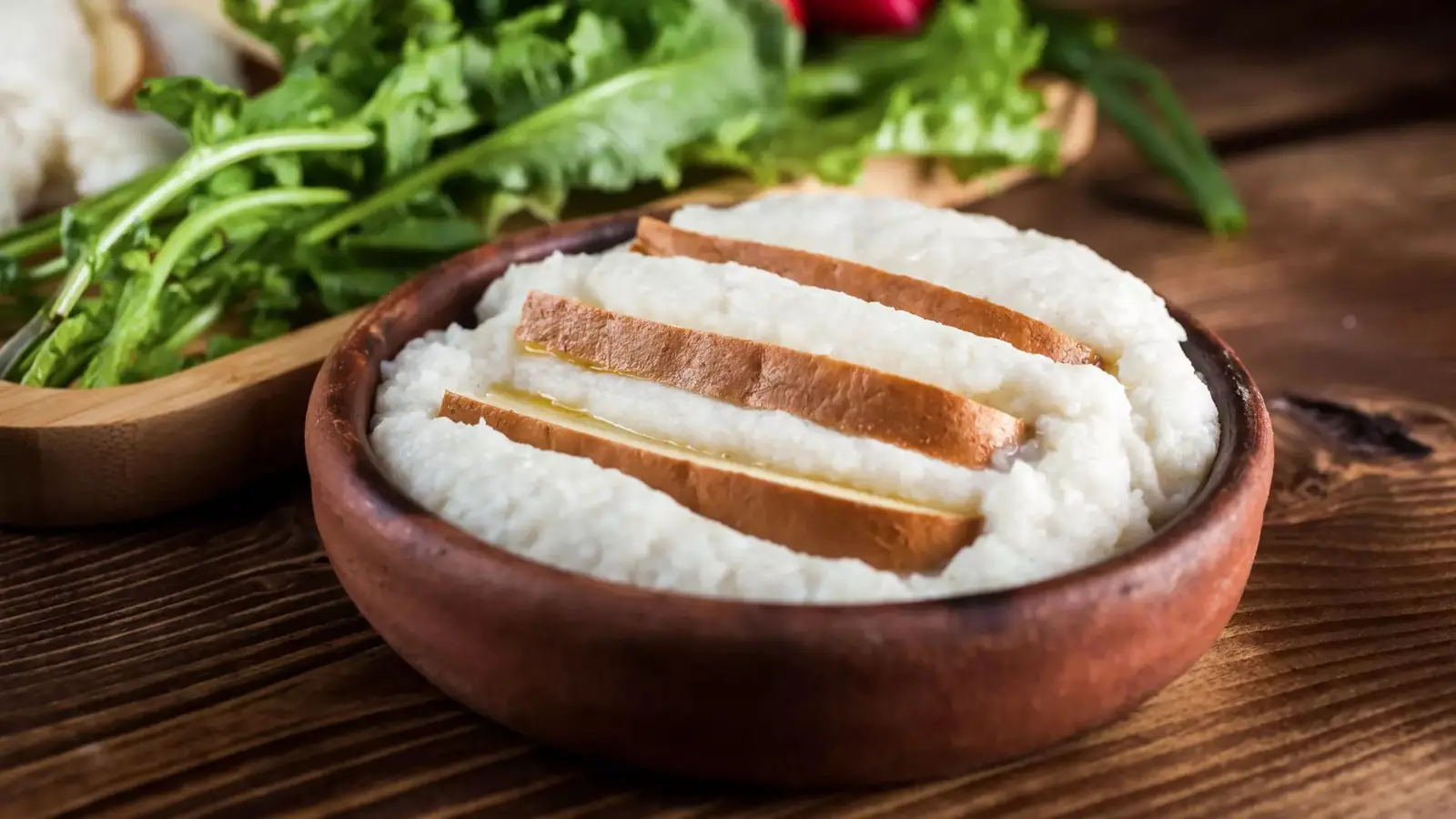
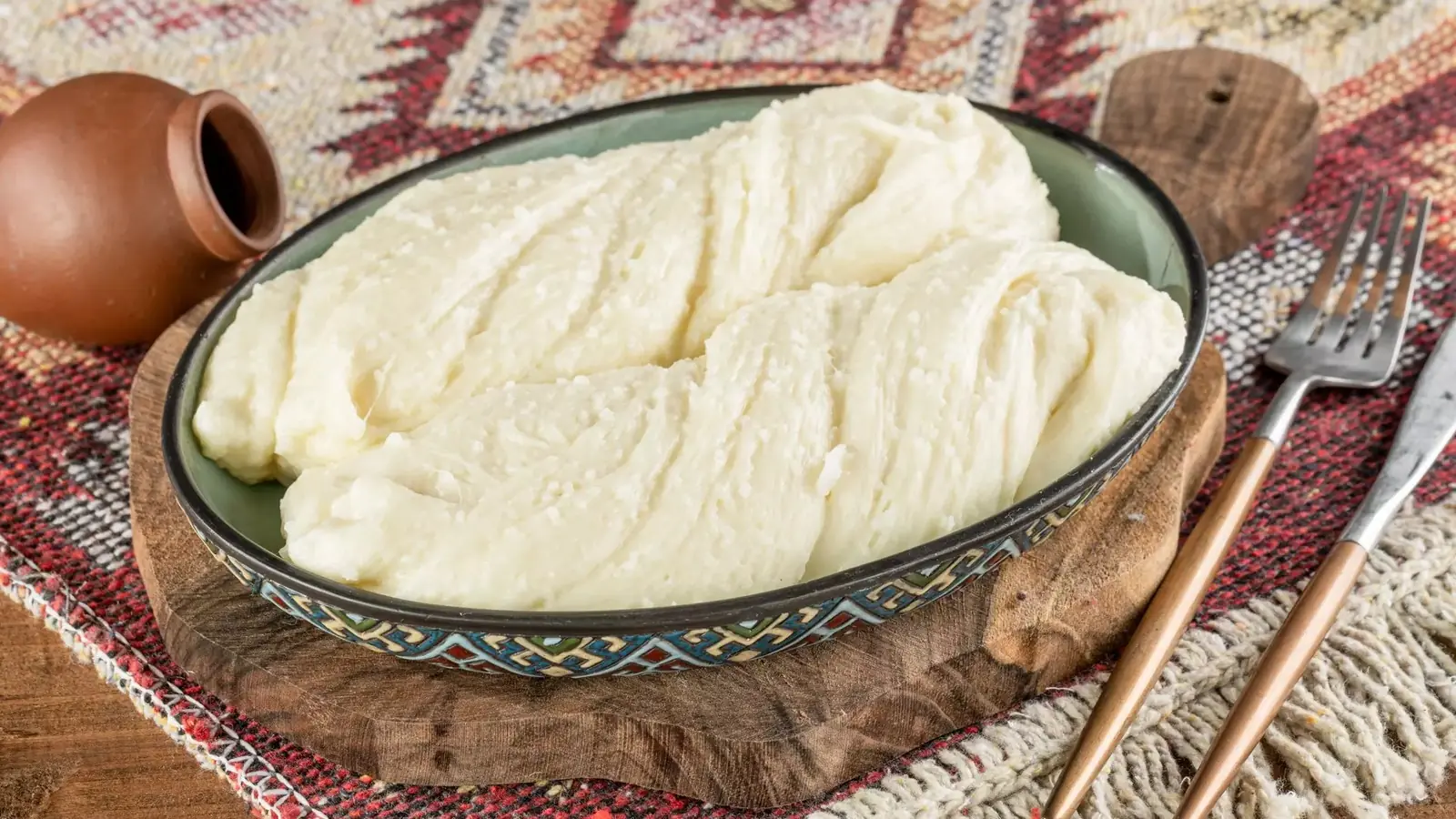
This ghomi recipe is for the dense, pale porridge that Megrelian cooks make from coarse white maize. The grits are rinsed until no dark flecks remain, cooked soft in plain water, then thickened with fine cornmeal and kneaded until the pot holds one smooth, heavy mass. Each portion comes out on a wet wooden paddle and gets a few slices of young sulguni that slump into the heat. You will also find it written gomi, and English-language guides often call it ghomi porridge or Georgian polenta.
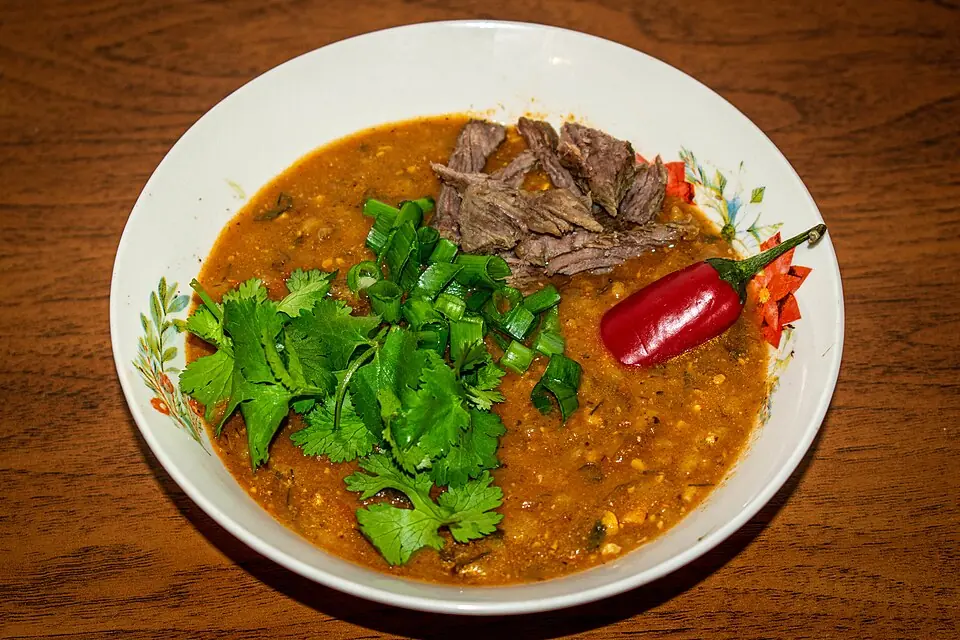
In Samegrelo and the rest of the west, ghomi does the job that bread does elsewhere. It is the plain, filling partner for Megrelian kharcho, satsivi, bazhe, red beans, kupati sausages and fried fish. The word is older than the maize: ghomi is the Georgian name for foxtail millet, the small grain western Georgians boiled into porridge before corn took over their fields, and a few cooks still make the old millet version.
Beat a large weight of cheese into the same pot and you have elarji, which has its own recipe on this site; this page sticks to plain ghomi with the cheese on top. White grits or coarse polenta and a mild melting cheese give a very close result outside Georgia. For the wider picture of Megrelian cooking, see our Georgian food guide.
Timeline: what to do, and when
1 h 25 min from start to table · 50 min hands-on
Each bar is one step. Hands-on Waiting, while the oven, the pot or the dough does the work. Steps that sit inside a wait are done in parallel.
Recipe
Ghomi
Ingredients
Porridge
To serve
Amounts are scaled. Times stay about the same, but a bigger pot takes a little longer to come to the boil.
Contains: milk.
You will need
- Large bowl and a sieve for washing the grits
- Heavy pot of 3 to 4 litres with a lid (cast iron or thick enamel)
- Flat wooden paddle (chogani) or a sturdy wooden spoon
- Small bowl of cold water for wetting the paddle
- Warmed plates
Method
- Wash the grits12 min hands-on· start here
Put the grits in the large bowl, pour in plenty of cold water and swirl them round with your hand. Wait a few seconds for the grain to settle, then pour off the cloudy water with the husks and dark specks floating on it. Repeat six to eight times, until the water is nearly clear and the grits look white, then drain them in the sieve.
- Start in cold water3 min hands-on· starts at +12 min
Tip the washed grits into the heavy pot with 1 litre of cold water and the salt. Stir once, cover with the lid and set the pot over medium-high heat.
- Bring to the boil10 min waiting· starts at +15 min
Let it come to the boil, which takes about 10 minutes. Megrelian cooks follow a simple rule here: leave the covered pot alone until it boils, or, if you do lift the lid and stir, keep stirring without a pause until it boils, because grains that are moved and then left will settle and stick.
- Simmer the grits35 min waiting· starts at +25 min
As soon as it boils, skim off the foam, turn the heat down to low and set the lid slightly ajar. Simmer for 30 to 40 minutes, scraping the bottom with the paddle every 5 to 10 minutes. The grits are ready for the next stage when a grain squashed between your fingers has no hard centre and the porridge is thick enough to push back against the paddle. If it dries out while the grains are still firm, add hot water 100 ml at a time.
- Slice the cheese, warm the plates10 min hands-on· starts at +40 min, during step 4
While the grits simmer, cut the sulguni into slices about 5 mm thick and leave them on the board so they lose the chill of the fridge. Warm the plates in the oven on its lowest setting and set a small bowl of cold water beside the stove for the paddle.
- Beat in the fine cornmeal5 min hands-on· starts at +1 h
Add the fine cornmeal in small showers, about a tablespoon at once, working the paddle fast and squashing any lumps against the side of the pot before the next lot goes in. Some cooks lift the pot off the heat while they do this so nothing catches. The porridge stiffens almost at once.
- Knead it over low heat15 min hands-on· starts at +1 h 5 min
Put the pot back on the lowest heat, cover, and every 3 to 4 minutes knead the porridge hard with the paddle, folding it from the sides into the middle. After about 15 minutes the smell of raw flour has gone, the ghomi turns as one smooth lump and a thin, dry ring has formed on the pot wall around it. One Georgian home test: stand the paddle upright in the middle, and if it stays up, the ghomi is cooked.
- Scoop and add the cheese5 min hands-on· starts at +1 h 20 min
Dip the paddle in the cold water, lift out about two paddlefuls per person and smooth each portion into a low mound on a warm plate, wetting the paddle again before every scoop. Press three or four slices of sulguni into the hot surface, add a small piece of butter if you like and serve at once, while the cheese is softening.
About 510 kcal per serving (1 of 4), with the sulguni, without butter. This is an estimate from standard values for the ingredients, not a lab figure.
Treat ghomi as the bread of the meal. Cut off a forkful with a little of the soft cheese and drag it through the kharcho, walnut sauce or beans on your plate. Eat it while it is hot: within ten minutes or so it firms and the cheese sets again.
Tips, swaps and variations
Tips from your host
- Take your time over the washing. Georgian cooks judge ghomi by its whiteness, and every husk or dark speck left in the bowl ends up on the plate. Letting the tap run gently into the bowl as you swirl makes the job quicker.
- A heavy pot matters. Megrelian families once kept a round, thick-bottomed pot for nothing but ghomi, and a thin saucepan burns on the bottom while the grains are still hard.
- Grits sold outside Georgia cook at very different speeds. Ordinary white grits from a supermarket may be soft in about 20 minutes, while stone-ground meal or Georgian ghergili sometimes takes 50 minutes or more. Squash a grain between your fingers instead of trusting the clock.
- Keep the bowl of cold water beside the pot and dip the paddle each time you serve. A wet paddle lets the ghomi drop off in a neat mound; a dry one drags it into a sticky mess.
- Save the crust. Megrelians call the toasted layer on the bottom of the pot nakhvatsa and eat it with sulguni. Once the pot is empty, leave it on a low flame for about 5 minutes, then prise the crust out in pieces with the paddle.
- As soon as the crust is out, fill the pot with water and leave the paddle to soak. Ghomi that dries on wood or cast iron sets hard and takes a long soak to shift.
Variations and swaps
- Grits and polenta abroad: white corn grits, regular or stone-ground but never instant, are the closest match to Georgian ghergili. Coarse yellow polenta works too and gives a golden ghomi with a sweeter corn flavour. With quick-cook polenta, use the water amount on the packet, cook it as directed, then add the fine cornmeal and give it 10 minutes more over low heat.
- No fine cornmeal: some Georgian cooks use semolina instead, at about half the weight (30 g here). It sets the porridge just as well, but semolina is wheat, so the ghomi is no longer gluten-free. Or blitz 60 g of the grits in a coffee or spice grinder until fine as flour.
- Cheese in the middle: put half a portion on the plate, lay the sulguni slices on it and cover with the rest, so the cheese melts inside the mound.
- Elarji: beat a large quantity of young sulguni straight into the finished pot until it stretches; our elarji recipe gives the amounts and method.
- Ghomi with puchkholia (ghomi puchkholiati): mash young Imeretian cheese with finely chopped fresh mint and a pinch of salt, roll it into small balls and set them on the ghomi beside the sulguni. Outside Georgia, mild feta crushed with a spoonful of ricotta makes a fair stand-in.
- Old-style rinse: some Megrelian cooks strain the first, milky rinsing water and boil the grits in it instead of in fresh water, to keep more of the corn flavour.
- Ghomis ghomi, the millet original: a few Georgian chefs cook whole foxtail millet grain the same way in lightly salted water and firm it with millet flour. Asian grocers often sell foxtail millet.
- Milk and butter: a few cooks swap part of the water for milk or finish each plate with a slice of butter. Plain water is the traditional choice.
Serve it with
Make ahead and storage
Ghomi is at its best hot from the pot; as it cools it firms up enough to slice. Leftovers keep for 2 to 3 days, wrapped or boxed, in the fridge. A Georgian way to use them: cut the cold ghomi into squares, split each square through the middle, tuck a slice of cheese inside and warm them in a lightly oiled frying pan or a hot oven until the cheese softens. Plain slices can also be fried in a little oil until crisp on both sides. To make it soft again, break it up in a pan with a few spoonfuls of water and beat it over low heat until smooth and hot.



Maspindzeli Travel, Tbilisi · private tours and cooking classes in Georgia · maspindzeli.ge · WhatsApp +995 598 74 74 54 · hello@maspindzeli.ge