Achma Recipe
აჩმა
A home achma recipe: thin sheets of egg dough, most of them dipped in boiling water, stacked with melted butter and salty cheese and baked until the top is crisp while the layers inside stay soft. One tin, cut into squares, feeds eight.
Recipe by the Maspindzeli team in Tbilisi · Updated 8 Nov 2026 · From Adjara, now baked across Georgia
Full recipe with the timeline, timers and US measures: maspindzeli.ge/recipes/achma/
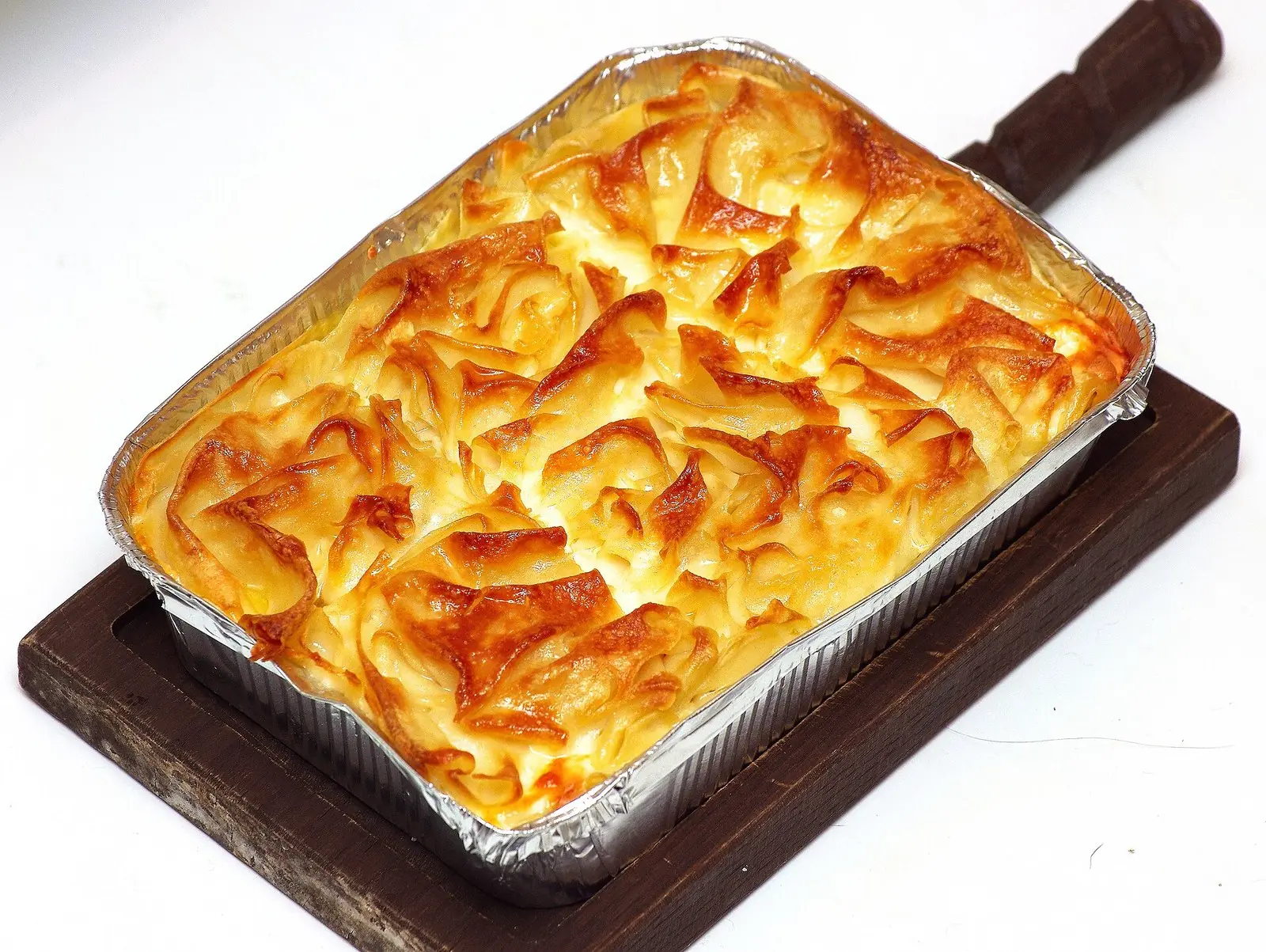
This achma recipe makes the layered cheese pie that Adjara bakes in big trays and sells by the square. It is not a bread like other khachapuri: a plain dough of flour, eggs and water is rolled into very thin sheets, most of them dipped in boiling water like pasta, then stacked in a tin with melted butter and grated cheese. In the oven the top turns crisp and golden, and the layers underneath stay soft and stringy with cheese. Menus sometimes call it achma khachapuri, and visitors often describe it as Georgian lasagne, though it has no sauce and no meat.
Adjara counts achma among its own dishes, and Georgia's national tourism site lists it with Adjarian cooking, while several food writers place its roots in neighbouring Abkhazia. Wherever it began, it has long since spread: bakeries and khachapuri cafés across the country sell it, and our khachapuri guide compares it with the rest of the family.
Georgians eat it warm, in squares: a piece with tea or coffee in the morning, a portion from the bakery for lunch, or a whole tray carried out for guests. Keep it for a free afternoon rather than a busy weeknight. For anyone wondering how to make achma at home without tearing every sheet, the method below sets up a simple boiling station and explains how to handle the soft dough.
Timeline: what to do, and when
2 h 35 min from start to table · 1 h 33 min hands-on · 40 min waiting
Each bar is one step. Hands-on Waiting, while the oven, the pot or the dough does the work. Steps that sit inside a wait are done in parallel.
Recipe
Achma
Ingredients
Dough
Cheese and butter
For boiling the sheets
To glaze (optional)
Amounts are scaled. Times stay about the same, but a bigger pot takes a little longer to come to the boil.
Contains: gluten (wheat), milk, egg.
You will need
- Baking tin about 23 x 33 cm and at least 5 cm deep (metal, glass or ceramic)
- Your widest large pot, holding at least 4 litres
- Large bowl of cold water, ideally with ice
- Long rolling pin and a floured worktop
- Spider strainer or large slotted spoon
- Pastry brush
- Two clean tea towels
- Small pan for melting the butter
- Sharp knife and a spatula
Method
- Make a firm dough15 min hands-on· start here
Beat the eggs and salt together in a large bowl, then whisk in the lukewarm water. Work in the flour a handful at a time, first with a fork and then with your hand, adding a spoonful more water only if dry crumbs will not join. Knead on the worktop for about 10 minutes, until the dough is smooth, firm and springs back slowly when you press it. It should feel stiffer than bread dough, more like fresh pasta.
- Rest the dough30 min waiting· starts at +15 min
Wrap the ball in cling film, or leave it in the bowl under an upturned plate, at room temperature for 30 minutes. Resting relaxes the dough, so it rolls out thin later without springing back.
- Get the cheese and butter ready12 min hands-on· starts at +17 min, during step 2
Coarsely grate the sulguni, crumble the Imeretian cheese and mix the two, then taste a pinch: it should be clearly salty, since the dough has hardly any salt. Split it into three equal heaps. Melt the butter over low heat, brush a little over the base and sides of the tin, and keep the rest warm so it stays runny.
- Set up a boiling station6 min hands-on· starts at +29 min, during step 2
Bring the water to the boil in your widest pot with the salt and oil, then cover it and keep it just simmering until the sheets are rolled. Line up beside the hob, in this order, a big bowl of cold water (with ice if you have some), a clean tea towel spread flat and the buttered tin. Moving each sheet along this line keeps the kitchen tidy.
- Roll and lay the base sheet8 min hands-on· starts at +45 min
Cut the dough into two larger pieces of about 130 g and six of about 85 g, and keep them covered. On a floured surface roll one large piece into a thin rectangle of about 30 x 40 cm. Roll it loosely round the pin, unroll it into the tin so it covers the base and climbs 3 to 4 cm up the sides, and brush it with butter. This sheet is not boiled.
- Roll the six inner sheets18 min hands-on· starts at +53 min
Roll each smaller piece to roughly the size of the tin and about 1 mm thick, thin enough to see the outline of your fingers through it. Dust it with flour, fold it loosely into quarters and stack it under a tea towel while you roll the rest. Ragged edges do not matter, because the boiled sheets are soft and can be gathered to fit.
- Boil, refresh and layer21 min hands-on· starts at +1 h 11 min
With the water at a fast boil, unfold a sheet, drape it over the rolling pin and lower it in; after 30 to 60 seconds, when it puffs and floats, lift it out with the strainer and plunge it into the cold water for half a minute. Let it drip, pat it on the towel, ease it into the tin and brush it with butter. Scatter one heap of cheese over the first, third and fifth boiled sheets, giving the second, fourth and sixth butter alone. Switch the oven on to 200 °C / 390 °F (180 °C / 355 °F fan) when you reach the fifth sheet.
- Close the top and cut10 min hands-on· starts at +1 h 32 min
Roll the second large piece a little bigger than the tin and lay it over the stack without boiling it. Tuck its edges down the sides, fold the rim of the base sheet in over it and press gently all round to seal the cheese inside. Brush the top with the remaining butter, then cut straight down to the base with a sharp knife, into 8 large or 12 smaller squares.
- Bake40 min waiting· starts at +1 h 42 min
Bake on a low shelf for 20 minutes, then move the tin up to the middle for 20 minutes more, until the top is a deep golden brown and butter bubbles at the edges. For a glossier, darker top, brush it with the yolk beaten with the milk after 25 minutes. If it colours too fast, lay a loose sheet of foil over the tin.
- Let it settle10 min waiting· starts at +2 h 22 min
Leave the achma in its tin for 10 minutes. The molten cheese firms slightly, so the squares come out in one piece instead of sliding apart.
- Lift out and serve3 min hands-on· starts at +2 h 32 min
Run the knife along the cuts once more and lift the squares out with a spatula. Serve them warm.
About 690 kcal per serving (1 of 8, a large square). This is an estimate from standard values for the ingredients, not a lab figure.
Lift each square out whole with a spatula so the layers stay stacked, and eat it with a fork while the cheese is still soft and pulls into strings. Cut down through the crisp lid rather than tearing it, or it breaks into shards and the filling slips out.
Tips, swaps and variations
Tips from your host
- Carry every sheet to the pot draped over the rolling pin rather than in your hands. A raw sheet this thin stretches and rips under its own weight, but on the pin it goes into the water in one smooth movement.
- Keep the water at a fierce boil and cook one sheet at a time. In water that only simmers, the dough sinks, sticks to the bottom of the pot and turns gluey.
- Holes in the boiled sheets are no disaster: lay a torn scrap over the gap and keep going. Only the two unboiled sheets, base and lid, have to stay whole, since they hold the cheese in.
- Drain each boiled sheet properly. Water carried into the tin leaves the middle soggy and stops the butter from coating the layers, so hold each one over the bowl until the drips slow, then pat it on the towel.
- Cut the squares before the tin goes in. A baked top shatters under the knife and squeezes the soft layers out sideways, whereas a raw one bakes into neat portions that lift out cleanly.
- Brush on more butter than feels sensible. It runs down through the cuts as the achma bakes, frying the base and soaking the inner sheets; a dry achma tastes of boiled flour.
Variations and swaps
- Cheese outside Georgia: replace the two Georgian cheeses with 450 g low-moisture mozzarella grated from a block and 250 g feta, crumbled. Mozzarella supplies the melt and the long strings, feta the salt and sour tang. Bags of ready-grated cheese are dusted with starch and melt poorly, and fresh mozzarella balls weep water into the layers. Shops selling Russian or Ukrainian food often have suluguni and brynza, which come closer still.
- Matsoni dough: some Georgian cooks knead the dough with the same quantity of matsoni or plain yoghurt in place of the water. The sheets come out a little more tender and slightly tangy.
- Creamier filling: stir about 100 g sour cream or matsoni into the grated cheese before layering, as a few home recipes do. The inside turns softer and richer, closer to a cheese sauce.
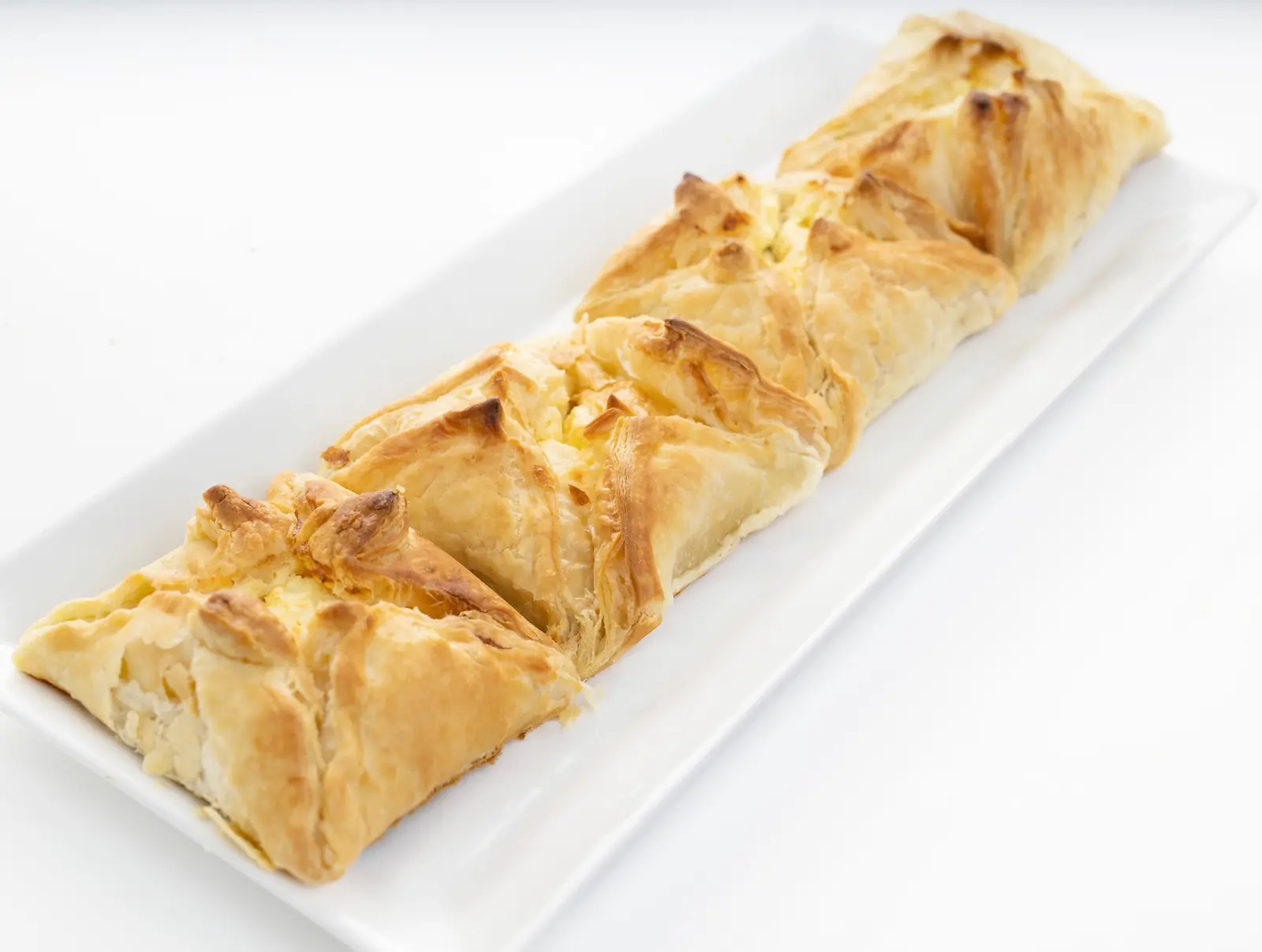
- Ruffled top, as in many bakeries: boil the top sheet as well and lay it on in loose folds, then turn the edges of the base sheet in over it. The ridges bake crisp and brown while the hollows stay soft, and you do not need a neat rectangle for the lid.
- Pasta machine: roll the six inner pieces to the second-thinnest setting. The strips will be narrower than the tin, so lay two or three side by side for each layer, overlapping them by a finger's width. Roll the base and lid by hand, as they need to be wide.
- With meat or greens: less common versions layer the boiled sheets with minced beef fried with ajika, or with cheese mixed with chopped beet leaves, dill and spring onion. The classic achma keeps to cheese and butter.
Serve it with
- Black tea or coffee, for a breakfast portion
- A salad of tomatoes, cucumbers, spring onions and fresh herbs
- Georgian pickles (mzhave), to cut through the butter
- Grilled meat or fish and plenty of vegetables, when it is one dish among many at a supra
- A light white Tsolikouri, or Chkhaveri from the hills of Adjara and Guria
Make ahead and storage
Achma reheats better than most cheese breads, so a full tin is never wasted. Once cool, cover the tin and refrigerate it; it keeps well for 3 days. Warm squares under foil at 180 °C / 355 °F for about 15 minutes, then uncover them for the last 5 so the top crisps again; a microwave turns the crust soft. To work ahead, assemble and cut the achma, cover it and chill it overnight, as several Georgian cooks do, and bake it the next day straight from the fridge, giving it about 10 minutes longer. Baked and wrapped, squares keep in the freezer for two months; put them still frozen, covered, into a 180 °C / 355 °F oven for about half an hour.


Maspindzeli Travel, Tbilisi · private tours and cooking classes in Georgia · maspindzeli.ge · WhatsApp +995 598 74 74 54 · hello@maspindzeli.ge