Ajika Recipe
აჯიკა
A home-style ajika recipe for the red Megrelian chilli paste: dried hot peppers ground raw with garlic, coriander seed, blue fenugreek and salt into a fiery seasoning that keeps for weeks in the fridge. Fresh-pepper and green versions are in the variations.
Recipe by the Maspindzeli team in Tbilisi · Updated 4 Nov 2026 · From Samegrelo, western Georgia
Full recipe with the timeline, timers and US measures: maspindzeli.ge/recipes/ajika/
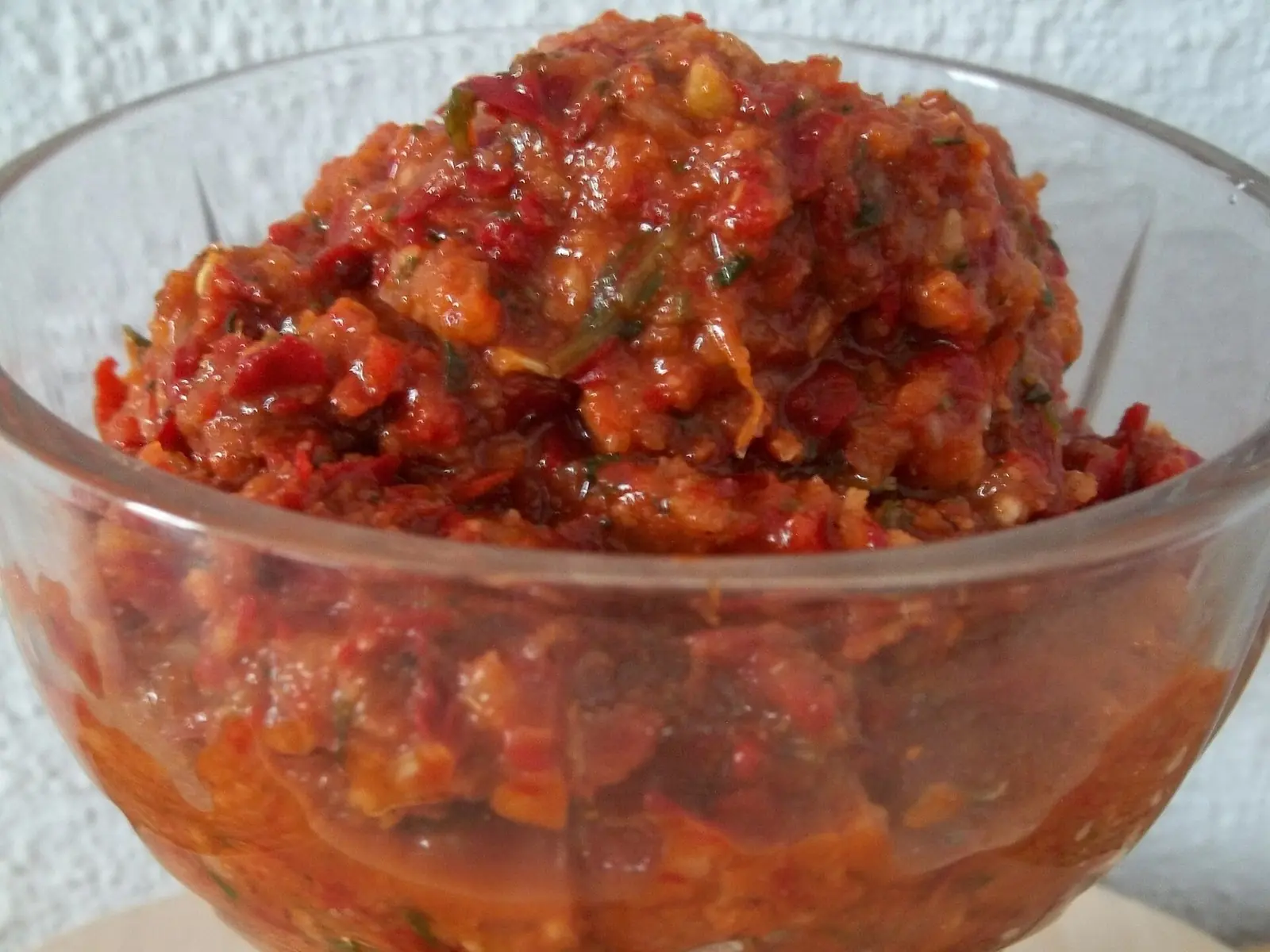
This ajika recipe makes the brick-red chilli paste of Samegrelo, in western Georgia: dried hot peppers softened in hot water, then ground with two heads of garlic, coriander seed, blue fenugreek and coarse salt until thick and glossy. Many English labels spell it adjika, and the method below shows how to make adjika the way Megrelian cooks keep it, in a jar near the stove. Think of it as a seasoning rather than a dip: one teaspoon is plenty for a plate.
If you know adjika from Russia or Ukraine, you may expect a cooked relish of tomatoes, sweet peppers, carrots and apples. That is a different product which borrowed the name. The classic Georgian paste is raw and holds no tomato, sugar or vinegar; heat, garlic, salt and the nutty smell of blue fenugreek carry it, and it sits on a spoon like a stiff pesto.
The paste reached Samegrelo from neighbouring Abkhazia and is now made all over Georgia. Its story, the green and dry kinds and where to buy a good jar are in our guide to Georgian sauces. This page starts from bought dried chillies, so you can make it in any month, and the variations add a fresh-pepper batch and green ajika.
Timeline: what to do, and when
4 h 15 min from start to table · 55 min hands-on · 3 h 30 min waiting
Each bar is one step. Hands-on Waiting, while the oven, the pot or the dough does the work. Steps that sit inside a wait are done in parallel.
Recipe
Ajika
Ingredients
Chillies
Paste
Amounts are scaled. Times stay about the same, but a bigger pot takes a little longer to come to the boil.
You will need
- Thin rubber or nitrile gloves
- Kitchen scales
- Heatproof bowl and a small plate to hold the chillies under water
- Sieve set over a jug
- Food processor, or a meat grinder fitted with its finest plate
- Mixing bowl and a wooden spoon
- Two clean 250 ml glass jars with lids
Method
- Gloves on, stalks off10 min hands-on· start here
Put on thin gloves and keep them on until the jars are full. Snap or snip the stalk off each chilli. For a hot paste leave the seeds in, as many Abkhaz and Megrelian cooks do; for a gentler one, split some pods and shake out their seeds and pale ribs. Rinse the chillies briefly in a sieve under cold water to wash off dust.
- Soak until pliable30 min waiting· starts at +10 min
Tip the chillies into a heatproof bowl, pour over 500 ml water straight off the boil and press a small plate on top so they stay submerged. Leave them for about 30 minutes, until the skins are soft and floppy and bend without cracking.
- Peel the garlic, wash the jars10 min hands-on· starts at +12 min, during step 2
Meanwhile peel the garlic and trim off any brown spots. Wash two 250 ml jars and their lids in hot soapy water, scald them with water from the kettle and stand them upside down on a clean cloth to dry. Leave a cup of boiled water to cool for later.
- Drain, keeping the liquid5 min hands-on· starts at +40 min
Lift the chillies into a sieve set over a jug and let them drip for a few minutes, pressing lightly with a spoon. Keep the soaking liquid: it is fiery and a little bitter, so you may prefer the cooled boiled water later. Fish out any loose seeds if you want less heat.
- Grind the chillies10 min hands-on· starts at +45 min
Put the chillies and half the salt in the food processor and pulse, scraping down the sides often, until finely chopped and starting to clump. With a meat grinder, feed them through the finest plate twice. Turn your face away each time you open the lid, as the fumes sting.
- Add the garlic and spices10 min hands-on· starts at +55 min
Add the garlic, coriander seed, blue fenugreek, marigold if using and the rest of the salt. Process for 3 to 4 minutes, stopping to scrape the bowl, until you have a thick, brick-red paste with no visible bits of garlic. A grinder needs two more passes to reach the same texture.
- Loosen and beat5 min hands-on· starts at +1 h 5 min
Scrape the paste into a bowl. Add 2 tbsp of the cooled water, or soaking liquid for extra fire, and beat hard with a wooden spoon for a minute or two until it turns glossy and holds its shape. Add another 1 to 2 tbsp only if it still looks dry and crumbly.
- Rest and stir3 h waiting· starts at +1 h 10 min
Cover the bowl with a plate and leave it somewhere cool, away from the stove, for about 3 hours, stirring once an hour. The salt dissolves, the garlic mellows and the colour deepens. At the end, taste a speck on bread: it should be very salty and very hot.
- Fill the jars5 min hands-on· starts at +4 h 10 min
Spoon the ajika into the dry jars, pressing it down with the back of the spoon to push out air pockets, and smooth the top. Wipe the rims, close the lids and put the jars straight in the fridge. You can use it at once, but the flavour settles and rounds out over the next 2 or 3 days.
About 13 kcal per serving (1 of 40, a heaped teaspoon, about 11 g). This is an estimate from standard values for the ingredients, not a lab figure.
Treat ajika like mustard rather than a dip. Take a little on the tip of a knife and smear it over meat or bread, or stir half a teaspoon into your bowl of beans. A small dish of it usually lasts a Georgian table the whole meal.
Tips, swaps and variations
Tips from your host
- Pick medium-hot chillies. Long, thin cayenne-type or Turkish dried chillies come closest to the peppers Megrelians dry for ajika. Tiny bird's eye chillies make a paste few people can eat; if they are all you have, use half the weight and make up the rest with mild dried peppers such as Kashmiri chillies.
- Most of the heat sits in the pale ribs and the seeds, so the number you shake out decides how hot the jar turns out. Do not throw them away: Georgian cooks grind the seeds on their own into a paler ajika that goes into walnut sauces such as bazhe.
- Chilli safety: keep gloved hands away from your eyes, nose and mouth, and do not touch contact lenses until you have washed up. If bare skin starts to burn, rub on a little cooking oil, then wash with soap and warm water; for a splash in the eye, rinse with plenty of cool running water. Wash the board, knife and processor bowl straight away.
- Use firm, dry garlic from a stored bulb. Georgian cooks keep young green garlic out of red ajika.
- A heaped teaspoon carries about 1 g of salt. When ajika goes into a stew, a marinade or a pot of beans, hold back the other salt and season only after tasting.
- For a warmer, rounder smell, toast whole coriander seed in a dry pan for a minute or two, let it cool and grind it yourself instead of using ready-ground.
Variations and swaps
- Fresh red ajika, Megrelian herb style (late summer): seed 250 g fresh hot red chillies and 250 g red peppers, then spread them on a clean tea towel with 100 g parsley, 75 g celery leaves and 75 g purple basil, all washed, and leave them overnight until every trace of water has dried. Mince everything with 150 to 200 g garlic, then, wearing gloves, work in by hand 1 1/2 tbsp each of blue fenugreek, coriander seed and marigold (all ground), 1 tbsp dill seed and about 25 g salt. It comes out greener, wetter and more herbal than the dried-pepper paste, and it keeps in the fridge for 2 to 3 weeks.
- Green ajika: seed 150 g hot green chillies and 1 green pepper (about 200 g) and pulse them with 4 garlic cloves, a big bunch of coriander (about 60 g), 20 g each of parsley and basil, a few celery leaves, 1 tbsp chopped dill, 1 tbsp ground coriander seed, 1 tbsp blue fenugreek and 2 tsp salt until rough and spreadable. Georgians spoon it over fresh cheese, eggs and boiled meat and stir it into lobio and pkhali, and a minty version flavours gebzhalia. Keep it chilled and eat it within a week or two.
- Walnut ajika: fold 60 g finely ground walnuts into the finished paste. It turns softer, rounder and a little less fierce, as Abkhaz market cooks make it, but it now contains nuts and keeps for only 2 to 3 weeks in the fridge.
- With ground chilli instead of whole pods: mix 80 g pure ground dried red chilli or Turkish pepper flakes (pul biber) with the crushed garlic, spices and salt, then beat in cooled boiled water a spoonful at a time, about 100 ml in all, until it looks like thick porridge. Process it smooth and rest it as above. Avoid chilli powder blends, which contain cumin and oregano.
- Abkhaz style: the oldest Abkhaz paste uses only chilli, garlic, salt and dried coriander, so leave out the fenugreek and marigold. Abkhaz families once dried their peppers in a hut over a smoky fire; replace 1 tbsp of the chillies with hot smoked paprika for a hint of that.
- Milder: swap up to half the hot chillies for mild dried red peppers, such as Kashmiri chillies or Spanish ñoras, and remove every seed and rib. Georgia's own product rules allow sweet pepper to stand in for part of the hot.
- Home-dried chillies: in late summer buy long fresh red chillies, thread a needle and strong cotton through the stalks and hang the strings somewhere warm, dry and airy, out of direct sun, for 3 to 4 weeks, until the pods are leathery and rattle when shaken. Then follow the main recipe.
- Spice changes: Megrelian families vary the dried spices from house to house. A teaspoon of dill seed, dried summer savory or khmeli suneli are all common additions.
Serve it with
- Mtsvadi and other grilled meat, with a small dab on the side
- Chicken or pork rubbed with ajika before roasting
- Megrelian kharcho, chashushuli and ostri, stirred into the pot
- Ghomi or elarji with slices of sulguni
- Bread with fresh cheese, or fried and boiled eggs
- Matsoni or sour cream stirred with a little ajika, as a dip
- Slices of watermelon or melon in summer, an unexpected but good match
Make ahead and storage
Ajika lives in the fridge. Keep it in a clean glass jar with the surface pressed flat, and dip in only with a clean, dry spoon. With the full 40 g of salt, this red paste keeps for 2 to 3 months; walnut and fresh-herb batches last 2 to 3 weeks and green ajika a week or two. For longer storage, freeze it in an ice-cube tray, then bag the cubes and use them within 6 months. Georgian households with very salty ajika keep it in a cool larder, but a home batch made with raw garlic and no acid should stay chilled and is not suitable for bottling in a water bath. Throw it out if you see mould or the jar smells sour or fizzes when opened.

Maspindzeli Travel, Tbilisi · private tours and cooking classes in Georgia · maspindzeli.ge · WhatsApp +995 598 74 74 54 · hello@maspindzeli.ge