- Amirani is the hero of the Amiraniani, a Georgian folk epic: a giant who kills devi and a dragon, then challenges God and is chained in a mountain.
- All year his dog wears the chain thin, and smiths once struck their anvils on the Thursday before Easter so that it would hold.
- Khevi places him under Mount Kazbek, Kartli and Kakheti on Mount Elbrus, and western Georgia ties the chained hero to Mount Khvamli.
- Prometheus Cave near Kutaisi got its name in 2010-2011, not in Soviet times.
- Do not confuse him with Amiran son of Darejan, the knight of a 12th-century prose romance attributed to Mose Khoneli.
Amirani is the Georgian Prometheus, a giant of folk legend who challenged God and was chained inside a mountain of the Caucasus. People have told his story in almost every corner of Georgia. He is the son of a hunting goddess, he kills giants and a dragon, and he carries off a maiden from the sky. Then pride undoes him. His dog licks the chain thin all year, and on one day the smiths strike their anvils and the chain grows thick again.
This guide retells the legend of Amirani in plain words and shows how it changes from Svaneti to Kakheti. It sets him beside the Greek Titan and separates him from a medieval knight with almost the same name. The last part is practical: where the story sits on the map, and how to see Mount Kazbek and Prometheus Cave on a trip.
Who is Amirani? The legend in short
Folklorists have written down about 150 versions, in prose, in verse or in both, and each valley tells the story a little differently. This outline follows the episodes most of them share.
- A goddess and a hunter
In the Svan telling his mother is Dali, the goddess of wild game, and his father a mortal hunter called Sulkalmakhi. Some say he came too early and finished growing inside a bull's stomach. He has eyes as wide as sieves and the strength of twelve oxen. - The hunt
Amirani rides out with his sworn brothers, Badri and Usup. In a tale from Racha a deer with golden horns takes their arrows without losing a drop of blood. They track it for days to a tower with no door, which Amirani kicks in. - Devi giants and the dragon
Most of his deeds are fights with devi, the many-headed giants of Georgian folklore. A dragon swallows him whole. He cuts his way out through its side. - Kamari, the sky maiden
He carries off Kamari, daughter of the lord of the clouds, who lives in a crystal tower in the sky. The historian Ivane Javakhishvili read Kamari as heavenly fire, so this may be Amirani's own theft of fire. - The challenge
With no rival left, Amirani turns on God, who in the Christian versions is also his godfather. That pride ends his adventures.
Chained in the mountain: the dog, the stake and the Holy Thursday smiths
The punishment is the heart of the legend. In a version from Racha, a poor man's son grows up weak and asks his godfather, Christ, for strength. Once he has it, he wants to wrestle Christ himself. First they test each other with an iron stake. Amirani drives it in, and Christ pulls it out with two fingers. Then Christ drives it in, and Amirani cannot move it. Christ chains him to it and sets a whole mountain over him like a house.
A dog stays with him and licks the chain all year, until only a thread of iron is left. Then, on the Thursday before Easter, a smith walks into his forge and strikes the anvil without a word. The chain is whole again. Once a year a door in the mountain opens.
This was more than a story. The poet Akaki Tsereteli wrote that smiths in his day struck the anvil three times on Holy Thursday morning, fasting and silent, to keep the stake firm. In 1894 a smith told the same tale to the British scholars Oliver and Marjory Wardrop, and Oliver's notes on it are in Oxford's Bodleian Library.
The Amiraniani: how the legend of Amirani changes by region
The cycle of tales is called the Amiraniani. Prince Teimuraz Bagrationi made the first known written record in the early 19th century. In 1947 the folklorist Mikheil Chikovani published texts from all over Georgia in a book called The Chained Amirani. Here is what tellers in each region add, from the texts in that book.
| Region | What the tellers add, and where they hold him |
|---|---|
| Svaneti | Dali is his mother. Kaji demons tie him to a staff Christ drove into the ground. Whenever he and his dog nearly pull it free, a wagtail lands on it. Amirani swings his hammer at the bird, and the staff sinks back in. |
| Racha | The golden-horned deer that does not bleed, the stake contest with Christ, and a silent smith on Holy Thursday. He lies inside a mountain whose door opens once a year. |
| Kartli | His father is Usip, and he is born with a short sword. An old woman whose jug he breaks tells him that devi hold his uncles. He is chained on Ialbuz, Mount Elbrus. |
| Kakheti | Several puppies lick the chain, not one dog. His mountain opens once in seven years, and he stays chained on Elbrus until the end of the world. |
| Pshavi and Khevsureti | Collectors also noted short sung verses about Amirani, Badri and Usup. In Pshavi a single faithful dog licks the chain. |
| Khevi (Kazbegi) | On New Year's Eve a hunter finds him on Kazbek and must fetch his hearth chain in silence. His wife asks where he is going, he answers, and the smiths' New Year blows shut the door. |
| Meskheti and Javakheti | The mountain opens once a year, and a raven brings him water. |
| Tusheti | The smiths mend the chain on Christmas Eve instead of Holy Thursday. |
Is Amirani the Georgian Prometheus? How he compares with the Greek Titan
Prince Teimuraz was the first to point out how close the two stories are. Greek writers had already agreed on the place: from Aeschylus to Strabo and Arrian, they set Prometheus's rock in the Caucasus. In the Argonaut story, the heroes hear the Titan groan and see the eagle fly over as they near Colchis.
| Amirani | Prometheus | |
|---|---|---|
| Who he is | A giant hero, son of a goddess and a hunter | A Titan, one of the old gods |
| His offence | Pride: he challenges God, his godfather | He steals fire for people and tricks Zeus |
| Fire | Only if you read Kamari as fire | The centre of the story |
| Punishment | Chained to an iron stake, often inside a mountain | Chained to a rock in the Caucasus |
| At his side | A loyal dog licking the chain; an eagle in a few versions | An eagle that eats his liver each day |
| The ending | Never freed; he still waits | Freed by Heracles |
Is Amirani older? No one can date an oral tale. Prometheus appears in Greek poetry from about 700 BC, while the first written Amirani text is from the 1800s. Georgian scholars date the core of the Amiraniani to the end of the Bronze Age. The French scholar Georges Charachidzé set Prometheus beside Amirani and the Abkhaz hero Abrskil in Prométhée ou le Caucase (1986), and argued that the Greeks drew on a Caucasian story. Fairly put, the Greek texts are older on paper, but the Greeks themselves pointed to the Caucasus.
Where the legend is placed: Kazbek, Elbrus, Khvamli and Prometheus Cave
Mount Kazbek
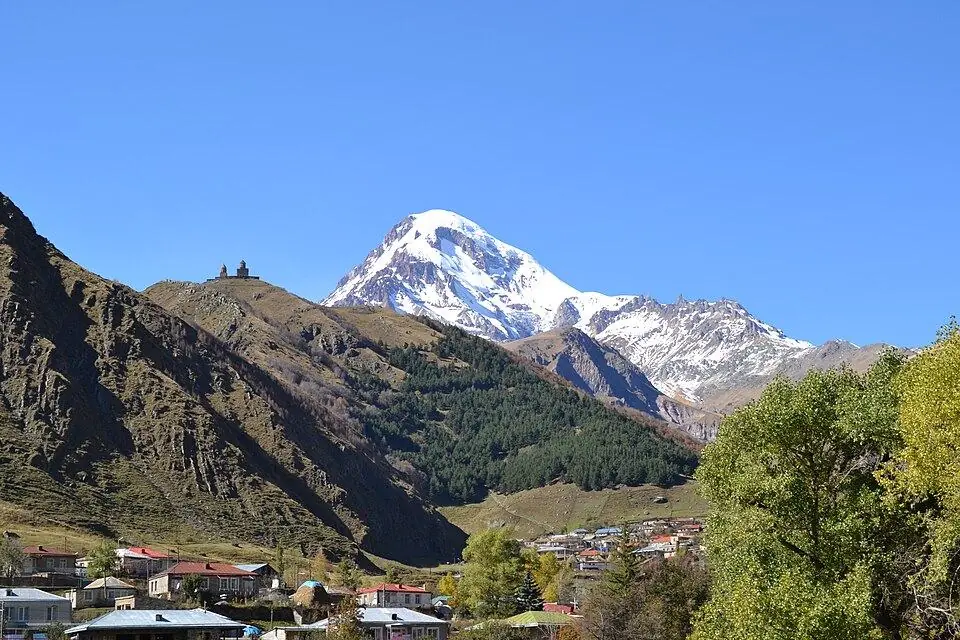
In Khevi, the valley below Kazbek, people say God chained Amirani on the slope of Mkinvartsveri, the Georgian name for the mountain. In his 1934 book on Khevi, the ethnographer Sergi Makalatia wrote that locals put Amirani's hut near Bethlemi, the holy cave high on the peak.
In August 1945 a 17-year-old from Gergeti showed Chikovani a rock on the mountain that looks, from afar, like a beast lying down. It was a dragon, he said, that crept down to eat the chained hero until St George turned it to stone. The French traveller Jacques-Francois Gamba stayed with the Kazbegi family in Stepantsminda in 1820. He noted that people took the peak facing their house for Prometheus's rock.
Elbrus and Mount Khvamli
Tellers in Kartli and Kakheti chain Amirani on Ialbuz, which is Mount Elbrus, today in Russia. In the west the candidate is Mount Khvamli, a 2,002 m limestone massif full of caves on the edge of Lechkhumi. The national tourism agency calls it the mountain where the Titan was bound, and Jules Verne used the same tradition in an 1883 novel.
Prometheus Cave
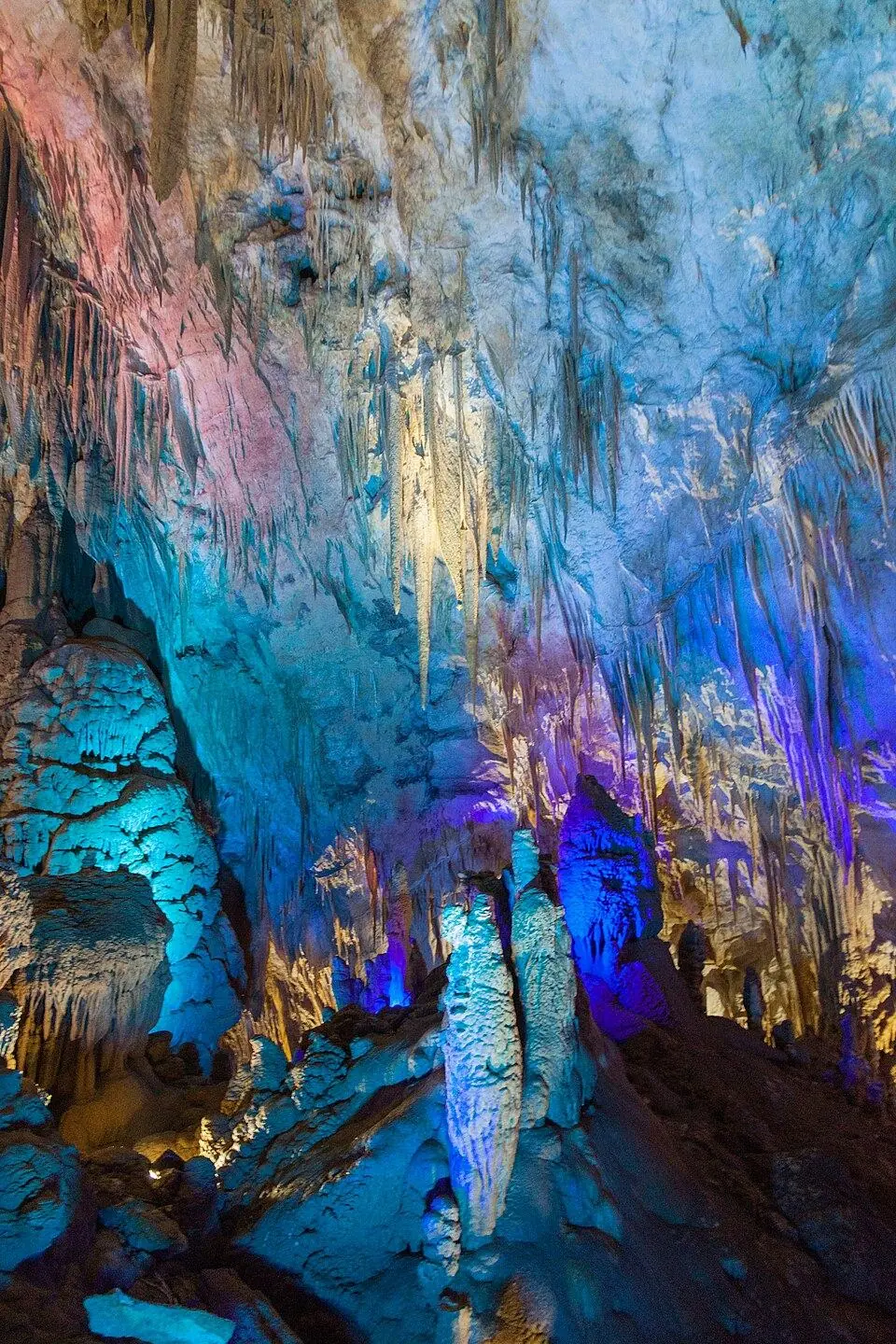
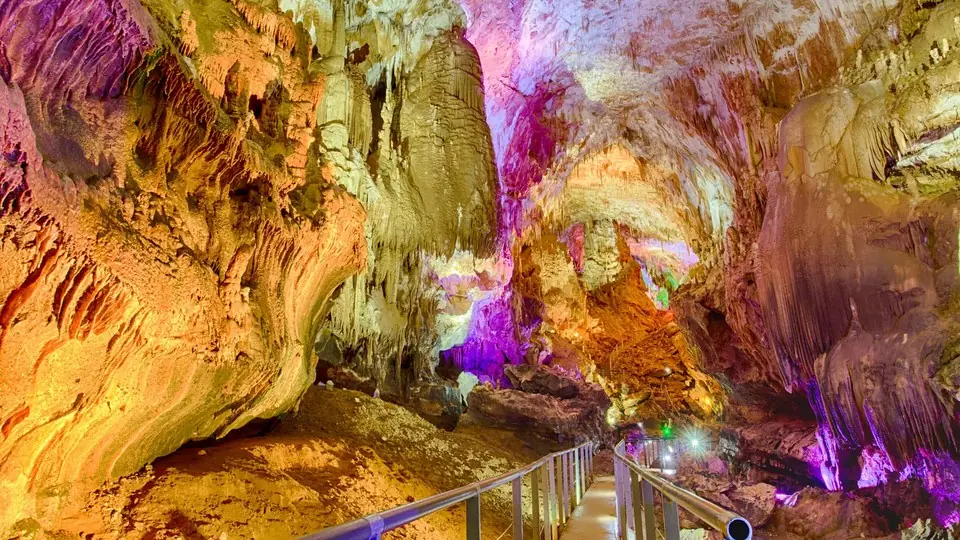
The show cave near Tskaltubo was called Kumistavi when cavers explored it in the 1980s. It took the name Prometheus in 2010, because local legend chains the Titan to the Khvamli cliffs to the north. The cave reopened as Prometheus Cave on 26 May 2011.
Amirani is not Amiran son of Darejan: the Amiran-Darejaniani
Two heroes share almost one name, and many websites mix them up. Amirani of the folk legend is a pagan giant chained by God. Amiran Darejanisdze, Amiran son of Darejan, is a knight in the Amiran-Darejaniani, a 12th-century prose romance told in twelve chapters called gates.
Its author is said to be Mose Khoneli, from Khoni in western Georgia. His only mention is in the epilogue of Shota Rustaveli's Knight in the Panther's Skin. His Amiran fights devi and sorcerers across an imagined East of India, Baghdad and Yemen. He is never chained and never defies God. Some scholars think the folk Amirani lent the romance its hero's name and some of its monsters.
You can see the romance on a church wall in Svaneti. At Lashtkhveri, a village in the Lenjeri community just west of Mestia, 14th- to 15th-century paintings on the outer north wall show scenes from it.
Amirani in Georgian poetry and art
Writers of the 19th and 20th centuries made the chained giant a symbol of Georgia pulling at its own chains. Akaki Tsereteli, Vazha-Pshavela and Galaktion Tabidze all used him that way. In 1989 the Soviet post put the Amiraniani on a stamp, in a series on the epics of the Soviet peoples.
Public statues are rare. A tall Amirani with a sword and a torch, made by the sculptor Vakhtang Oniani in 1980, once greeted drivers at the Nukriani entrance to Sighnaghi. It was lost when the town was renovated, so do not go looking for it. A volcano on Jupiter's moon Io carries his name.
Where to find Amirani on a trip: Kazbegi, Kutaisi and Sataplia
Kazbegi: the mountain of the chained hero
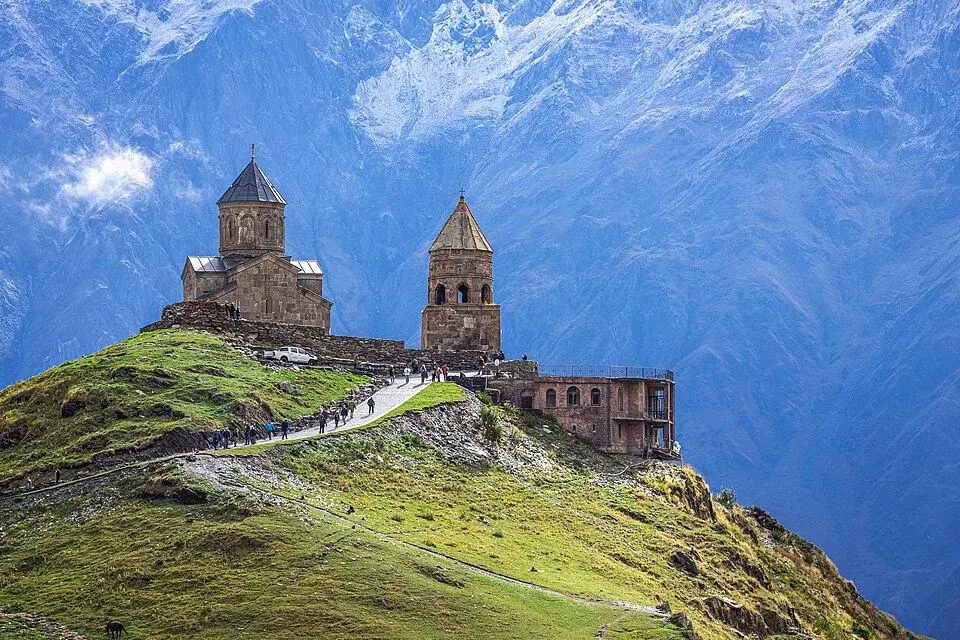
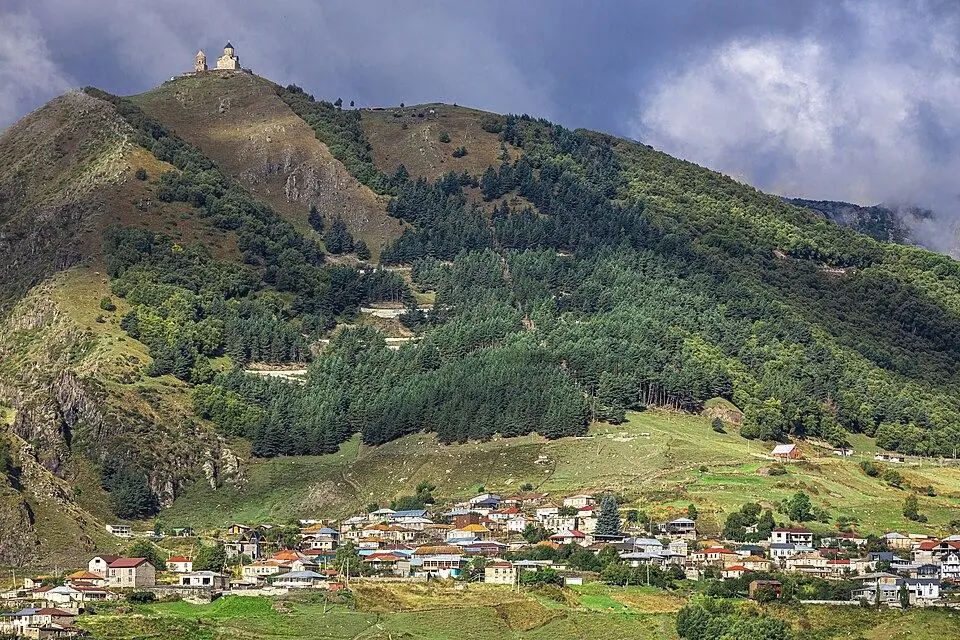
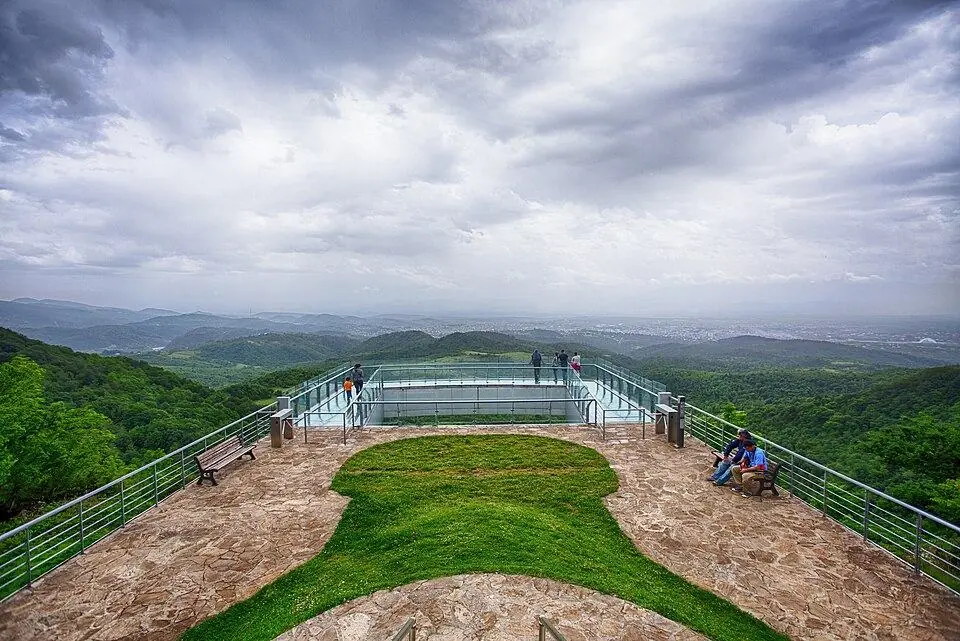
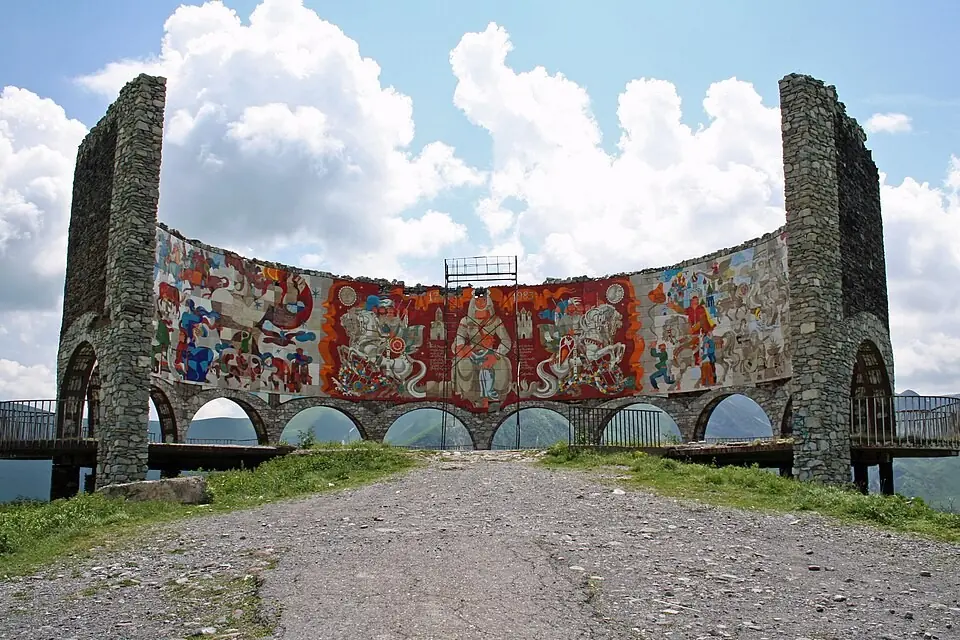
For the Kazbek side of the legend, head to Stepantsminda, ~155 km north of Tbilisi and about 3 hours by car. From Gergeti Trinity Church, at 2,170 m, you look straight at the summit and the snowfields where Khevi places Amirani's prison. The Gergeti Glacier trail takes walkers closer. Bethlemi, at ~4,000 m, is for roped climbers only (see our guide to climbing Kazbek).
On our private Kazbegi Day Trip you leave Tbilisi on the Georgian Military Road, stop at Ananuri fortress and cross the Jvari Pass, then switch to a 4x4 for the climb to the church. The date is yours to set, any group size works, and your guide talks with you in your own language.
Kutaisi: Prometheus Cave and Sataplia
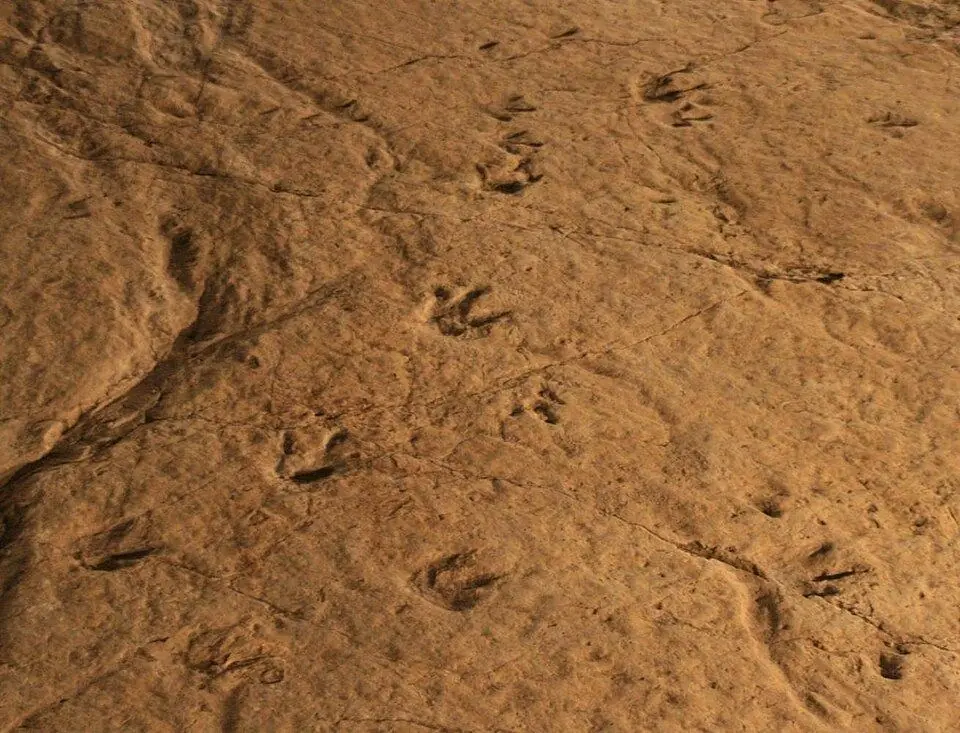
Prometheus Cave lies ~20 km north-west of Kutaisi, and one of its six open halls carries the Titan's name. In 2026, entry for a foreign adult came to about 40 GEL (about $15), guide included. Sataplia, about 20 minutes away, adds dinosaur tracks and a glass deck over the forest. Our caves and monasteries day trip links both with Gelati and Motsameta, privately and on your dates.
Amirani legend: questions people ask
Who is Amirani in Georgian mythology?
He is the hero of the Amiraniani, Georgia's best-known folk epic: a giant son of the hunting goddess Dali who kills devi and a dragon. Then he challenges God and is chained inside a Caucasus mountain.
Why is Amirani called the Georgian Prometheus?
Both are bound in the Caucasus for defying the highest god, and Greek writers set Prometheus's rock in the same range. But Amirani is punished for pride, not for stealing fire, and no Heracles frees him.
Where is Amirani chained?
It depends on who tells it. In Khevi he lies under Mount Kazbek, in Kartli and Kakheti on Mount Elbrus, and in western Georgia the chained hero is placed on Mount Khvamli in Lechkhumi.
What is the story of Amirani's dog?
A loyal dog licks the chain all year until it is almost worn through. Then smiths strike their anvils and it is whole again: on the Thursday before Easter in most regions, at New Year in Khevi and on Christmas Eve in Tusheti.
Is Amirani the same as the hero of the Amiran-Darejaniani?
No. The Amiran-Darejaniani is a 12th-century prose romance about a knight, Amiran son of Darejan. The folk Amirani is a pagan giant punished by God.
Is Prometheus Cave connected to the Amirani legend?
Only through its name, given in 2010-2011 because local legend chains the Titan on the Khvamli cliffs to the north. Inside you find stalactites, not a chained hero.