Badrijani Nigvzit Recipe
ბადრიჯანი ნიგვზით
A home-style badrijani nigvzit recipe: salted aubergine slices fried until soft and golden, spread with a walnut, garlic and coriander paste, rolled up and finished with pomegranate seeds. Vegan, fine for Lent, and best made a few hours ahead.
Recipe by the Maspindzeli team in Tbilisi · Updated 9 Nov 2026 · Made everywhere; often credited to Imereti
Full recipe with the timeline, timers and US measures: maspindzeli.ge/recipes/badrijani-nigvzit/
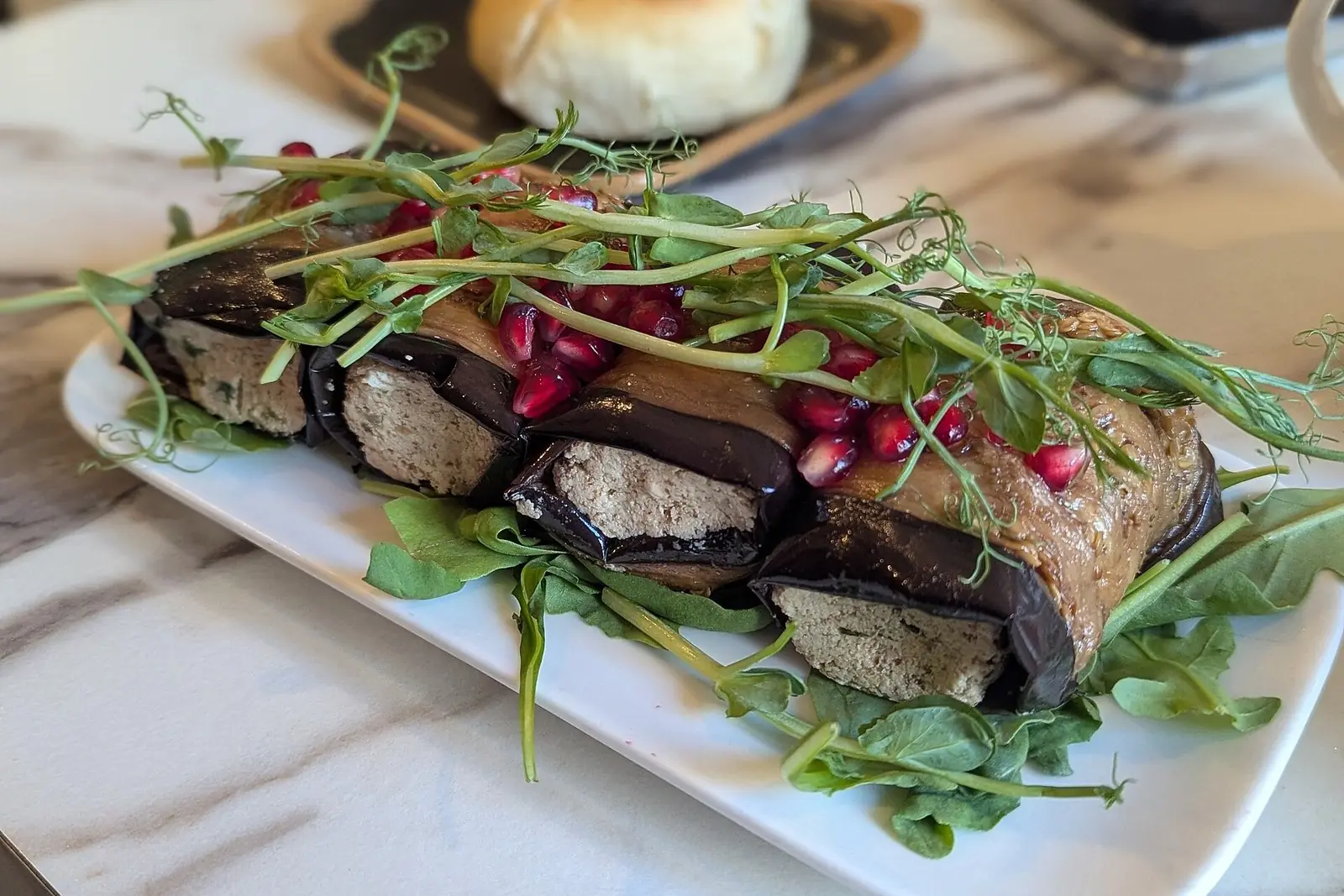
This badrijani nigvzit recipe makes the Georgian aubergine rolls that appear at nearly every Georgian feast: long, thin slices of aubergine fried until tender, spread with a paste of ground walnuts, garlic, coriander and blue fenugreek, rolled up and scattered with pomegranate seeds. The name means aubergine with walnuts. You will also see it as nigvziani badrijani (walnut aubergine), and English menus call it Georgian eggplant rolls or eggplant with walnuts. Most Georgians just say badrijani.
Georgia's national tourism office files it under western Georgian cooking and gives the credit to Imereti, though today every region makes it and recipes vary from house to house. Some cooks add onion or a pinch of cinnamon, some fold the slices instead of rolling them, and local aubergines are in season from June to November, so summer and autumn tables see it most.
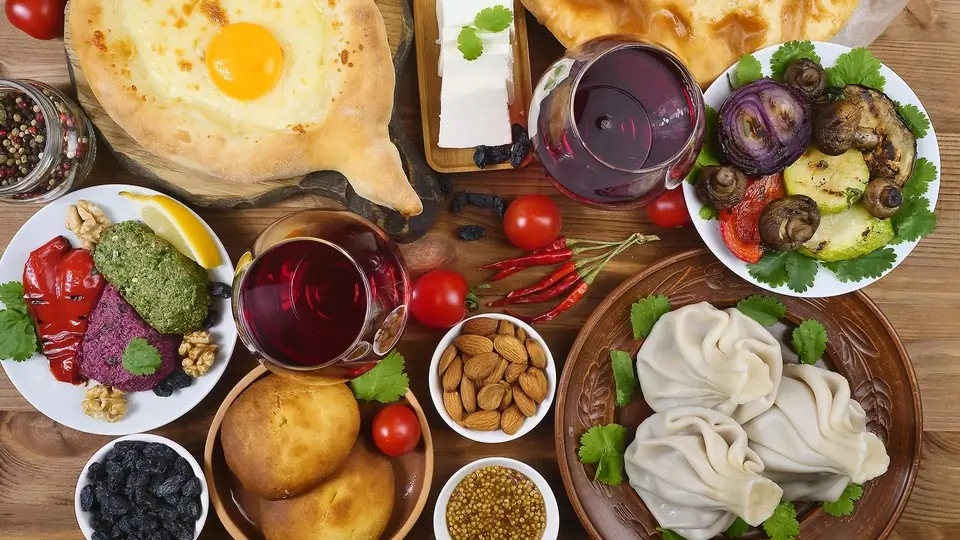
Badrijani is a cold starter. It waits on the table with pkhali, cheese and bread before the hot dishes come out, and it tastes better after an hour or two of rest. Made with oil and no animal products, it is vegan and fits the Orthodox fasting days many Georgians keep, Lent included.
Timeline: what to do, and when
2 h 45 min from start to table · 1 h 20 min hands-on · 1 h 45 min waiting
Each bar is one step. Hands-on Waiting, while the oven, the pot or the dough does the work. Steps that sit inside a wait are done in parallel.
Recipe
Badrijani Nigvzit
Ingredients
Aubergines
Walnut filling
To finish
Amounts are scaled. Times stay about the same, but a bigger pot takes a little longer to come to the boil.
Contains: walnuts (tree nuts).
You will need
- Long, very sharp knife or a mandoline
- 2 large trays or platters lined with kitchen paper
- Large heavy frying pan (about 28 cm)
- Food processor, hand-cranked mincer or large mortar and pestle
- Mixing bowl
- Fish slice or tongs
- Serving platter
Method
- Slice and salt10 min hands-on· start here
Cut off the stalks. If you like, peel two or three narrow strips of skin from top to bottom of each aubergine, as Imeretian cooks do, so the slices bend without splitting. Cut each one lengthwise into slices about 6 mm thick and set the two skin-covered end pieces aside for another dish. Lay the slices on the lined trays and sprinkle both sides with the 2 tsp salt.
- Let them sweat30 min waiting· starts at +10 min
Leave the slices for 30 minutes. Brown beads of liquid will appear on the cut faces. With that water gone, the aubergine browns in the pan rather than stewing, and it takes up noticeably less oil.
- Grind the walnuts8 min hands-on· starts at +10 min, during step 2
Meanwhile, put the walnuts and peeled garlic in the food processor and pulse in short bursts, scraping down the sides once or twice, until the crumbs are very fine and start to cling together. A hand-cranked mincer, the usual tool in Georgian kitchens, does the job if you feed the nuts through twice; a big mortar works too, a handful at a time.
- Season the paste7 min hands-on· starts at +18 min, during step 2
Tip the ground nuts into the bowl and stir in the coriander seed, blue fenugreek, marigold, red pepper, vinegar, grated onion (if using) and 1/2 tsp salt. Beat in about 80 ml of the water, then more a spoonful at a time, until the paste spreads easily but does not run, a little firmer than hummus. Fold in most of the chopped coriander and save a few leaves for the top.
- Blot the slices5 min hands-on· starts at +40 min
Press each slice gently between sheets of kitchen paper or in a clean tea towel to soak up the salty liquid. Do not wring them: they need to stay flat and whole for rolling.
- Fry in batches25 min hands-on· starts at +45 min
Heat 3 tbsp oil in the large pan on a moderate flame until a test slice hisses the moment it goes in. Fry the aubergine in a single layer for 3 to 4 minutes a side, until both faces are golden and the flesh is soft right through, with no pale, spongy patches. Lift each batch onto fresh kitchen paper and add more oil only when the pan looks dry.
- Cool15 min waiting· starts at +1 h 10 min
Leave the fried slices on the paper until they are cool enough to handle easily. Warm slices are floppy and tear when you roll them.
- Seed the pomegranate5 min hands-on· starts at +1 h 12 min, during step 7
While the aubergine cools, halve the pomegranate across its middle, hold one half cut side down over a bowl and knock the skin firmly with a wooden spoon until the seeds fall out. Remove any yellowish membrane. Taste the walnut paste once more and adjust the vinegar, chilli or salt.
- Spread and roll15 min hands-on· starts at +1 h 25 min
Lay a slice on the board with its wider end towards you. Spread about 1 tbsp of paste over it in an even layer, leaving about 1 cm bare at the far end, then roll it up away from you, firmly but without squeezing. Set it on the platter seam side down and carry on with the rest. Spoon any leftover paste in a thin line along the tops.
- Let the flavours settle1 h waiting· starts at +1 h 40 min
Cover the platter and put it in the fridge for 1 hour, or up to 3 hours. In that time the raw garlic mellows, the vinegar works into the aubergine and the rolls firm up so they lift cleanly.
- Garnish and serve5 min hands-on· starts at +2 h 40 min
Scatter the pomegranate seeds and the saved coriander leaves over the rolls, pressing a few seeds into the paste at the open ends so they stay in place. Serve cool rather than cold; after a longer spell in the fridge, give them 15 to 20 minutes on the counter first.
About 450 kcal per serving (about 3 rolls, 1 of 6). This is an estimate from standard values for the ingredients, not a lab figure.
At a supra badrijani is finger food. Take two or three rolls onto your plate with a piece of bread, eat each one in a couple of bites and make sure a few pomegranate seeds come with every mouthful.
Tips, swaps and variations
Tips from your host
- Choose long, slim aubergines that feel heavy for their size and have tight, glossy skin. Fat round ones give short, wide slices with a seedy middle that cracks when you roll it.
- Keep the slices between 5 and 8 mm thick. Thinner ones break up in the pan, thicker ones stay spongy in the centre and spring open again. A mandoline or a long, very sharp knife makes even slices far easier.
- Cook the aubergine until it is completely soft. Undercooked slices squeak against your teeth and refuse to stay rolled, so press the thickest part with a spatula before you lift it out: it should give without any bounce.
- Never crowd the pan. Too many slices at once cool the oil, and the aubergine sits there drinking it instead of browning. Several smaller batches are quicker in the end.
- Before any water goes into the filling, work the ground walnuts hard with your hand for a few minutes. A little golden oil will gather at the edge of the bowl; spoon it off and drizzle it over the rolls just before serving, a western Georgian finishing touch that gives them a shine and a deeper nutty taste.
- Salt the filling last. The slices take up salt while they sweat, so roll one, taste it, and only then decide whether the paste needs more.
Variations and swaps
- Oven-baked, with less oil: brush the blotted slices on both sides with 4 tbsp oil in all, spread them over two trays lined with baking paper and give them 20 to 25 minutes in the oven at 200 °C / 390 °F (fan oven 180 °C / 355 °F), turning each slice once, until soft and patched with gold. They are a little drier and lighter than fried slices but roll just as well. A ridged griddle pan or a barbecue works too.
- Folded instead of rolled, the traditional shape: spread paste over one half of each slice, fold the other half over and smear a little more on top. It suits slightly thicker slices and is quicker for a big supra.
- Imeretian spicing: add a small pinch each of ground cinnamon and ground cloves to the paste. Some families also add chopped parsley and celery leaves with the coriander, or a spoonful of chopped basil.
- With pomegranate in the filling: swap half the vinegar for fresh, sour pomegranate juice, or knead a spoonful of seeds into the paste, for a fruitier, faintly pink filling. Pomegranate molasses is another option, 1 tsp at most, though it sweetens the filling.
- Whole stuffed aubergines: in late autumn, when the harvest is ending and only small aubergines are left, cooks slit them lengthwise without cutting through, salt them, fry them whole and pack the pocket with walnut paste. Leave the stalks on for a neat finish.
- Torn aubergine with walnuts (atsetsili badrijani): for an everyday version, skip the rolling. Tear the fried or baked aubergine into strips by hand and toss it with the paste in a bowl.
- Short of Georgian spices: use 1 1/2 to 2 tsp khmeli suneli instead of the three separate spices (coriander seed, utskho suneli and marigold), or swap the blue fenugreek for 1/2 tsp ground fenugreek seed and the marigold for a tiny pinch of turmeric.
Serve it with
- Spinach or beetroot pkhali, for a plate of cold walnut starters
- Shoti bread or mchadi cornbread
- Georgian tomato and cucumber salad
- Lobio, for a meatless fasting-day spread
- Fresh herbs, pickled jonjoli and, outside fasting days, sulguni
- Mtsvadi later in the meal, if you are feeding meat eaters
Make ahead and storage
Covered in the fridge, the rolls keep for 2 days. By the second day the aubergine is even softer and the garlic louder, which some people prefer. To work in stages, fry the slices up to a day ahead and keep them flat between sheets of baking paper, and make the paste up to 2 days ahead; roll on the day. Add the pomegranate just before serving and let chilled rolls stand for a while so the walnut flavour comes back. They do not freeze well: thawed aubergine weeps and the filling loses its smooth texture.


Maspindzeli Travel, Tbilisi · private tours and cooking classes in Georgia · maspindzeli.ge · WhatsApp +995 598 74 74 54 · hello@maspindzeli.ge