Guruli Khachapuri Recipe
გურული ღვეზელი
A home-style guruli khachapuri recipe for four Gurian Christmas pies: a soft yeast dough wrapped around Imeretian cheese and hard-boiled egg halves, shaped into crescents, glazed with yolk and baked hot. Allow about 2 hours 40 minutes, most of it rising time.
Recipe by the Maspindzeli team in Tbilisi · Updated 14 Nov 2026 · From Guria, around Ozurgeti in western Georgia
Full recipe with the timeline, timers and US measures: maspindzeli.ge/recipes/guruli-khachapuri/
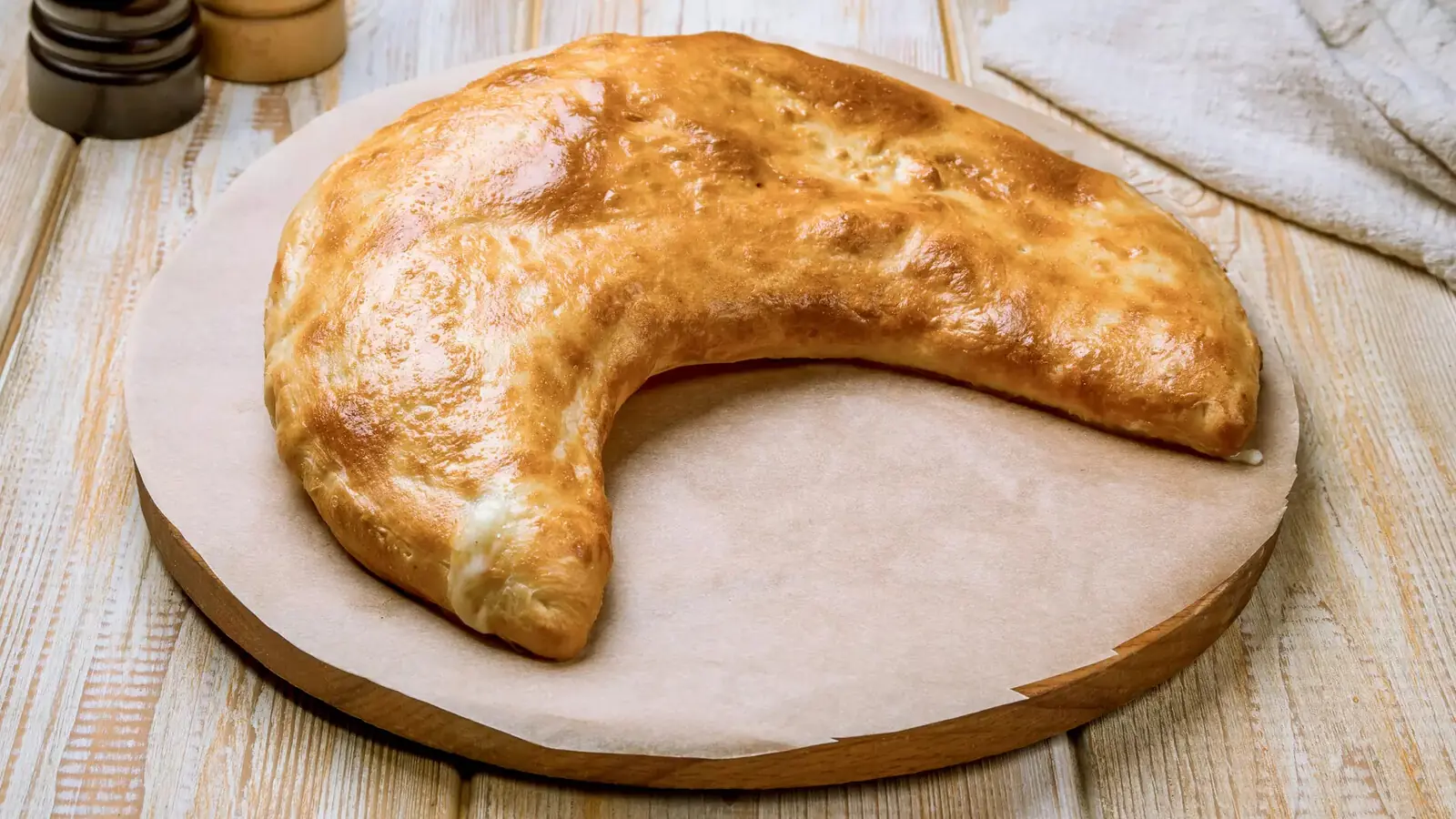
This guruli khachapuri recipe makes the crescent-shaped cheese and egg pies of Guria, a small, green region of western Georgia that runs down to the Black Sea. A soft yeast dough, mixed with half milk and half water, goes around crumbled Imeretian cheese and halved hard-boiled eggs, then gets bent into a crescent, brushed with yolk and baked until deep gold. Georgians call it guruli ghvezeli (also written gvezeli), which simply means Gurian pie, and in Guria it is often just the sashobao ghvezeli, the Christmas pie. Menus in Tbilisi and abroad list it as Gurian khachapuri.
Its day is 7 January, Orthodox Christmas in Georgia, when these pies were traditionally the first thing eaten after the 40-day Nativity fast. The dough used to be kneaded the evening before. Many families still bake one pie per person, smaller ones for the children, and a big one with extra eggs goes in the middle of the table. Some households tuck a coin or a nut into one of them for luck. The customs and the rest of the holiday table are in our Georgian Christmas guide.
You do not have to wait for January. Bakeries all over Georgia stock Gurian khachapuri around the holidays, a few in Tbilisi keep it all year, and since the pie is sealed it survives a lunch box far better than an open khachapuri. If you have made Imeruli, the cheese is the same; what is new here is the yeast dough, the eggs and the fold.
Timeline: what to do, and when
2 h 40 min from start to table · 1 h 3 min hands-on · 1 h 35 min waiting
Each bar is one step. Hands-on Waiting, while the oven, the pot or the dough does the work. Steps that sit inside a wait are done in parallel.
Recipe
Guruli Khachapuri
Ingredients
Yeast dough
Cheese and egg filling
Glaze
Amounts are scaled. Times stay about the same, but a bigger pot takes a little longer to come to the boil.
Contains: gluten (wheat), milk, egg.
You will need
- Large mixing bowl
- Small saucepan for the eggs
- Rolling pin (optional; your palms work too)
- 2 large baking trays and baking paper
- Pastry brush
- Fork and a small bowl for the glaze
Method
- Make the dough20 min hands-on· start here
Heat the milk and water to about 38 °C / 100 °F, which feels barely warm on your wrist. Whisk in the sugar and yeast and give it 5 minutes to turn frothy. Put the flour in a large bowl with the salt, hollow out the centre, add the frothy liquid and the melted butter and bring it together with a spoon, then by hand. Turn it onto a floured board and knead for 8 to 10 minutes: it is ready when it feels silky, soft and barely sticky. Gurian cooks like this dough tender and pliable, never stiff.
- Let it rise1 h 15 min waiting· starts at +20 min
Shape the dough into a ball, return it to the bowl rubbed with a little oil, cover with a cloth and leave somewhere warm, around 25 °C / 75 °F, until doubled. That takes about an hour in a warm room and up to an hour and a half in a cool winter kitchen.
- Boil the eggs15 min waiting· starts at +30 min, during step 2
Meanwhile, put the 6 eggs in a small pan, cover them with cold water and bring to the boil. Turn the heat down and simmer for 9 to 10 minutes, so the yolks set right through.
- Peel and halve the eggs8 min hands-on· starts at +45 min, during step 2
Tip the eggs into a bowl of cold water for a few minutes, then peel them. Pat each one completely dry with kitchen paper and cut it in half lengthways.
- Prepare the cheese10 min hands-on· starts at +53 min, during step 2
Taste the cheese for salt (see the tips), then break it into small crumbs with your fingertips; a firm cheese is easier on the coarse side of a grater. Split it into 4 equal heaps of roughly 150 g.
- Divide the dough5 min hands-on· starts at +1 h 35 min
Heat the oven to 220 °C / 430 °F (200 °C / 390 °F fan) and line 2 baking trays with baking paper. Press the air out of the risen dough. For the traditional Christmas crosses, pinch off a walnut-sized piece and keep it covered, then cut the rest into 4 equal pieces of about 210 g and roll each into a smooth ball.
- Rest the balls15 min waiting· starts at +1 h 40 min
Cover the balls with a tea towel for about 15 minutes. Rested like this, they open out easily under your hands instead of shrinking back.
- Shape the crescents16 min hands-on· starts at +1 h 55 min
Take one ball at a time and press it out with your palms, or roll it, into a round about 22 cm across and 4 to 5 mm thick. Scatter two-thirds of a cheese portion over one half, leaving a clean 2 cm rim, lay 3 egg halves cut side down in a gentle curve along the middle and cover them with the rest of that portion. Fold the bare half over, press the edges together, then pinch and roll the rim inwards so it is tightly sealed. Lift the pie onto a lined tray and bend it so the two ends curve towards each other.
- Glaze and decorate4 min hands-on· starts at +2 h 11 min
Beat the yolk with the matsoni and brush it over the tops and sides. If you kept back some dough, roll it into thin strands, lay a small cross on each pie and glaze the crosses too. Prick every crescent twice with a fork so the steam can escape.
- Bake20 min waiting· starts at +2 h 15 min
Bake for 18 to 22 minutes, until the pies are an even, deep gold on top and browned underneath. With two trays in a fan oven, swap them over halfway through.
- Rest and serve5 min waiting· starts at +2 h 35 min
Leave the crescents on a board for 5 minutes so the melted cheese firms up a little. Serve them warm, whole or cut across into thick slices that show the egg inside.
About 1,100 kcal per crescent (1 of 4). This is an estimate from standard values for the ingredients, not a lab figure.
At a Gurian Christmas each person gets a whole crescent of their own, eaten warm from the hand. Start at one tip and work towards the middle, where the eggs sit thickest; on a shared table, cut it across into slices instead.
Tips, swaps and variations
Tips from your host
- Taste a crumb of cheese before anything else. It should be clearly seasoned, because the dough carries very little salt, yet milder than a cheese you would eat on its own, and Gurian cooks choose a less salty one for this pie. If it is sharp, slice it and soak it in cold water for an hour or two, then squeeze it dry. Start the soak as soon as the dough goes to rise.
- Dry the peeled eggs well, as wet whites steam inside the pie and loosen the filling. Old Gurian households smoked boiled eggs by the hearth for a couple of days before Christmas; for a hint of that, roll them in a hot pan with a little butter or oil for 3 to 4 minutes until lightly golden, the way many cooks in Guria do now.
- Keep cheese off the rim. A greasy or floury edge will not stick, so dab it with a drop of water if it looks dry, and seal it twice: press it flat first, then pinch and fold it over itself like a rope.
- Bend the pie into its crescent only once it sits on the tray. Curved on the worktop, it tends to tear or straighten out when you lift it.
- Do not take the pies out too early. A pale crust often hides a band of raw dough next to the filling, so lift one with a spatula and check that the base is golden brown.
- For children, make small pies from 100 g of dough, 70 g of cheese and one egg; they need about 15 minutes in the oven. In Guria the Christmas pies were traditionally sized to suit each person.
Variations and swaps
- Cheese outside Georgia: mix equal weights of low-moisture mozzarella and feta, or two parts mozzarella to one of feta when the feta is very salty. Brynza, or a farmer's cheese from a Polish or Russian deli, is fine too once you have tasted it for salt, and plenty of Georgian cooks blend in some sulguni (sold abroad as suluguni) for extra stretch.
- Chopped egg filling: rather than laying halves on the cheese, chop the boiled eggs roughly and stir them through it. Many Georgian cooks fill the pie this way, and the slices cut more evenly.
- One or two big pies: Gurian families also bake a large crescent to share. Split the dough in half, roll each piece to about 32 cm, fill it with half the cheese and 3 halved eggs and bake for 25 to 30 minutes.
- Richer dough: some home recipes beat an egg into the warm liquid. Use 100 ml water instead of 150 ml and the crumb comes out a little more golden and cake-like.
- Glaze: a yolk beaten with matsoni is the Gurian habit, but sour cream or milk does the same job. For a softer, shinier crust, brush the pies with melted butter as they leave the oven.
- Ready-made dough: in Georgia plenty of people buy fresh yeast dough from the neighbourhood bakery for holiday baking. About 850 g of plain bread or pizza dough, brought to room temperature, can replace the homemade dough.
- Crisper base: slide the pies, still on their paper, onto a pizza stone or baking steel that has heated in the oven for 40 minutes. The underside browns faster this way, so check it after 15 minutes.
Serve it with
- Satsivi, poultry in walnut sauce, on the Christmas table
- Roast pork with ajika
- Pickles (mzhave), especially jonjoli and green tomatoes
- Fresh herbs, radishes and spring onions
- Black tea from the Gurian tea gardens, or a glass of dry white wine
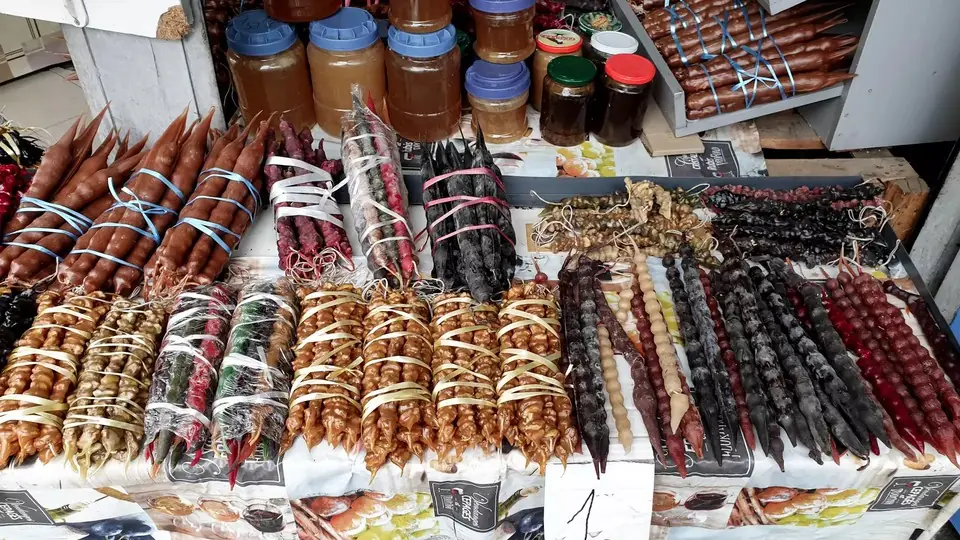
- Gozinaki and churchkhela to finish
Make ahead and storage
Gurian pies are at their best warm, within a couple of hours of baking. Because of the boiled eggs, wrap leftovers once they are cool, keep them in the fridge and finish them within 2 days. Cold slices make a good packed lunch, or warm whole ones through in a moderate oven, 180 °C / 355 °F, for around 10 minutes. To get ahead, boil the eggs and crumble the cheese the day before, or let the dough rise slowly in the fridge overnight and leave it out for an hour before you shape it. Freezing is not a good idea, because boiled egg white turns rubbery.


Maspindzeli Travel, Tbilisi · private tours and cooking classes in Georgia · maspindzeli.ge · WhatsApp +995 598 74 74 54 · hello@maspindzeli.ge