Chanakhi Recipe
ჩანახი
A home-style chanakhi recipe: fatty lamb layered in clay pots with onion, potato, aubergine stuffed with garlic and herbs, and ripe tomatoes, then baked slowly with only a splash of water until the vegetables have made their own sauce. One large casserole works too.
Recipe by the Maspindzeli team in Tbilisi · Updated 6 Nov 2026 · Cooked everywhere; best when aubergines and tomatoes are in season
Full recipe with the timeline, timers and US measures: maspindzeli.ge/recipes/chanakhi/
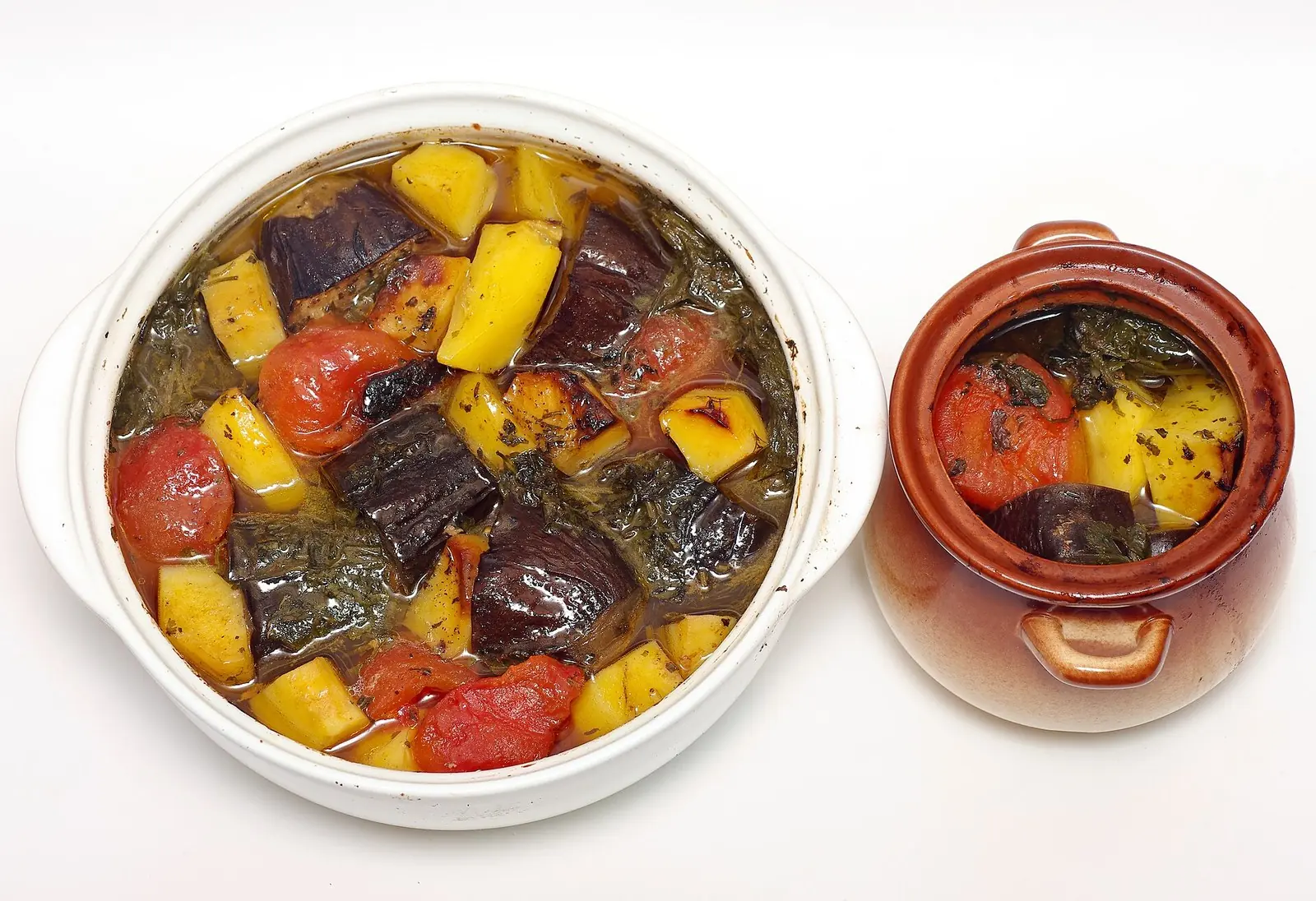
This chanakhi recipe makes the Georgian dish of lamb and summer vegetables baked in clay pots. Raw chunks of fatty lamb go in at the bottom, then onion, potato, aubergine with a pocket of garlic, herbs and fat, and whole ripe tomatoes on top. Almost no water is added. During a long, slow spell in the oven the tomatoes and aubergine slump into a herby, golden juice around meat that falls apart under a spoon. You may also see the name written chanahi, and some English cookbooks call it Georgian lamb and vegetable stew.
Traditionally every person gets a pot of their own, although plenty of Georgian families layer one big pot instead. The name is usually traced to çanak, a Turkish word for a bowl or an earthenware pot. Armenia and Azerbaijan bake lamb in individual pots as well, and the questions at the end of the page explain how those dishes differ. It is at its best in late summer and autumn, when aubergines and tomatoes are ripe and cheap.
The method below shows how to make chanakhi the way most Georgian home recipes do: everything goes in raw and nothing is stirred. Some Georgian cookbooks fry each part first and fill the aubergines with crisp bits of tail fat, and that richer version is in the variations. No clay pots? A heavy lidded casserole gives a very similar result.
Timeline: what to do, and when
3 h 50 min from start to table · 1 h 10 min hands-on · 10 min waiting
Each bar is one step. Hands-on Waiting, while the oven, the pot or the dough does the work. Steps that sit inside a wait are done in parallel.
Recipe
Chanakhi
Ingredients
Lamb
Vegetables
Herbs and seasoning
Amounts are scaled. Times stay about the same, but a bigger pot takes a little longer to come to the boil.
You will need
- 4 lidded clay pots of 800 ml to 1 litre each, or one heavy casserole of 4 to 5 litres with a lid
- Baking tray to stand the pots on
- Sharp knife and a large chopping board
- Colander
- Small bowl for the stuffing
- Oven gloves, plus a wooden board or folded tea towel to put the hot pots on
Method
- Cut and salt the aubergines10 min hands-on· start here
Trim off the stalks and cut each aubergine across into 3 or 4 chunky pieces about 5 cm long. Cut a deep slit along one side of every piece to make a pocket, without going right through. Rub 1 tsp salt over them, inside the pockets too, and leave them in a colander.
- Let them sweat20 min waiting· starts at +10 min
Leave the aubergines for 20 minutes. Brown drops of juice will gather on the cut sides and the flesh turns a little floppy, which makes the pockets easier to fill.
- Prepare the lamb and vegetables15 min hands-on· starts at +10 min, during step 2
Cut the lamb into pieces of about 4 cm, keeping the fat on, and toss them with 1 tsp salt, the black pepper and the ground coriander. Peel the potatoes and cut them lengthways into halves or quarters. Slice the onions into thick rings, halve any large tomatoes and slice the chilli.
- Make the stuffing10 min hands-on· starts at +25 min, during step 2
Chop the tail fat very finely and set a third of it aside for the bottom of the pots. Chop the coriander, basil and parsley, coriander stalks included, and keep a big handful for the end. Finely chop 4 garlic cloves and mix them with the rest of the fat, half of the remaining herbs and a pinch of salt into a rough green paste.
- Stuff the aubergines10 min hands-on· starts at +35 min
Squeeze each piece of aubergine gently over the sink to press out the brown juice, then pat it dry. Push a heaped teaspoon of the stuffing deep into every pocket.
- Layer the pots15 min hands-on· starts at +45 min
Share everything between the four pots in this order: the reserved fat, the lamb, the onion rings, the potatoes, then the stuffed aubergines with the chilli and the last of the chopped herbs (not the handful kept for the end). Finish with the tomatoes, cut side down, and add a pinch of salt over the potatoes and the tomatoes as you go. Press down firmly so the pots are full to the rim, pour 2 tbsp water into each and put the lids on.
- Bake, starting from a cold oven2 h 15 min waiting· starts at +1 h
Stand the pots on a baking tray and slide it into the cold oven. Set the oven to 180 °C / 355 °F (160 °C / 320 °F fan) and leave the pots covered for 2 hours 15 minutes; clay heats slowly, and it can take 40 minutes or more before the juices start to bubble under the lids. Do not open or stir them.
- Chop the garlic for the top5 min hands-on· starts at +3 h 5 min, during step 7
Near the end of the baking time, finely chop the last 2 garlic cloves and mix them with half of the herbs you kept back.
- Check the lamb and uncover5 min hands-on· starts at +3 h 15 min
Take the tray out and, with oven gloves on, lift one lid. Push a spoon down to the bottom and press a piece of lamb: it should break apart easily. If it is still firm, cover again and give the pots another 20 to 30 minutes. Scatter the garlic and herbs over the tomatoes.
- Bake uncovered20 min waiting· starts at +3 h 20 min
Return the pots to the oven without their lids for 20 minutes, until the tomatoes have coloured at the edges and the juices have thickened a little.
- Rest, then serve10 min waiting· starts at +3 h 40 min
Set the hot pots on a wooden board or a folded tea towel, never on cold stone or a wet surface, and leave them for 10 minutes. Scatter over the remaining herbs and give everyone their own pot with a spoon and some bread.
About 790 kcal per serving (1 of 4). This is an estimate from standard values for the ingredients, not a lab figure.
Each guest gets a pot on a small plate. Lift the lid at the table and let the first cloud of steam out, then eat straight from the pot or spoon it onto a plate, digging down so that each mouthful has lamb from the bottom and tomato from the top. The bread is for wiping up the juice at the end.
Tips, swaps and variations
Tips from your host
- Put clay pots into a cold oven and let them warm up together. A cold pot in a hot oven, or a hot pot put down on a stone worktop or a wet sink, can crack.
- If the pots look dry when you check them, add boiling water from the kettle. Cold water poured into a hot clay pot is the other usual way to break one.
- Pick lamb with fat and some connective tissue, such as shoulder, neck or breast. Lean leg turns dry and stringy over two and a half hours; if leg is all you can get, use the full amount of tail fat or butter.
- Fill each pot right to the rim and press down hard. Aubergine and tomato shrink a lot as they cook, and a pot that starts half full ends up looking sparse.
- Be stingy with water. Ripe tomatoes and aubergine give off plenty of juice, and a generous pour turns chanakhi into soup.
- Never stir. The layers should still be visible when the lid comes off, so that every spoonful brings up a little of each.
Variations and swaps
- Fried first: melt the chopped tail fat in a frying pan and brown the lamb in it, then lightly fry whole aubergines, the potato wedges and whole tomatoes, one batch at a time. Slit the aubergines, hollow out the tomatoes and fill both with the crisp bits of fat mixed with the garlic, herbs and ground coriander, then layer as above. The result is richer and darker; browning adds flavour but does not make the lamb tender any sooner, so keep the oven time the same.
- One large casserole: layer everything in a heavy 4 to 5 litre pot with a tight lid, in the same order, and add all 120 ml water at once. A cast-iron or enamelled pot can go straight into an oven heated to 180 °C / 355 °F; check the lamb after 2 hours.
- Beef or veal: Georgian cooks often use fatty beef or veal instead of lamb. Choose chuck, shin or veal shoulder, cut it the same size and allow 30 to 45 minutes longer before the lids come off.
- Mutton: meat from an older sheep has more flavour but needs a head start. Bring it to the boil in a pan of water, drain and rinse it, then layer it as usual and expect the pots to need up to an hour longer.
- Butter instead of tail fat: several Georgian and English recipes put a knob of butter in the bottom of each pot and use butter in the stuffing as well, about 40 g in all. The flavour is milder, and the dish is no longer dairy-free.
- Summer extras: strips of sweet pepper, a handful of green beans or a few small tomatoes stuffed like the aubergines can go in with the vegetable layers.
- Seasoning: Georgian versions are usually plain, but 1 tsp khmeli suneli in place of the ground coriander, Svanetian salt instead of plain salt, or a spoonful of ajika between the layers all suit the dish.
- Out of season: use a 400 g can of whole plum tomatoes, drained and torn, in the middle of the pot, with about 200 g of fresh tomatoes on top.
Serve it with
- Fresh shoti or tonis puri bread for the juice at the bottom
- Georgian tomato and cucumber salad
- Young cheese such as imeruli or sulguni
- Radishes, spring onions and a handful of whole herbs
- Mzhave (pickles) or a little tkemali on the side
- A glass of dry red Saperavi
Make ahead and storage
Chanakhi keeps for up to 3 days in the fridge, covered. To warm it up, tip it into a lidded saucepan with a few spoonfuls of water and heat it slowly, or cover it in an ovenproof dish and give it about 30 minutes at 160 °C / 320 °F, until it is steaming in the middle; clay pots straight from the fridge must start in a cold oven again. Scatter fresh coriander over before serving. Frozen, it lasts about 2 months, although the potatoes go a little grainy once thawed.

Maspindzeli Travel, Tbilisi · private tours and cooking classes in Georgia · maspindzeli.ge · WhatsApp +995 598 74 74 54 · hello@maspindzeli.ge