- Most traditional Georgian desserts began as ways to keep the harvest: grape must boiled thick, walnuts set in honey, and fruit dried in the sun or kept whole in syrup.
- Six old sweets are the core: churchkhela, pelamushi, gozinaki, tklapi, chiri and muraba. Kada, nazuki and pakhlava come from bakeries, and cafes still sell Soviet-era cakes such as Napoleon and medok.
- Sweets follow the calendar: fresh churchkhela and pelamushi after the September and October harvest, dried persimmons in late autumn, gozinaki from late December to Old New Year on 13-14 January, and paska at Easter (2 May 2027).
- Buy them at Dezerter Bazaar in Tbilisi, at the stalls by Svetitskhoveli in Mtskheta, from the nazuki bakers of Surami and in supermarkets. In 2026 churchkhela cost about 3-5 GEL (about $1-2) apiece, while honey ran to about 15-35 GEL (about $6-13) for each jar.
- Many fasting sweets are vegan, and tklapi, chiri and fruit muraba contain no nuts, but walnuts and hazelnuts are everywhere else, so travellers with a nut allergy should ask every time.
Georgian desserts grew out of the harvest. Families boiled grape must until it thickened, set walnuts in honey and dried fruit in the sun so the summer would last through winter. The result is a set of sweets you can carry in a bag: churchkhela, pelamushi, gozinaki, tklapi, chiri and muraba. Bakeries add kada, nazuki from Surami and Adjarian pakhlava. Cafes still serve the cakes of Soviet times, such as Napoleon and medok, the honey cake.
This guide gives each traditional Georgian dessert a short profile: what it is, where it comes from, when it is in season, what it costs in 2026 and where to find it. Then it covers Georgian honey, the sweets of each holiday, the best places to shop and the choices for vegans and travellers with nut allergies. For the savoury side of the table, read our guide to Georgian food.
Traditional Georgian desserts at a glance
Use this table as a checklist for the market. It starts with the old village sweets, made from grapes, nuts, honey and fruit. Pastries and sweet breads come next, then the cakes that arrived in the 20th century. Each one has its own short section further down.
| Sweet | What it is | From | Best time | Diet notes |
|---|---|---|---|---|
| Churchkhela | Nuts on a string, coated in thick grape juice | Kakheti; hazelnut kind in the west | October to January | Vegan; nuts; wheat in the east |
| Pelamushi (tatara) | Grape juice pudding set in a bowl | All regions with vines | September to November | Vegan; often topped with walnuts |
| Gozinaki | Walnuts set in boiled honey | All of Georgia | Late December to mid-January | Honey; nuts; no flour |
| Korkoti (tsandili) | Boiled wheat with honey, raisins and nuts | All of Georgia | Memorial meals; some cafes | Honey; nuts; wheat |
| Kaklucha | A walnut inside a caramel shell | Orbeliani family, 19th century | All year; rare | Nuts |
| Tklapi | Thin sheets of dried fruit purée | All of Georgia | Made in summer, sold all year | Vegan; nut-free |
| Chiri | Dried fruit, above all whole persimmons | Village homes | November to January | Vegan; nut-free |
| Muraba | Whole fruit or green walnuts in syrup | Family kitchens | All year | Vegan; walnut kind has nuts |
| Honey | Acacia, linden, meadow, chestnut and alpine | Adjara, Racha, Svaneti and more | All year | Not vegan |
| Kada | Butter pastry with a toasted flour filling | Kartli, Kakheti, Meskheti | All year; Christmas | Butter, egg, wheat |
| Nazuki | Spiced sweet bread with raisins | Surami, Shida Kartli | All year, warm from the oven | Milk, egg, wheat |
| Pakhlava | Walnut baklava soaked in syrup | Adjara and Batumi | All year | Nuts, butter, wheat |
| Paska | Round, domed Easter cake | All of Georgia | Easter week | Milk, egg, wheat |
| Napoleon | Puff pastry layered with custard | Soviet-era cafes | All year | Milk, egg, wheat |
| Medok | Layered honey cake with milk cream | Soviet-era cafes | All year | Milk, egg, wheat, honey |
| Bird's milk | Sponge, soufflé and chocolate glaze | Soviet-era cafes | All year | Milk, egg |
| Ponchiki | Round doughnuts filled with custard | Pastry shops | All year | Milk, egg, wheat |
| Sokhumi ice cream | Vanilla ice cream, tangerine jam, nuts | Abkhazian cooking | Summer | Milk; nuts |
Grape sweets from the harvest: churchkhela, pelamushi and badagi
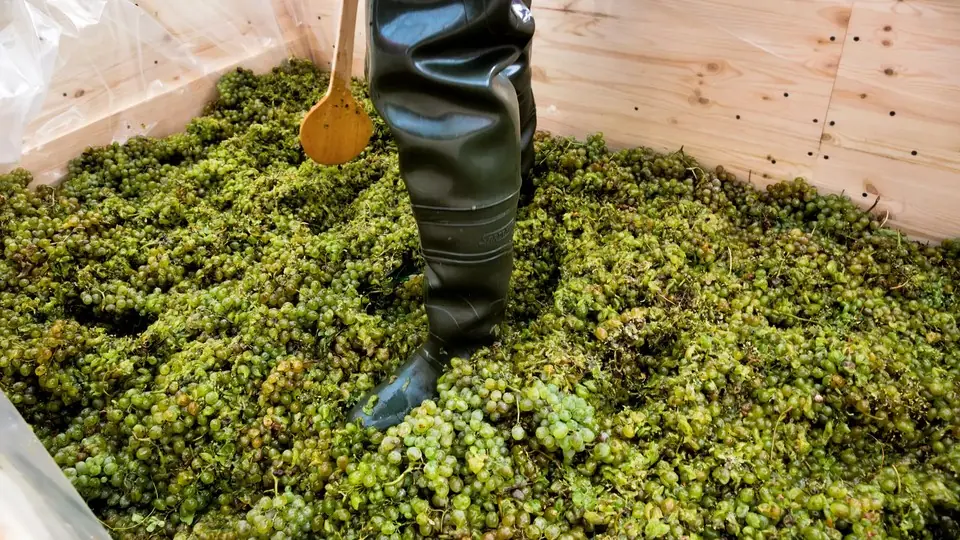
Every grape sweet starts with badagi. Fresh must from the press goes into a wide cauldron and simmers for hours, while someone skims off the foam. It turns into a dark, sticky syrup. Stir flour into it and you have the paste that becomes both churchkhela and pelamushi. That is why the two sweets appear at the same time, in the same villages, straight after rtveli, when the grapes are picked in September and October.
Churchkhela
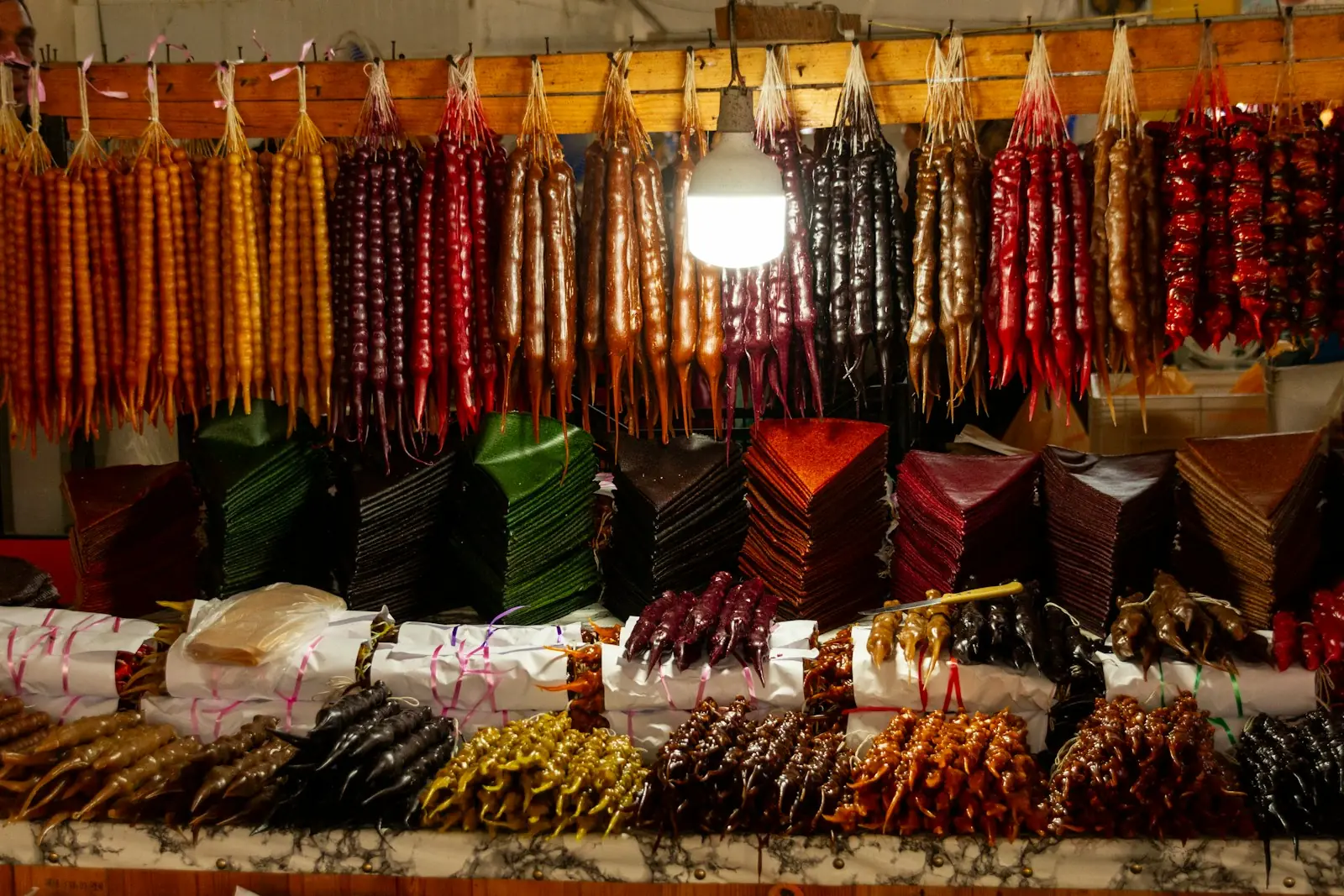
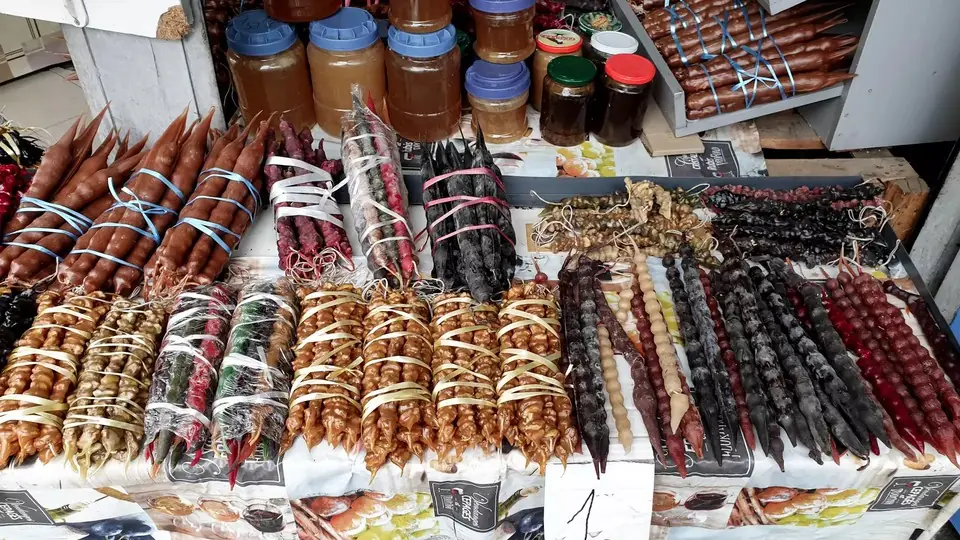
Churchkhela looks like a long, knobbly candle. Walnut halves or hazelnuts are threaded on cotton, dipped in the warm grape paste several times and hung up to dry. White grapes give a golden coat and red grapes a deep purple one. Kakheti makes the walnut and wheat version. In Imereti, Guria and Samegrelo cooks prefer hazelnuts and maize flour, and many call the result janjukha. The name is protected in Georgia, and in the European Union since 2016.
In 2026 one stick sold for about 3-5 GEL (about $1-2) at Tbilisi markets and Kakheti roadside stands; gift shops in the Old Town charge a little more. Soft new sticks reach the stalls from October. Our churchkhela guide covers styles, history and how to choose a good one.
Pelamushi and tatara
Pelamushi is the same thickened grape juice, poured into bowls or moulds and left to set. It comes out soft, glossy and pink or plum-coloured, and it tastes of grapes rather than sugar. The name follows the flour. In Kakheti and Kartli, where wheat flour thickens it, people often call it tatara. In the west, where maize flour is used, it is pelamushi. Cooks serve it chilled, with walnuts on top.
Restaurants put it on the menu in autumn and on Lent fasting menus. With no dairy or eggs, it is one of the easiest desserts for vegans. Our pelamushi recipe works with bottled grape juice.
On our Rtveli Grape Harvest tour you cut grapes with a Kakhetian family in the morning and dip churchkhela in their fresh tatara after lunch. Only your own party travels, on days you pick within the harvest weeks, whatever its size. The guide is fluent in your language, and young children and teenagers can all join in.
Walnut and honey sweets: gozinaki, korkoti and kaklucha
Walnuts and honey are old symbols of plenty in Georgia, and three sweets put them together in very different ways.
Gozinaki, the New Year sweet
Gozinaki is chopped, toasted walnuts bound in honey that has boiled until it sets. The hot mass is rolled flat and cut into diamonds. It is firm and chewy, never glassy, and it tastes mostly of nuts. Families make it in the last days of December, and a plate sits on the table at midnight on 31 December. Leftovers last through Christmas on 7 January and often until Old New Year on 13-14 January.
In December, bakeries and supermarkets sell boxed gozinaki, and the stalls of the Tbilisi Christmas market stock it too. The customs around it, from the year's first visitor to the midnight table, are in our New Year in Georgia guide. Our recipe page shows the cold-water test for the honey.
Korkoti, also called tsandili
Korkoti is whole wheat grains boiled soft, then mixed with honey, raisins and walnuts. Some cooks add dried apricots or cherries. It is a food of remembrance: families serve it at memorial meals for the dead, and different regions call it tsandili or kolio. A few cafes in Tbilisi and Kutaisi now serve modern versions as a dessert. If a host offers you korkoti at a memorial, accept a spoonful as part of the ritual.
Kaklucha, the royal candy
Kaklucha is a single walnut wrapped in a soft, creamy layer and a hard shell of crystallised sugar. Georgians credit it to Princess Mariam Orbeliani, the poet Vakhtang Orbeliani's daughter, who devised it in the 19th century with a cook named Pelagia. It is still sold as Orbeliani candy or royal candy. Few people know the method, so you find it in only a handful of Tbilisi cafes and sweet shops.
Dried fruit and preserves: tklapi, chiri and muraba
Before fridges, fruit was dried, rolled into sheets or cooked in syrup. All three habits survive, and all three products are vegan.
Tklapi
Tklapi is fruit purée spread thin and dried in the sun until it peels off like leather. There are two families. Sour tklapi, made from cherry plums, is a kitchen ingredient that gives kharcho its tang. Sweet tklapi, from apricots, peaches, apples or grapes, is a snack. Market stalls sell both, rolled up or folded, in colours from amber to almost black. Ask which is which before you bite. Our recipe page covers the sour plum kind.
Chiri: dried persimmons and other fruit
Chiri is the Georgian word for dried fruit. Apricots, apples, plums and figs all count, but the star is the persimmon, called khurma. In late autumn, families string whole persimmons and hang them under balconies and eaves. Over the weeks they darken, shrink and grow a fine white coat of fruit sugar. Dried persimmons and figs then join the New Year and Christmas table. Markets fill with fresh persimmons in November, and the dried ones follow in December.
Muraba
Muraba is fruit kept whole, or in large pieces, in syrup, so it is runnier and chunkier than jam. Households serve it in small glass dishes with tea or coffee, and guesthouse breakfasts often include one or two jars. Popular kinds are cherry, fig, quince and watermelon rind. The most prized is green walnut muraba, made from young walnuts picked in early summer, before the shell hardens, and cooked until they turn black and tender. Markets and supermarkets sell jars all year.
Georgian honey: Racha, Adjara, Svaneti and the protected names
Honey has a long record here. In 2003, builders laying an oil pipeline near Sakire, in the Borjomi area, uncovered a burial mound. Clay vessels in a woman's grave still held traces of honey from linden and meadow flowers. Scientists dated it to about 5,500 years ago, some 2,000 years older than the honey found in Tutankhamun's tomb.
Today the colour tells you the source. Acacia and citrus honey are pale and clear. Linden and meadow honey are amber. Chestnut honey is dark, with a bitter edge. Mountain stalls sell alpine honey from summer pastures. Georgians eat it by the spoon with tea, stir it into matsoni yoghurt with walnuts, and use it for gozinaki.
Adjara: jara and Machakhela honey
A jara is an old Adjarian beehive cut from a whole tree trunk. Honey from these hives has been listed as a monument of Georgia's intangible cultural heritage, and very few places in the world still keep bees this way. Expect a much higher price than for ordinary honey. The Machakhela valley, south-east of Batumi on the Turkish border, gave its name to Machakhela honey, a registered geographical indication since 2 March 2016.
Racha and Svaneti
Georgia's tourism board singles out Racha honey for its clean rivers and air. Ask your guesthouse in Ambrolauri or Oni whether the family keeps bees. In Lower Svaneti, around Lentekhi, small beekeepers sell honey from alpine flowers directly to visitors. In Upper Svaneti, ask your hosts in Mestia for local honey.
The three protected honeys
| Name | Where it comes from | Registered |
|---|---|---|
| Machakhela honey | Machakhela valley, Adjara | 2 March 2016 |
| Ninotsminda honey | Javakheti plateau around Ninotsminda | 1 October 2020 |
| Mukhuri honey | Mukhuri, Samegrelo, home of the Mukhuri bee | 22 December 2021 |
The Mukhuri bee is a local strain known for its long tongue and high yields. In 2026 a jar of honey cost about 15-35 GEL (about $6-13) at markets and roadside stalls. Pack it in your checked bag, since airport security takes liquids over 100 ml from hand luggage. Honey is an animal product, so check your home country's import rules before you buy a big jar.

Georgian pastries and sweet breads: kada, nazuki, pakhlava and paska
Kada
Kada is a soft butter pastry wrapped around a crumbly filling of toasted flour, butter and sugar. Bakeries sell it rolled and sliced, by the piece, next to the khachapuri. In Meskheti the filling is often sealed inside a thick round instead. Families in Kartli and Kakheti bake it for Christmas, and in some mountain valleys kada is a savoury bread with cheese. It goes with a glass of tea.
Nazuki from Surami
Nazuki is a glossy, oval loaf of sweet yeast dough with raisins, cinnamon and cloves. It is the food of the road west. In Surami, ~130 km from Tbilisi, bakers line the old highway and pull loaves from clay tone ovens all day, and a loaf costs only a few lari. Buy one hot and eat it in the car. It contains milk, eggs and wheat, but no nuts in the classic recipe.
Pakhlava, Adjarian baklava
Pakhlava is the Georgian name for baklava, a legacy of centuries of Ottoman rule in the south-west. The Adjarian kind uses walnuts only, layered between thin sheets of pastry and finished with sweet syrup, so it is sticky and rich. Batumi's sweet shops sell trays of it, and in Kobuleti many families call it tatli. Pakhlava from bakeries elsewhere in Georgia is often drier, with less syrup.
Paska at Easter
Paska is a round, domed Easter cake with raisins and a white sugar topping. In Holy Week every bakery and supermarket stacks them in all sizes. Many families take a paska and red-dyed eggs to the graves of their relatives during Easter week. Orthodox Easter falls on 2 May in 2027.

Soviet-era cakes and cafe sweets: Napoleon, medok, ponchiki and ice cream
Georgia spent most of the 20th century in the Soviet Union, and its cake shops still show it. Look for the sign sakonditro, which means cake shop or confectioner's.
- Napoleon: many thin layers of puff pastry spread with vanilla custard, with crumbs on top. Almost every cafe and bakery has one.
- Medok: a honey cake built from thin layers baked with burnt honey. The Georgian version is usually filled with milk cream rather than sour cream, so it tastes sweeter. Some bakers top it with walnuts.
- Bird's milk: sponge layers around a light soufflé, under a chocolate glaze. Many Georgians grew up with it.
- Ponchiki: round doughnuts filled with vanilla custard and dusted with sugar. They are best warm, from a small pastry counter.
- Sokhumi ice cream: creamy vanilla ice cream topped with tangerine jam and crushed nuts. It is named after Sokhumi in Abkhazia, an occupied region, and at least one Tbilisi restaurant run by a family from Abkhazia still serves it.
In 2026 a slice of Napoleon or medok cost about 6-12 GEL (about $2-5) in Tbilisi cafes. Cream cakes do not travel, so eat them there.
Georgian sweets by season and holiday
Most sweets are sold all year, but each has a moment when it is freshest or tied to a holiday.
| When | What to look for | Why |
|---|---|---|
| 1-14 January | Gozinaki, churchkhela, chiri, kada | New Year, Christmas on 7 January, Old New Year on 13-14 January |
| Great Lent (15 March to 1 May 2027) | Churchkhela, pelamushi, tklapi, chiri, muraba | Fasting food with no dairy or eggs |
| Easter (2 May 2027) | Paska and red eggs | The biggest feast of the church year |
| June to August | Cherry and green walnut muraba, sour tklapi | Fruit and young walnuts are picked and preserved |
| September and October | Badagi, fresh pelamushi, new churchkhela | Rtveli, the grape harvest |
| November and December | Persimmons, new walnuts, chiri, then gozinaki | Late autumn drying and holiday baking |
Visiting over the holidays? Our guide to Georgian Christmas food describes the festive table, and the New Year Village market in Tbilisi usually opens in mid-December.
Where to buy Georgian sweets: Dezerter Bazaar, Surami, Mtskheta and supermarkets
Tbilisi
Dezerter Bazaar, by the central railway station, is the best single stop. It runs from about 07:00 to 17:00 every day, and mornings are busiest. Rows of stalls inside the halls sell churchkhela, dried fruit, tklapi, nuts and honey side by side, so you can compare a dozen sellers in a few minutes. Bring cash in small notes. Our guide to Tbilisi markets covers the halls and the other bazaars.
For cakes, try any neighbourhood cafe or cake shop. In December, the city's festive market adds gozinaki and churchkhela stalls, and Old Town gift shops sell boxed sweets at higher prices.
On day trips
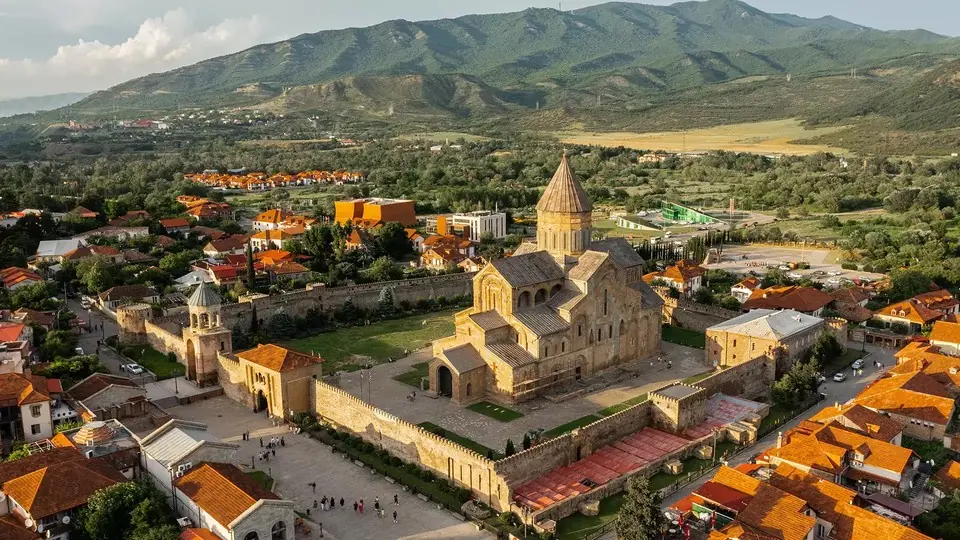
- Mtskheta: stalls on the lanes outside Svetitskhoveli Cathedral sell churchkhela, honey and fruit leather, 30 minutes from Tbilisi.
- Ananuri, on the Georgian Military Road: stands by the fortress gate sell churchkhela and jars of mountain honey.
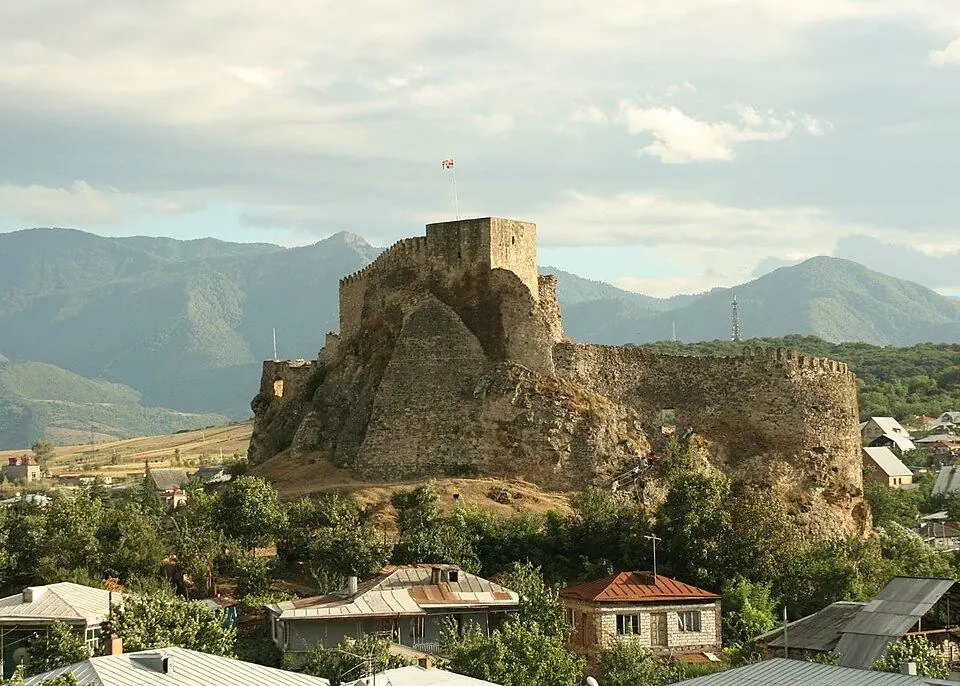
- Surami: the nazuki bakers sit just off the E60 motorway on the road west towards Borjomi and Kutaisi; pair the stop with Surami Fortress.
- Kakheti: from October, farm stands along the road to Sighnaghi and Telavi hang fresh churchkhela, and the Telavi market sells it with local honey.
Western Georgia
In Kutaisi, the Green Bazaar sells honey, hazelnut churchkhela and tklapi, with persimmons in autumn. In Batumi, buy pakhlava in a sweet shop and look for hazelnut churchkhela at the central market.
Supermarkets
Big chains such as Nikora, Spar, Carrefour and Goodwill stock packed churchkhela, jars of muraba and honey, and boxed gozinaki around New Year. They also sell paska in Holy Week. Supermarket sweets are convenient and clearly priced, but market ones are usually fresher.
| What | Where | Rough price, 2026 |
|---|---|---|
| Churchkhela, one stick | Markets and roadside stands | About 3-5 GEL (about $1-2) |
| Churchkhela, one stick | Old Town gift shops | About 5-7 GEL (about $2-3) |
| Honey, one jar | Markets and roadside stalls | About 15-35 GEL (about $6-13) |
| Napoleon or medok, one slice | Tbilisi cafes | About 6-12 GEL (about $2-5) |
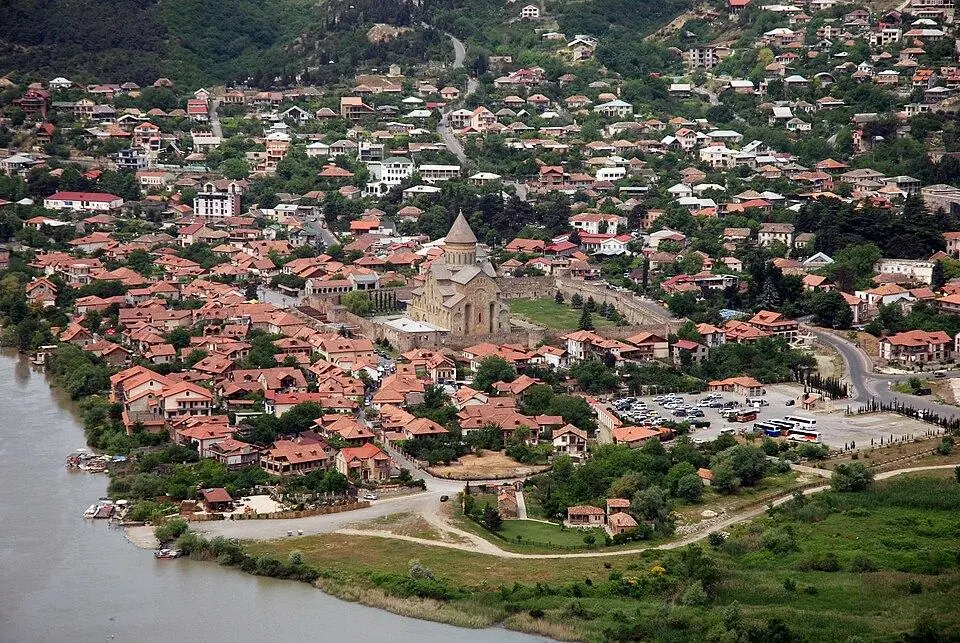
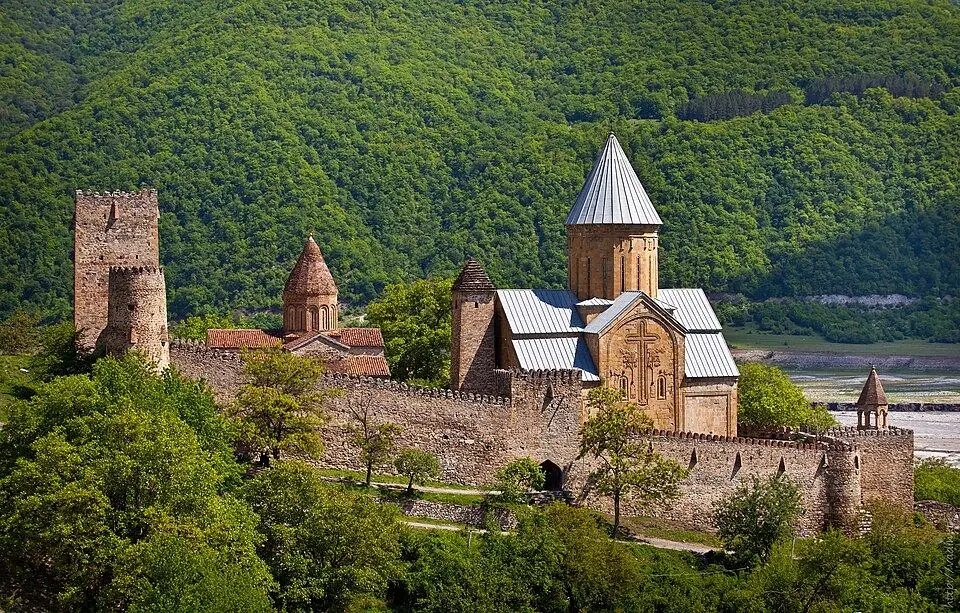
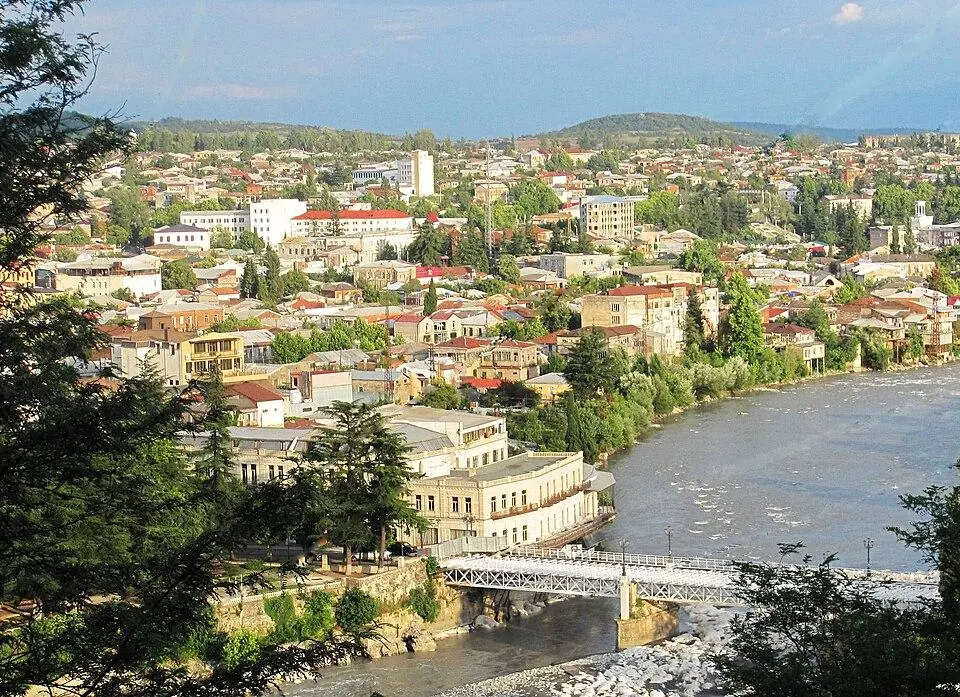
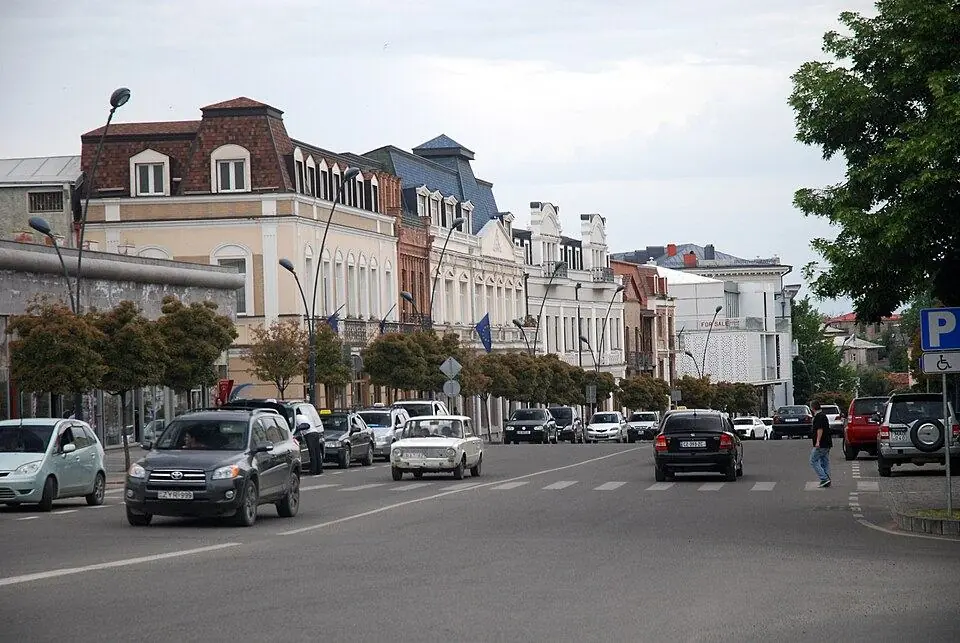
Our private day tour to Mtskheta spends about six hours at Jvari, Svetitskhoveli and Samtavro, with lunch in town, so there is time to browse the sweet stalls by the cathedral. It runs on the day you pick, for your party alone and at any size. Your guide speaks your language fluently, and families with babies or teenagers are equally welcome.
Vegan, gluten-free and nut-free Georgian sweets
Orthodox fasting helps vegans. During Lent and on most Wednesdays and Fridays, observant Georgians skip meat, dairy and eggs, so many old sweets are made without them. Look for the word samarkhvo, fasting food, on menus and labels. Nuts are the harder problem: walnuts and hazelnuts go into or onto most traditional desserts.
| If you need | Good choices | Take care with |
|---|---|---|
| Vegan | Churchkhela, pelamushi, tklapi, chiri, fruit muraba | Gozinaki and korkoti contain honey; pastries and cakes use butter, eggs or milk |
| Nut-free | Tklapi, chiri, fruit muraba, honey, plain pelamushi | Churchkhela, gozinaki, kaklucha, pakhlava, walnut muraba, Sokhumi ice cream, cake toppings |
| Gluten-free | Gozinaki, chiri, tklapi, muraba, honey | Kada, nazuki, pakhlava and cakes; eastern churchkhela and tatara contain wheat flour |
| Lent and fasting | Churchkhela, pelamushi, tklapi, chiri, muraba, honey | Paska, kada and cream cakes |
Pelamushi is usually served with walnuts on top. Ask for it without them, and choose a western, maize-flour version if you also avoid gluten. Plain chiri and tklapi are the safest snacks for both needs, but buy them from a stall that does not also sell loose nuts.
Learn to make Georgian desserts: cooking classes and recipes
The sweets make more sense once you have stirred the pot. On our Georgian Cooking Tour, you shop at Dezerter Bazaar on day two, dip churchkhela with a family near Sighnaghi on day three, and stop for warm nazuki at Surami on the drive west. The last morning is at the Green Bazaar in Kutaisi, with tips on packing tklapi and spices for the flight. The tour is private, so it starts on the dates you want and suits a group of any size. A guide who speaks your language and knows Georgian cooking leads each day, and children of any age are welcome. Threading nuts for churchkhela is often left to the youngest.
To cook at home, our recipes section has tested versions of six sweets: churchkhela, pelamushi, gozinaki, tklapi, kada and nazuki. The pages suggest swaps for ingredients that are hard to find abroad, such as bottled grape juice in place of fresh must.
Georgian desserts FAQ
What is the most famous Georgian dessert?
Churchkhela, a string of walnuts or hazelnuts coated again and again in thickened grape juice and dried. It hangs at every market and keeps for months. Gozinaki, walnuts set in honey, is the best-known holiday sweet.
What are traditional Georgian desserts?
The old village sweets are churchkhela, pelamushi, gozinaki, korkoti, tklapi, chiri and muraba, all built on grapes, walnuts, honey or fruit. Bakeries add kada, nazuki, pakhlava and paska at Easter.
What Georgian sweets are eaten at New Year?
Gozinaki is the classic, with churchkhela, dried persimmons, figs and walnuts beside it. The plate is kept full from 31 December until Old New Year, 13-14 January, with Christmas on 7 January in between.
Are Georgian desserts vegan?
Many are. Churchkhela, pelamushi, tklapi, chiri and fruit muraba contain no animal products, thanks to the Orthodox fasting tradition. Gozinaki and korkoti contain honey, and bakery items are made with dairy and eggs.
Which Georgian sweets are safe with a nut allergy?
Tklapi, chiri, fruit muraba and honey contain no nuts, and pelamushi can be served without its walnut topping. Most other traditional sweets contain walnuts or hazelnuts, and market stalls handle loose nuts, so ask every time.
Where can I buy Georgian sweets in Tbilisi?
Dezerter Bazaar near the central station has the widest choice, open from about 07:00 to 17:00. Supermarkets stock packed churchkhela, honey, muraba and, in December, gozinaki. Cafes and cake shops sell Napoleon, medok and ponchiki.
What is jara honey?
Honey from jara hives, beehives cut from a whole tree trunk in Adjara. The tradition has national intangible heritage status, and the honey costs far more than ordinary jars. Machakhela honey, also from Adjara, is a registered geographical indication.
Which Georgian sweets can I take home?
Churchkhela, tklapi, chiri and gozinaki pack well and keep for weeks. Honey and muraba travel in checked luggage. Check your own country's food import rules first, especially for honey.